

A course translated into Polish can still be the wrong course for your team. Choosing eLearning for Polish-speaking staff means asking more than whether the words are familiar: does the training match their roles, workplace risks and compliance needs? If employees find English-only materials difficult to follow, how can you improve access without compromising course quality?
Language matters, but so do accurate content, relevant examples and clear evidence of completion. A translated course doesn’t automatically meet legal or accreditation requirements, so check what’s included before assigning it.
This guide explains how to assess Polish-language workplace eLearning, confirm course suitability and plan a rollout. It covers course content, credentials, assessments and delivery formats, as well as ways to manage access and monitor progress. WH eLearning offers more than 100 video-based workplace courses, with machine translation into more than 25 languages. Polish availability should be confirmed for each course. Organisational licences include progress and compliance-status tracking to help coordinate training across your team. Use these features alongside your staff’s needs to make an informed choice.
Key Takeaways
- Assess eLearning for Polish-speaking employees against their roles, language needs and workplace risks, not translation alone.
- Check Polish availability for the exact course and assessment, then verify course relevance and any accreditation or certificate conditions.
- Compare Polish-language eLearning, English training and face-to-face delivery to find the format that best fits your team.
- Plan a rollout by identifying staff needs, setting training priorities and reviewing participation and progress.
- Explore WH eLearning’s workplace course options and organisational tracking features, confirming Polish availability for each course before choosing.
What Does eLearning for Polish-Speaking Employees Need to Deliver?
Polish-language workplace eLearning teaches job-related knowledge and procedures through instruction presented in Polish. It is designed to help employees learn about their work, not to teach Polish grammar, vocabulary or conversation. When choosing training for operational, office-based or mixed teams, check that the course addresses what staff need to understand and do in their roles.
Accessible instruction can make it easier for employees to follow explanations, engage with learning and complete consistent training across a team. For example, someone learning a workplace procedure needs to understand the steps and relevant hazards, not simply recognise translated terms. Clear language can support understanding, but it cannot confirm that content is accurate, role-specific or suitable for a particular compliance purpose.
When is Polish-language workplace training worth considering?
Consider language access if employees find English-only materials difficult to follow or complete. This may apply to frontline operations, office-based roles or teams working across different settings. Ask employees and managers which language they prefer for training rather than assuming all Polish-speaking colleagues want instruction in Polish. The aim is to make essential information easier to understand while checking that examples and procedures fit the work.
How does workplace eLearning differ from a Polish language course?
A general Polish course develops language skills such as vocabulary, grammar or conversation. Workplace eLearning covers a work-related subject, with learning outcomes tied to a role, procedure or training objective. A language lesson may help someone practise everyday phrases; a compliance course should help them understand relevant workplace information. The two serve different needs, even if both use Polish.
Polish has its own alphabet and grammatical features, and regional language use can also matter. When reviewing translated material, consider whether the wording is clear for your employees and appropriate to the workplace context. The nuances of the Polish language are one reason not to treat translation as a simple word-for-word switch.
For employers considering eLearning for Polish-speaking staff, language access is a starting point, not a quality check. Confirm that the exact course covers the right subject and roles, and review its assessment and any certificate conditions. A translated course does not automatically satisfy regulatory, role-specific or accreditation requirements. Check these against your organisation’s training objectives and the relevant course information.
How to Assess Polish eLearning Quality, Course Fit and Accreditation
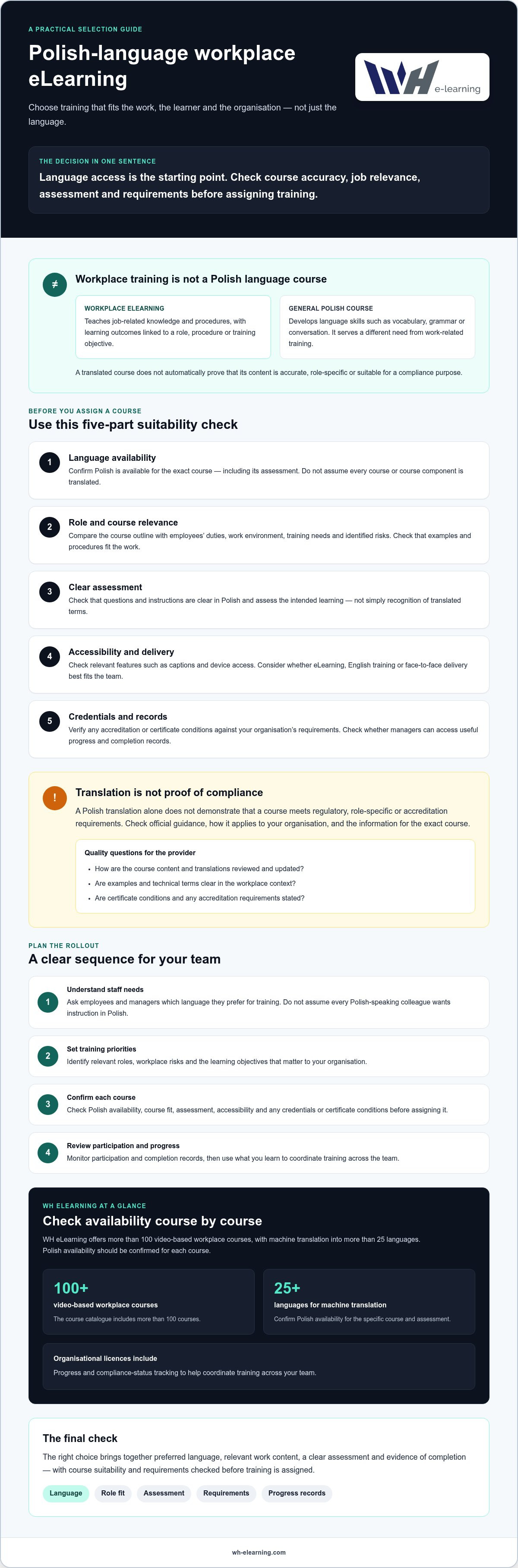
Use a consistent checklist before assigning a course. Verify that the exact course and assessment are available in Polish, fit employees’ duties and meet your organisation’s requirements for credentials and accessibility. Don’t assume that a Polish-language option covers every part of the course.
Start with the specific training need. For example, a course for staff who use particular equipment should address relevant tasks and hazards, not just provide general safety information. The Polish Government Business Portal outlines mandatory employee training in Poland. Check the official guidance and how it applies to your organisation. Choosing a translated course alone does not demonstrate that all requirements are met.
| What to check | Questions to ask |
|---|---|
| Language availability | Is the full course, including the assessment, available in Polish? |
| Course relevance | Does the content match the employees’ duties, work environment and training needs? |
| Assessment | Are questions and instructions clear in Polish, and do they assess the intended learning? |
| Accessibility | Are captions, device access or other relevant features available? |
| Reporting | Can managers see learner progress and completion records in a useful format? |
Which checks help confirm a course fits the job?
Compare the course outline with real work tasks and identified risks. Ask the provider how course content and translations are reviewed and updated, and whether examples and technical terms remain clear in Polish. If possible, review sample content and assessment questions with a manager familiar with the work and an employee who will take the course. This can flag unclear wording before you arrange wider access.
How can employers check accessibility and accreditation?
Check which devices employees can use and whether features such as closed captions are included where needed. Accreditation is course-specific: confirm the exact course and awarding body, then check assessment requirements and certificate conditions with that body. Machine translation is not proof of formal approval or legal compliance. WH eLearning provides workplace eLearning courses, including video-based learning, device access and closed captions. Confirm Polish availability and the details for the course you’re considering.
For eLearning for Polish-speaking teams, treat language, course fit, credentials and tracking as separate checks. Keeping a record of what you verified makes it easier to explain why you selected a course and identify any follow-up needed.
Polish eLearning, English Training or Face-to-Face: Which Approach Fits?
No single training format suits every employee or subject. Choose by considering what staff need to learn, how they work and which language helps them engage with the material. Polish translation can improve access, but it does not guarantee understanding or prove that the course fits employees’ roles. Check the course itself, not just its language option.
| Approach | May suit | Consider |
|---|---|---|
| Polish-language eLearning | Teams seeking online access to workplace training in Polish, including employees working across locations or shifts. | Confirm Polish is available for the exact course and assessment, and check that video and assessment suit the topic. |
| English-language training | Employees who prefer or are comfortable learning in English. | Ask staff about their language preferences rather than assuming fluency from job role or background. |
| Face-to-face training | Subjects where demonstration, discussion or supervised practice may help. | Check that the session can address the workplace context and learning objectives. |
When might translated eLearning suit a team?
Online learning may suit teams that need access across different sites or shift patterns, particularly when employees can complete a course flexibly around work. It can work for subjects taught effectively through video and assessment, provided the material reflects employees’ duties. Captions may support learners who benefit from text alongside audio, while access across devices can add flexibility. Check which features are available for the specific course and whether Polish covers both instruction and assessment.
Ask employees which language they prefer for training. Preferences can vary within the same team. A translated course is one option, not a substitute for checking comprehension, relevance and any course-specific requirements.
When should employers consider face-to-face support?
Some learning objectives call for more than watching content and completing an assessment. If staff need to practise a task, see equipment demonstrated or discuss how a procedure applies at work, an in-person session may add useful context. Consider whether an instructor with relevant expertise can tailor the session to the workplace. WH eLearning offers in-house face-to-face training; check whether that format fits the subject and your team’s needs.
A blended approach can combine online study with in-person discussion or practice, but each element should support a clear learning objective. For example, online material may introduce a topic before a practical session reinforces key steps. Compare the options against the intended outcome, employees’ language preferences and work patterns, then confirm the delivery details before planning a rollout.
How to Roll Out Polish-Language Training Across Your Workforce
A considered rollout helps ensure that language access supports the right people and learning objectives. Follow a clear sequence, starting with workforce needs and ending with a review of what employees have learned and what support they may still need.
- 1. Map roles and needs. Ask managers which roles need training, what the priorities are and which languages employees prefer for learning. Check whether needs differ between operational, office-based and mixed teams.
- 2. Match courses to objectives. Identify the intended learners and the outcomes each course should support. Confirm Polish availability for the exact course and its assessment, then check that the content fits the roles and workplace context.
- 3. Set up a small pilot. Before assigning training more widely, ask a small group of suitable learners to try the course. Gather feedback on translated terminology, pace, access and assessment clarity. Their comments may flag issues that are not apparent from a course description.
- 4. Prepare employees and managers. Explain why the training has been assigned, set clear completion expectations and show employees how to access the materials. Make sure managers know how to respond if learners need clarification or further support.
- 5. Monitor and review. Track enrolment, completion and assessment outcomes using the reporting available. Follow up on incomplete learning, consider whether refresher training is needed and review the course if roles, risks or workplace procedures change.
What should an employer confirm before assigning courses?
Check the course’s intended audience, learning outcomes and language options before employees begin. Confirm whether Polish applies to the assessment as well as the learning materials, and verify relevant certificate or accreditation conditions. Record completion expectations and tell employees who to approach if instructions or terminology are unclear.
How can training progress be reviewed?
Reporting can help managers identify who has started or completed assigned learning and where follow-up may be useful. Progress alone does not show whether employees found translated content clear, so collect learner feedback too. Ask about terminology, pacing and assessment questions, then act on recurring issues. A workplace compliance checklist can also help structure broader review tasks.
A planned rollout makes eLearning for Polish-speaking employees easier to coordinate, while leaving room to adapt as team needs change. To explore workplace training options for your organisation, review WH eLearning’s course options and confirm Polish availability for each course you’re considering.
Explore WH eLearning Options for Polish-Speaking Teams
WH eLearning provides more than 100 video-based workplace courses across health and safety, HR and business compliance. Courses can be accessed on different devices and include machine translation into more than 25 languages. Availability can vary by course, so don’t assume a particular course is offered in Polish. Treat eLearning for Polish-speaking employees as a course-by-course decision based on the subject, language options and your organisation’s needs.
What should organisations ask WH eLearning about Polish availability?
Before assigning a course, ask for confirmation of the details that affect learners and your training objectives:
- Which relevant courses currently support Polish-language learning materials?
- Does translation apply to the video content, captions and assessment, or only to some elements?
- Are certificates available, and what conditions apply to completion or assessment?
- Is the course accredited, and how can you verify its status and requirements with the relevant awarding body?
These checks help distinguish language access from course suitability. Translation alone does not establish that a course meets your organisation’s requirements or that its accreditation and certificate conditions apply in the same way. Confirm details for the exact course before purchasing or assigning access.
How can WH eLearning support a wider learning plan?
Organisations can purchase bulk access to help coordinate course assignments across a workforce. Administrative features let managers track learner progress and compliance status, helping them see where follow-up may be needed. These features support training administration, but progress records should be considered alongside your own assessment of course relevance and employee understanding.
Closed captions are available as an accessibility feature and may help learners who benefit from reading as well as listening. Check the features available for the course and consider what will work for your team. For broader context on multilingual course planning, read the multi-language eLearning course guide.
Once you’ve confirmed Polish availability, assessment and any accreditation or certificate conditions, compare suitable options against your workforce needs. Explore WH eLearning training options to review the workplace courses available to your organisation.
Make Your Team’s Training More Accessible
Effective eLearning for Polish-speaking employees starts with more than translation. Match the course to employees’ roles and workplace needs, then confirm that Polish-language materials and assessments are available for the exact course. Check accreditation and certificate conditions too, as translated content alone does not establish suitability.
WH eLearning offers more than 100 online workplace courses across health and safety, HR and business compliance. Video-based learning, access across devices and closed captions can support different learning needs, while organisational licences include progress and compliance-status tracking to help coordinate training. Confirm Polish availability course by course.
Explore WH eLearning options for your team and check which courses align with your training priorities. With the right checks and a considered rollout, you can make workplace learning clearer and more accessible for your staff.
Frequently Asked Questions
Is Polish-language workplace eLearning available for employees?
Polish-language workplace eLearning may be available, but options depend on the provider and course. WH eLearning offers machine translation into more than 25 languages, but Polish availability should be confirmed for each course. Ask whether translation covers the learning materials, video content, captions and assessment. For eLearning for Polish-speaking employees, check the exact course before assigning it rather than assuming every course has the same language options.
Can translated eLearning count towards workplace compliance training?
It may contribute to a training plan if the course is relevant to employees’ roles and meets the organisation’s requirements. Translation alone does not establish that a course fulfils a legal, regulatory or accreditation requirement. Check the course content, intended learners, assessment and any applicable guidance before relying on it. Where a particular requirement applies, confirm that the training format and course are suitable for that purpose.
How can employers check whether a Polish online course is accredited?
Check the exact course title, the named awarding body and the accreditation conditions. Confirm the course’s status directly with that awarding body, including whether assessment and certification conditions apply to the Polish-language version. Don’t treat translated material as proof of accreditation. WH eLearning describes its courses as accredited, but employers should verify the relevant course and its certificate requirements before enrolling employees or recording it as completed training.
What should a Polish-language health and safety course include?
A suitable course should cover topics relevant to employees’ work, such as applicable procedures, workplace hazards and the actions learners need to understand. Check that examples and technical terms are clear in Polish and that the assessment tests the intended learning. The right content depends on roles and the work environment, so compare the course outline with your organisation’s training needs rather than relying on a general course title.
Can employees complete Polish eLearning on a mobile device?
WH eLearning courses can be accessed on different devices, so employees may be able to use a mobile device. Before assigning a course, confirm that the specific learning materials and assessment work on the devices available to your team. Consider whether the screen size and learning format suit the subject. Closed captions are also available on courses and may help learners who benefit from reading alongside video content.
How can a business track Polish-speaking employees’ training progress?
Organisational licences from WH eLearning include administrative features for tracking learner progress and compliance status. These can help managers identify incomplete training and follow up with employees. Pair tracking with checks on assessment outcomes and learner feedback, since completion records alone do not show whether translated instructions were clear. Confirm which reporting features apply to the access option and courses your organisation is considering.
Is translated eLearning or face-to-face training better for Polish-speaking staff?
Neither approach is best for every team. Translated eLearning may suit employees who need flexible access to video-based learning, while face-to-face training can add value when a subject benefits from demonstration, discussion or supervised practice. Consider the learning objectives, work patterns and employees’ language preferences. A blended approach is also possible when both formats serve a clear purpose. Whichever you choose, check course relevance and language suitability first.


