

Confined space awareness training doesn’t, by itself, make someone competent to enter a confined space. Workers need to recognise potential dangers, but any entry must also be supported by suitable, site-specific controls and the practical competence required for the task. Knowing what counts as a confined space, and what awareness training can prepare someone to do, helps employers set clear expectations.
Good awareness training can help workers spot spaces that may present serious risks, understand the hazards they could contain and know when to stop and seek guidance. It can also clarify responsibilities and why safe systems of work matter. Awareness is not entry authorisation, and course completion shouldn’t be treated as proof that someone can safely carry out a confined-space task.
This guide explains what confined space awareness training should cover, where its limits lie and how it fits into wider workplace arrangements. You’ll learn how to recognise potential confined spaces, understand key responsibilities and controls, and distinguish foundational learning from the practical competence required for specific roles.
Key Takeaways
- Learn how to recognise spaces that may present confined-space risks and identify hazards that call for careful assessment.
- Understand what confined space awareness training can teach, and why it doesn’t by itself authorise someone to enter.
- See how clear responsibilities, risk assessments and safe systems of work guide decisions before and during work.
- Explore practical steps employers can take to connect learning with team roles, procedures and emergency arrangements.
- Find out how online learning can build foundational awareness across a team while leaving practical skills and site-specific instruction in their proper place.
What is confined space awareness training, and who needs it?
Confined space awareness training is foundational learning that helps people recognise potential confined spaces, understand the risks they may present and follow workplace arrangements for keeping people safe. It supports hazard recognition and sound decisions, but it doesn’t prove someone is competent or authorised to enter.
In UK guidance, a confined space is a place that is substantially, though not necessarily entirely, enclosed and where a specified risk could reasonably be expected because of its enclosed nature. The legal test depends on both the space and the risk, not simply on whether a room or structure feels enclosed. The Confined space overview provides wider background on the types of hazards associated with these environments.
Which workplaces and roles can involve confined spaces?
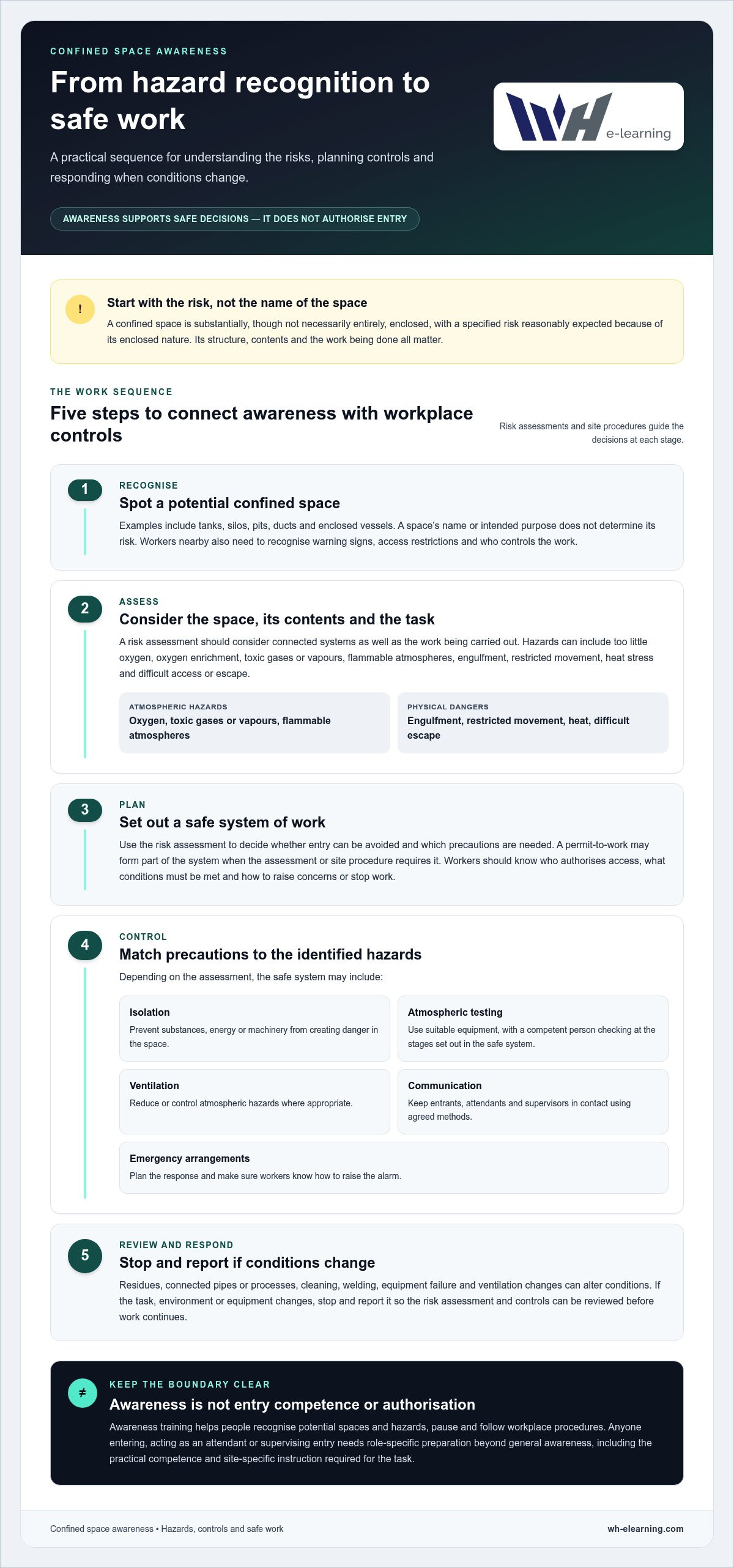
Examples include tanks, silos, pits, ducts and enclosed vessels. A space’s name or intended purpose doesn’t determine its risk. The structure, what it contains and the work being done all matter. A pit may present little risk in one situation but become hazardous if a task introduces fumes or changes airflow.
Awareness is relevant not only to workers who may approach or enter these spaces, but also to supervisors, contractors and others working nearby. They need to recognise warning signs, understand access restrictions and know who controls the work. A colleague who doesn’t enter can still affect safety by opening access points, changing a process or failing to report a new hazard.
What should learners be able to recognise afterwards?
After suitable confined space awareness training, learners should be better able to spot a potential confined space, pause before approaching or entering, and follow their organisation’s procedures. They should know who controls access, whom to notify if hazards or conditions change, and why they must not improvise an entry or rescue.
Concise definition: Confined-space awareness training teaches people to recognise potential confined spaces and their hazards, and to follow relevant workplace controls. It does not, by itself, establish competence or authorisation to enter.
The right learning depends on a person’s duties, the risks and the work environment. Someone who may enter, act as an attendant or supervise entry will need role-specific preparation beyond general awareness. Contractors also need clear information about local hazards and procedures before work begins. Treat awareness as one part of a wider safe system, not a substitute for risk assessment, practical skills or site-specific instruction.
Which confined space hazards and controls should awareness training explain?
Confined spaces can expose workers to hazards that are difficult to see, smell or predict. A risk assessment should consider the space, its contents, connected systems and the task being carried out. Under UK guidance, a confined space presents a risk of serious injury from a specified hazard, such as fire or explosion, loss of consciousness, drowning or asphyxiation. Controls must reflect the actual risks, not a generic checklist.
Atmospheric hazards include too little oxygen, oxygen enrichment, toxic gases or vapours, and flammable atmospheres. Physical dangers can include engulfment by liquids or solids, restricted movement, heat stress and difficult access or escape. Risks may combine: a worker could, for example, be exposed to harmful fumes in a space where reaching an exit is difficult. The OSHA confined space standards provide a US reference for hazard recognition, but UK workplaces should follow applicable UK requirements and site procedures.
How can confined space hazards develop or change?
Conditions can shift during a job. Residues may release vapours; connected pipes or processes may introduce gases or liquids; and cleaning, welding or other work may create fumes, heat or ignition sources. Equipment failure or changes in ventilation can also alter conditions. If the task, environment or equipment changes, workers should stop and report it so the risk assessment and controls can be reviewed before work continues.
What controls should workers understand before work begins?
A risk assessment informs the safe system of work, including whether entry can be avoided and what precautions are needed. A permit-to-work may be part of that system where the assessment or site procedure requires it. Workers should know who authorises access, what conditions must be met, and how to raise concerns or stop work.
Controls must match the identified hazards. Depending on the assessment, they may include:
- Isolation: Preventing substances, energy or machinery from creating danger in the space.
- Atmospheric testing: Checking conditions with suitable equipment, by a competent person, at the stages set out in the safe system.
- Ventilation: Reducing or controlling atmospheric hazards where appropriate.
- Communication: Keeping entrants, attendants and supervisors in contact using agreed methods.
- Emergency arrangements: Planning the response and making sure workers know how to raise the alarm.
Confined space awareness training helps workers understand why these measures matter, but doesn’t replace task-specific instruction or the practical ability to carry out a role safely. For broader foundational learning, explore workplace health and safety training.
Does confined space awareness training qualify someone to enter?
No. Confined space awareness training alone doesn’t give someone permission or practical competence to enter. It helps learners recognise hazards, understand workplace procedures and know when to stop or raise a concern. Entry requires preparation matched to the person’s role and the assessed risks, alongside the employer’s site-specific arrangements and authorisation.
Awareness training versus entry and task-specific competence
Training needs depend on the work and the duties assigned. An entrant, attendant, entry supervisor, gas tester or rescuer may need different instruction and practical skills. Completing one level doesn’t automatically satisfy the requirements of another.
| Stage | What it supports | What it doesn’t establish |
|---|---|---|
| Awareness | Recognising potential hazards, understanding procedures and knowing whom to notify. | Practical ability or permission to enter. |
| Task-specific instruction | Understanding the particular work method, equipment and controls. | Competence unless the person can also perform their assigned tasks effectively. |
| Practical competence | Demonstrating the skills needed for a defined role, such as entry or atmospheric testing. | Automatic authorisation for every space or task. |
| Employer authorisation | Confirming the person may carry out specified duties under the workplace system. | A substitute for suitable training, assessment or controls. |
Course completion records learning; employers assess competence for assigned duties. When reviewing training records, distinguish evidence of completed learning from evidence that someone can safely perform a site-specific role. The UK approach should be based on the risks and work arrangements. The OSHA Permit-Required Confined Spaces Standard is a US regulation, not UK guidance.
Why rescue arrangements need separate planning
Plan the emergency response before work starts, including who raises the alarm, how help is summoned and which trained responders carry out the rescue. Rescue may require specialist equipment and role-specific preparation, so don’t assume that a worker who has completed awareness learning can take on that task.
An improvised attempt can expose another person to the same danger. If someone is in difficulty, follow the site emergency arrangements and alert the designated responders. Don’t enter to attempt a rescue unless you’re trained, equipped and authorised under the plan. Clear role boundaries help everyone act promptly without creating further risk.
How can employers apply confined space awareness training at work?
Make learning part of the safety arrangements, not a separate tick-box exercise. Confined space awareness training is most useful when it reflects the spaces, tasks and responsibilities people may encounter at work. Link learning to risk assessments, safe systems of work and emergency arrangements, then check whether people understand how to apply them.
- Identify roles: Map who may enter, supervise, test the atmosphere, maintain equipment or work nearby.
- Assess risks: Use the workplace risk assessment to identify hazards, controls and the knowledge each role needs.
- Assign learning: Match foundational awareness and any further role-specific instruction to duties and risks.
- Reinforce procedures: Brief teams on access rules, communication, stop-work triggers and emergency arrangements.
- Review understanding: Record completion, address gaps and revisit learning when work conditions or responsibilities change.
How should organisations match training to worker roles?
Start with the work, not a one-size-fits-all course list. Identify employees and contractors who may enter a space, control access, supervise work, test the atmosphere, maintain related equipment or work in the surrounding area. Match the depth of learning to each person’s responsibilities and the assessed risks. Include temporary workers and contractors in relevant briefings and communication arrangements before work begins.
Training records can show who has completed assigned learning and highlight where additional preparation may be needed. Keep them alongside relevant workplace information, such as procedures and role assignments. A completion record is useful evidence of learning, but it isn’t proof on its own that someone can perform a practical duty safely.
How can employers check learning is applied?
Use assessment results as one indicator, then reinforce key points through supervisor briefings, procedure reviews and appropriate checks during work. Ask workers to explain how they would report a changed condition or follow the site’s arrangements. If an incident, task change or knowledge gap reveals a weakness, review the risk controls and update learning as needed.
Keep the link between learning and work visible. Before a job starts, supervisors can confirm that the people involved understand the relevant procedure, their responsibilities and how to raise concerns. If conditions change, pause and follow the workplace process for reassessing the work rather than relying on an earlier briefing.
For broader learning that supports workplace safety, explore occupational safety and health training courses and build a consistent foundation across your team.
How can online confined space awareness training support your team?
Online learning can give workers a consistent foundation in hazard recognition and safe-work responsibilities, whether they’re based at one site or spread across different locations. It can also make learning easier to schedule and track. The boundary is important: online study builds awareness, but it can’t replace practical skills, site-specific instruction or an employer’s assessment of someone’s ability to carry out a particular role.
When does online learning fit confined space awareness?
Use online learning to introduce core concepts, support refreshers and provide a consistent starting point for people with relevant duties. Then connect that learning to local hazards, access rules and emergency procedures through workplace briefings and instruction. A completed online assessment records learning, but it doesn’t demonstrate practical entry competence or authorise a worker to enter.
This blended approach keeps foundational learning separate from the controls that must reflect the actual site and task. Supervisors can reinforce the connection by discussing how procedures apply to the planned work and directing role-specific preparation where needed.
How can teams make learning accessible and trackable?
WH eLearning provides a library of over 100 video-based workplace courses, including health and safety topics. Courses can be accessed on different devices, and features such as closed captions and machine translation into more than 25 languages support accessible learning for diverse workforces.
Individuals can enrol, while organisations can arrange bulk access and use administrative progress tracking to monitor completion across teams. This helps managers identify outstanding learning and maintain training records. Tracking completion is useful, but it shouldn’t be treated as evidence that workers can perform practical duties safely or that they understand site-specific procedures.
To make online learning effective, pair it with clear workplace arrangements. Explain who controls access, where site procedures are kept and how workers should report changed conditions. Review understanding as tasks and risks evolve, rather than relying on course completion alone.
Explore WH eLearning’s training options to find flexible learning that can support your team’s foundational health and safety knowledge.
Build safer confined-space practices with clear learning
Effective confined space awareness training helps workers recognise hazards, understand their responsibilities and follow workplace procedures. It’s a foundation for safer decisions, not permission or proof of competence to enter. Employers still need to match learning to each role, assess workplace risks and provide the practical instruction and controls the work requires.
Keep learning connected to the job. Reinforce procedures through supervision and briefings, make emergency arrangements clear, and review understanding when tasks or conditions change. Completion records can help track learning, but they don’t replace an assessment of competence for assigned duties.
WH eLearning offers over 100 workplace courses across compliance, health and safety and other topics. Video-based learning is accessible on different devices, with closed captions and machine translation into more than 25 languages. Organisations can use bulk training access and administrative progress tracking to support learning across teams.
Explore WH eLearning training options and take a practical next step towards building knowledge across your workforce. Clear learning and well-applied workplace arrangements can help your team work with greater confidence.
Frequently Asked Questions
What is confined space awareness training?
Confined space awareness training is foundational learning that helps people recognise potential confined spaces, understand common hazards and follow workplace procedures. It may cover atmospheric, physical and access risks, as well as reporting concerns and emergency arrangements. The aim is to support safer decisions, not to teach every task. Awareness training doesn’t, by itself, demonstrate practical competence or authorise someone to enter a confined space.
Is confined space awareness training a legal requirement in the UK?
UK employers must provide suitable information, instruction and training where needed to protect workers, and confined-space work is subject to specific legal requirements. What learning is appropriate depends on the risks, the task and each person’s responsibilities. A generic awareness course shouldn’t be treated as proof that every duty has been met. Employers should check current Health and Safety Executive guidance and applicable legislation when setting workplace arrangements.
Can I enter a confined space after completing awareness training?
No, not automatically. Awareness learning can help you recognise hazards and understand workplace procedures, but entry may require role-specific instruction, practical competence and employer authorisation. Work should follow the relevant risk assessment and safe system of work. If you’re unsure about the hazards, controls or your assigned role, don’t enter. Follow your organisation’s procedures and raise your concerns with the responsible person.
What topics should confined space awareness training cover?
Useful topics include recognising potential confined spaces, atmospheric and physical hazards, risk assessments, safe systems of work, access controls and emergency arrangements. Learners should know how to report concerns and when to stop or avoid work. The content should reflect workplace risks and learners’ responsibilities. One general course can build foundational understanding, but it shouldn’t imply that it covers every confined-space task or role.
Who needs confined space awareness training?
It may be relevant to workers who could encounter confined spaces, supervisors overseeing related work and staff who communicate site procedures. Contractors and temporary workers may also need appropriate information before starting work. Employers should identify learners through the workplace risk assessment and match learning to actual duties, rather than job titles alone. People with entry, testing, supervision or rescue responsibilities may need additional role-specific preparation.
Does online confined space awareness training replace practical training?
No. Online confined space awareness training can build foundational knowledge and support consistent learning across a team, but it doesn’t automatically provide practical skills or site-specific competence. People assigned to entry, supervision, testing or rescue duties may need further preparation suited to their roles. Employers should use their risk assessments and applicable guidance to determine what instruction, practice and assessment are needed, and keep online learning connected to local procedures.


