

What if a workplace violence prevention course looks comprehensive on screen but leaves staff unsure what to do when a situation escalates? Training is more useful when it reflects the risks people face in their roles and gives them practical steps to take.
It’s reasonable to ask whether generic content will change workplace behaviour. Staff need more than a list of warning signs: they need to know how to respond safely, where to report concerns and how their learning connects to workplace controls. Without clear reporting and follow-up, important lessons can stop when the course ends.
This guide explains what effective training should cover and how to assess whether a course fits your team, worksite and risk profile. You’ll learn what to look for in prevention, de-escalation, emergency response and reporting content, and how to match learning to different roles. We’ll also look at how to link training with risk assessment and review, so it supports a wider prevention approach rather than standing alone. Check the current catalogue and verify the syllabus before choosing, as course availability and coverage can vary.
Key Takeaways
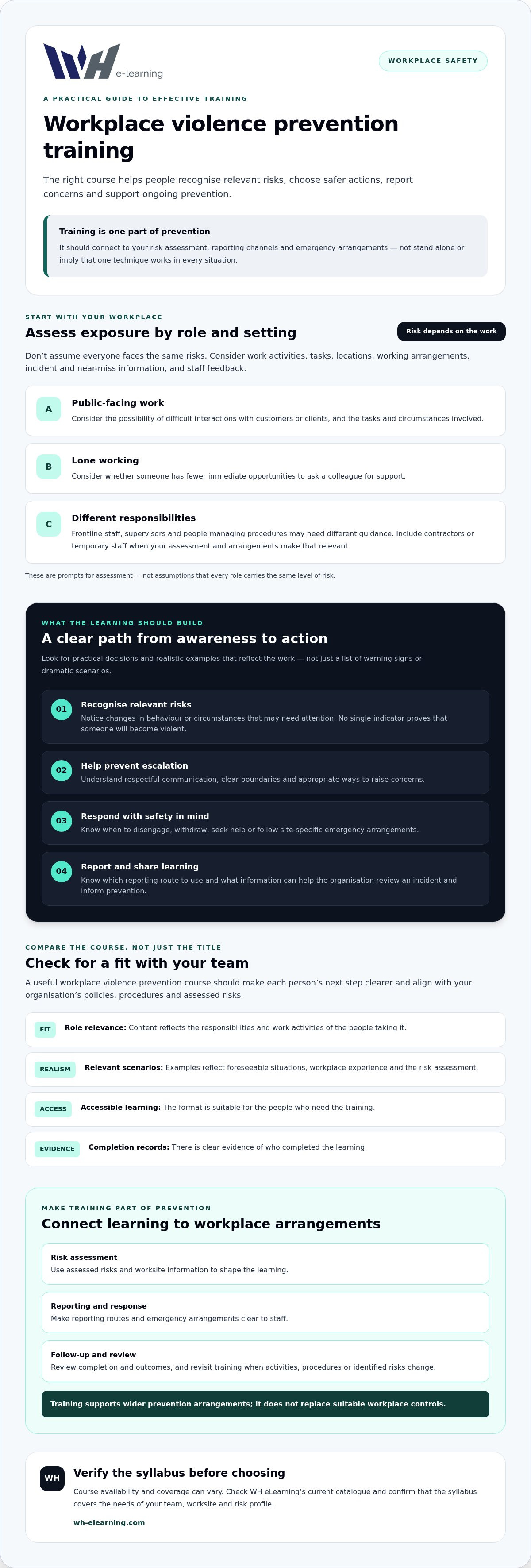
- Assess exposure by role, work setting, public contact and tasks instead of assuming every employee faces the same risks.
- Choose a workplace violence prevention course that builds practical skills in recognising risks, de-escalating where appropriate, responding safely and reporting concerns.
- Compare courses for role relevance, realistic scenarios, accessible learning and clear evidence of completion.
- Connect training to your organisation’s risk assessment, reporting channels and emergency arrangements, then review completion and outcomes.
- Check WH eLearning’s current catalogue and verify the syllabus, as availability of a dedicated course under this name needs to be confirmed.
What a workplace violence prevention course should help employees do
A useful course helps employees recognise and respond to behaviour that could harm, intimidate or threaten people at work. Workplace violence is a broad term. It can include physical assault, threats and aggressive conduct, whether the behaviour comes from a member of the public, a colleague or someone connected to an employee. Harassment may also be relevant, but it isn’t automatically the same as violence. The terms can overlap, and their formal meanings vary, so training should reflect the organisation’s policies and applicable requirements.
In brief: Prevention training helps people recognise relevant risks, choose safer actions, report concerns through the right channels and share information that can inform future prevention.
A course is one part of prevention, not a replacement for suitable workplace controls. Employees should understand what they can do, while organisations consider the conditions and procedures that affect risk. Training shouldn’t suggest that a particular phrase or de-escalation technique will work in every situation. It should help people make informed choices, prioritise safety and know when to seek help.
Which workplace situations and roles may need attention?
Risk depends on the work, not just the job title. Public-facing staff may encounter difficult interactions with customers or clients. Lone workers may have fewer immediate opportunities to ask a colleague for support. Particular tasks, locations and working arrangements can also affect exposure. These are prompts for assessment, not signs that every public-facing or lone-working role carries the same risk.
Start with your own work activities. Consider incident and near-miss information, the tasks employees perform and feedback from staff. This helps focus training on foreseeable situations rather than dramatic scenarios that aren’t supported by workplace experience or the risk assessment.
Who should take workplace violence prevention training?
The right content can differ by responsibility. Frontline employees may need clear guidance on recognising concerning behaviour, maintaining a safe distance where appropriate and reporting incidents. Supervisors may need to know how to respond to reports and support consistent follow-up. People who manage procedures need to understand how staff should use them and where to find the relevant guidance.
Include contractors or temporary staff when your risk assessment and workplace arrangements make that relevant. Don’t assume one course or schedule suits everyone. Follow applicable guidance, and review training when work activities, procedures or identified risks change. A well-chosen workplace violence prevention course should make each person’s next step clearer while supporting the wider prevention arrangements around them.
What effective workplace violence prevention training needs to cover
A strong syllabus moves from awareness to action. Employees should learn to spot relevant risks, take reasonable steps to avoid escalation, respond safely and report concerns. The OSHA workplace violence prevention guidelines offer a useful reference for connecting training with wider prevention arrangements, including worksite analysis and employee participation. Check course content against your organisation’s procedures and assessed risks as well.
Look for learning that helps staff make practical decisions, not simply memorise a list of warning signs. Useful topics may include:
- Recognising risks: Notice changes in behaviour or circumstances that may need attention, without treating any one indicator as proof that someone will become violent.
- Preventing escalation: Use respectful communication, clear boundaries and appropriate ways to raise concerns.
- Responding safely: Understand when to disengage, withdraw, seek help or follow site-specific emergency arrangements.
- Reporting and learning: Know which reporting route to use and what information can help the organisation review an incident.
Risk awareness, prevention and early intervention
Training should use realistic examples that reflect the work, rather than relying on stereotypes or dramatic scenarios. An employee might notice an interaction becoming heated and need to know how to communicate calmly, set a respectful boundary or alert a supervisor. Make clear that these approaches can’t guarantee a situation will settle. Staff should follow workplace procedures and seek appropriate support when needed.
Responding, reporting and learning after an incident
Distinguish urgent action from routine reporting. If someone faces immediate danger, employees should follow the organisation’s emergency arrangements and seek help. An incident report is not a substitute for urgent action. Once it’s safe, staff should know how to record or escalate concerns through established channels. Follow-up may include supporting affected employees and reviewing procedures or controls, with the response shaped by the incident and the organisation’s arrangements.
Emergency advice must fit the workplace’s location, sector and assessed risks. A course should direct learners to the instructions that apply at their site, rather than suggesting one response suits every employer. Check the current WH eLearning course catalogue for relevant coverage, then compare the syllabus with the actions and reporting routes your staff need to know.
How to compare workplace violence prevention courses
Compare courses against your organisation’s risk assessment, not just their titles or length. A workplace violence prevention course should address situations learners may encounter and the actions your procedures expect them to take. Generic examples can introduce a topic, but may not prepare staff for the tasks, settings or reporting routes specific to your workplace.
Put providers side by side in a simple comparison table. Apply the same criteria to each option so you can see where it fits and where you need more information:
- Role relevance: Does the content suit the learners and the risks they face?
- Learning outcomes: Are learners expected to recognise concerns, respond safely and follow reporting procedures?
- Practical application: Do examples reflect plausible situations and help staff practise decisions they may need to make?
- Accessibility: Can intended learners access and understand the course, including across devices, with captions or language support where needed?
- Evidence of completion: What record is provided, and can administrators track progress across the relevant workforce?
Check course content, assessment and evidence
Ask the provider for the current syllabus and compare its outcomes with the behaviours staff need to demonstrate. Check whether learning is assessed, how completion is confirmed and what records or certificate details are supplied. If accreditation or certification matters to your organisation, verify its current status and scope directly with the provider. Don’t rely on a course title or an unverified claim.
Look for a clear link between course material and your workplace arrangements. For example, if employees need to follow a particular internal reporting route, establish whether the course explains it or whether you’ll need to brief staff separately.
Match delivery and accessibility to your workforce
Online and in-house delivery can both be suitable. Compare them against shift patterns, team locations and whether learners need opportunities for discussion or practical activities. The format matters less than whether staff can access the material and apply it to their work.
Check practical details before selecting a provider: device access, closed captions, available language support and how completion is recorded. WH eLearning offers video-based learning accessible across devices, closed captions, machine translation into more than 25 languages, and progress tracking for organisations. Check the current catalogue to confirm whether a dedicated workplace violence prevention course is available, then verify its syllabus before deciding if it meets your needs.
How to put workplace violence prevention training into practice
Training is most useful when it forms part of a wider approach that can be reviewed. A workplace violence prevention course can build staff knowledge, but attendance alone doesn’t show whether risks are controlled or procedures work in practice. Use a clear sequence to connect learning with the way your organisation manages safety.
- 1. Review risks. Identify who may be affected, in which work situations and what controls already apply. Consult employees and consider relevant incident information where appropriate.
- 2. Select role-relevant learning. Match course content to the risks and responsibilities identified, rather than assuming every role needs identical examples.
- 3. Brief staff. Explain how course learning connects to your workplace’s reporting channels, local emergency arrangements and other relevant procedures.
- 4. Record completion. Keep a suitable record of who completed the learning and follow up on gaps. Treat this as evidence of participation, not proof that workplace risks are controlled.
- 5. Review outcomes. Consider learner questions, feedback, incident reports and changes in work tasks when deciding whether training or other arrangements need updating.
Connect training to workplace risk assessment and controls
Before choosing or assigning training, make the risk assessment practical: who could be affected, in which situations and which controls are already in place? Use employee feedback and relevant incident information to check whether procedures work on the ground. Training should reinforce those arrangements, not replace them. For legal or compliance decisions, check current HSE guidance and the requirements that apply in your location and sector.
Keep instructions specific. Staff should know where to report a concern, whom to contact and which local emergency arrangements apply. A course can introduce the principles, while a workplace briefing explains how they operate at each site.
Measure learning and improve the approach
Look beyond completion records. Gather feedback on whether learners understand the procedures and can identify the right next step. Review relevant reporting trends alongside this information, but interpret changes with care. More reports might reflect improved confidence in reporting, a change in exposure or other factors. Don’t treat one trend as a simple measure of course success.
Revisit the approach after a significant change to work activities or an incident, following your organisation’s procedures. Use staff questions and reports to identify unclear guidance, training gaps or controls that may need review. Check WH eLearning’s current catalogue and course syllabus to confirm whether relevant training is available. You can explore WH eLearning’s course catalogue as part of that check.
Choosing workplace violence prevention training for your organisation
Choose learning that matches your assessed risks, the roles your staff perform and the procedures they need to follow. A workplace violence prevention course should help learners take relevant action, not simply provide a broad overview. Check the syllabus against your workplace arrangements and confirm any details that matter to your organisation before you enrol or arrange training.
When online or in-house training may suit your team
Online learning can give teams working across locations or shifts flexible access to training. In-house face-to-face sessions may suit organisations that want specialist-led discussion linked to their workplace context. Neither format is automatically the better choice. Consider whether learners can access the content, ask questions and connect it to the procedures they’ll use.
WH eLearning offers video-based courses and in-house training. Check its current catalogue to confirm whether a dedicated workplace violence prevention course is available and whether it covers your needs. Closed captions, machine translation into more than 25 languages and progress tracking are available features to consider for workforce access and administration. These features alone don’t demonstrate that a particular course is suitable or effective.
A final checklist before you enrol or licence training
Before making a decision, ask the provider to confirm:
- Availability: Is there a current course covering the topic and audience you need?
- Audience and relevance: Does the content fit your assessed risks, learner roles and workplace procedures?
- Syllabus: What topics and learning outcomes are included?
- Assessment and completion: How is learning assessed, and what evidence of completion is supplied?
- Accreditation: Is any accreditation claimed, and can the provider verify its current status and scope?
- Organisational access: If purchasing for a team, can managers track staff progress and identify outstanding learning?
Use the answers to compare providers against the same requirements, rather than relying on a course title or delivery format alone. If the course doesn’t reflect your procedures, plan how staff will receive that workplace-specific information alongside their learning. Clear checks at the selection stage make it easier to identify gaps before training begins.
Explore WH eLearning courses and organisational training options, and confirm current availability and course details with the provider.
Make your next training decision count
The right workplace violence prevention course should reflect your assessed risks, suit the roles taking part and connect learning to your organisation’s procedures. Check the syllabus, assessment and completion evidence before choosing, then use staff feedback and workplace information to review whether the wider approach needs updating. Training supports prevention, but it can’t replace suitable controls or guarantee that incidents won’t occur.
WH eLearning offers more than 100 online courses across workplace topics. Its learning features include closed captions, machine translation into more than 25 languages, and corporate access with staff progress and compliance tracking. Check the current catalogue and course details to confirm whether training on workplace violence prevention is available and suitable for your needs.
Explore WH eLearning courses and organisational training options to review the current catalogue and consider the learning formats available. Check the syllabus against your requirements before choosing.
Frequently Asked Questions
What does a workplace violence prevention course cover?
A workplace violence prevention course should help employees recognise relevant risks, choose safer actions, report concerns and understand how learning supports wider prevention. Depending on the syllabus, it may cover threats, aggressive behaviour, communication, de-escalation principles, emergency procedures and incident reporting. Check that examples and instructions fit your workplace, and that the course doesn’t present any technique as guaranteed to work in every situation.
Is workplace violence prevention training a legal requirement in the UK?
There isn’t a single UK-wide rule requiring every employer to buy a standalone course with this exact title. Employers must manage relevant health and safety risks and provide suitable information, instruction or training where needed. What’s appropriate depends on the work and applicable requirements. Check current HSE guidance and any relevant sector-specific rules, and seek competent advice if you’re unsure. Review your approach when work activities or risks change.
Can online training help prevent violence at work?
Yes, online learning can help staff understand warning signs, safe responses and reporting procedures, particularly when the content is relevant to their roles. It can make learning accessible across locations and shifts, but it can’t replace suitable workplace controls, local emergency instructions or practical briefings where needed. Check the syllabus, accessibility and completion evidence, then reinforce the learning with procedures employees can use in their day-to-day work.
How often should employees repeat workplace violence prevention training?
There isn’t one repeat-training interval that suits every workplace. Set a review schedule that reflects applicable guidance, your organisation’s procedures and the risks identified in your assessment. Consider whether learning needs refreshing after an incident, a change in tasks or procedures, or feedback showing that staff are unclear about what to do. Keep track of completion, but don’t treat attendance alone as evidence that risks are controlled.
What is the difference between workplace violence and workplace harassment?
Workplace violence generally describes physical violence, threats or other aggressive behaviour that may harm or intimidate someone at work. Harassment refers to unwanted conduct and can take different forms, including behaviour that creates an intimidating or hostile environment. The terms may overlap, but they aren’t interchangeable, and formal definitions depend on context and applicable rules. Employers should explain relevant policy definitions and reporting routes clearly to staff.
How can an employer choose a workplace violence prevention course?
Compare the course syllabus with your assessed risks, staff roles and workplace procedures. Check its learning outcomes, practical examples, assessment method, completion evidence and any claimed accreditation directly with the provider. Consider whether learners can access and understand the content, and whether organisational progress tracking is available if needed. Check WH eLearning’s current catalogue to verify whether a dedicated course under this name is available before selecting training.


