

Emergency Training for Staff: A Practical Guide for 2026
A written emergency plan can look clear on paper and still leave staff unsure what to do when seconds matter. Effective emergency procedures training for staff turns instructions into actions people can recall under pressure, rather than relying on a document alone.
Managers need everyone to understand their role, which exit to use, where to assemble and how to report an incident. That can be difficult when hazards, work areas and team needs vary, or when people and premises change. Training should connect the written arrangements to the actions staff are expected to take in their own workplace.
This guide shows you how to give staff clear, role-specific actions and build confidence through practice. You’ll learn how to choose methods that suit your workplace, prepare for scenarios such as evacuation or a medical emergency, and review training when responsibilities or procedures change. It also covers how clear communication, accessible learning and regular rehearsal can help staff put written plans into practice.
Key Takeaways
- Build emergency procedures training for staff around your workplace’s hazards and existing arrangements, rather than relying on a generic plan.
- Give everyone shared essentials, then add role-specific or site-specific instruction where responsibilities call for it.
- Choose learning methods for their purpose, combining briefings, online learning and safe practice where appropriate.
- Use staff feedback and changes to people, premises or procedures to guide regular reviews and updates.
- Use video-based courses and progress tracking to support organised learning, while keeping site-specific instruction and rehearsal in place.
Emergency procedures training for staff: what it covers and why it matters
Emergencies are stressful. In the moment, staff need simple actions they can recall, not lengthy instructions they’ve only seen once. Emergency procedures training for staff teaches people how to respond in their own workplace: what to do first, who is responsible and how to communicate. It should reflect the site’s likely hazards, layout and existing arrangements, with details checked against applicable local guidance.
This differs from general safety awareness, which builds broader understanding of workplace hazards and safe behaviour. It also differs from the written emergency plan: the plan records arrangements, whilst training helps staff understand how to use them. Both matter, but neither should leave people guessing about their first action.
What should staff learn during emergency procedures training?
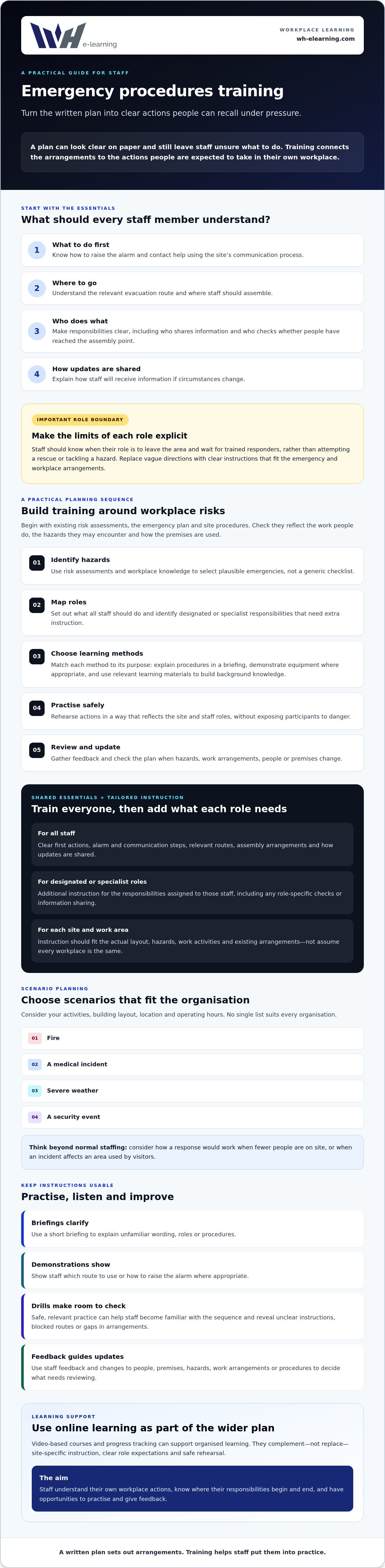
Give employees clear instructions they can follow in sequence. Explain how to raise the alarm, contact help and use the site’s communication process. Cover relevant evacuation routes, assembly arrangements and how staff will receive updates if circumstances change. Make responsibilities explicit, including who shares information and who checks whether people have reached the assembly point.
Set boundaries, too. Staff should know when their role is to leave the area and wait for trained responders, rather than attempting a rescue or tackling a hazard. The right action depends on the emergency and workplace arrangements, so replace vague directions such as “deal with it safely” with clear, relevant instructions.
Why is a written procedure not enough on its own?
A procedure may use unfamiliar terms, assume staff know the layout or assign duties without explaining them. Under pressure, that can lead to hesitation or conflicting actions. A short briefing can clarify the wording; a demonstration can show which route to use or how to raise the alarm. Practice helps staff check whether the instructions make sense in their actual work area.
Emergency procedures training teaches staff the workplace-specific actions, roles and communication steps to follow when an emergency occurs. A drill can help turn those steps into a familiar sequence, such as practising how a building would be evacuated. Keep practice appropriate to the risk and ensure it doesn’t expose participants to danger. Use feedback to identify unclear instructions, blocked routes or gaps in the arrangements, then decide what needs to change.
How to build emergency procedures training around workplace risks
Start with the arrangements you already have. Before designing emergency procedures training for staff, review your risk assessments, emergency plan and site procedures. Check that they reflect the work people do, the hazards they may encounter and how the premises are used. The OSHA emergency preparedness guide offers a planning reference for US workplaces; employers elsewhere should check the relevant local guidance.
Use this sequence to turn that review into a practical training plan:
- Identify hazards. Use risk assessments and workplace knowledge to select plausible emergencies, rather than relying on a generic checklist.
- Map roles. Set out the actions expected of all staff and identify designated or specialist responsibilities that need additional instruction.
- Choose learning. Match the method to the task: explain procedures in a briefing, demonstrate equipment where appropriate, and use relevant learning materials to build background knowledge.
- Practise. Rehearse the actions safely, reflecting the site and the roles staff may need to perform.
- Review. Gather feedback and check the plan when hazards, work arrangements, people or premises change.
Which emergency scenarios should an organisation include?
Choose scenarios by considering your activities, building layout, location and operating hours. Fire, a medical incident, severe weather or a security event may be relevant, but no single list fits every organisation. Think through how the response would work when fewer people are on site, or when an incident affects an area used by visitors. Broader workplace safety training courses can support general safety learning alongside these site-specific arrangements.
How should responsibilities and communication be taught?
Make responsibilities clear: who raises the alarm, guides others, contacts emergency services and accounts for people? Explain how information passes between shifts, remote teams and visitors, including who takes over if a designated person is absent. Check that contact methods, assembly arrangements and role assignments match current practice. Shared actions should be clear to everyone; specialist tasks need suitable additional instruction, not assumptions.
For broader health and safety learning, explore WH eLearning’s health and safety training courses. Use relevant learning to complement workplace-specific instruction and practice, not replace them.
Should emergency training and drills be the same for all?
No. Everyone needs a shared understanding of how to recognise an alarm, follow instructions and get to safety. But emergency procedures training for staff should also prepare people for the responsibilities assigned to their roles. A visitor-facing employee and a designated coordinator, for example, may need different guidance during the same evacuation.
Use a role-based structure to make the distinction clear:
| Training group | What to cover |
|---|---|
| All staff | Recognise alarms, follow evacuation or other instructions, know where to go, report concerns and understand how to seek or offer appropriate assistance. |
| Designated roles | Practise assigned actions, such as coordinating a response, sharing updates or accounting for people, in line with the organisation’s procedures. |
| Specialist or site-specific roles | Receive additional instruction for tasks that require particular knowledge, equipment or familiarity with a specific area. Keep duties within each person’s competence. |
The aim isn’t to train every person to perform every task. It’s to help each person understand their part and how it connects with the wider response.
What should every staff member know?
Staff should know what the alarm sounds or looks like, which instructions to follow, where to go and whom to contact if they spot a problem. Explain how to raise concerns if a route appears unsafe or someone hasn’t reached the agreed location. Include visitors and contractors in the arrangements, and clarify how staff can respond if someone needs assistance without putting themselves at risk.
Which staff may need additional emergency training?
Look at the duties assigned in your procedures. Coordinators or other designated people may need extra practice with communication, handovers or their specific responsibilities. Specialist tasks need suitable instruction, and staff shouldn’t be expected to act beyond their training or competence. Consider accessibility needs and individual circumstances when planning both instruction and evacuation arrangements.
Drills don’t have to be identical for every team or location. Choose a format and frequency that reflect workplace risks, staff responsibilities and changes to premises or procedures. Check applicable local requirements with the relevant regulator or competent adviser, as legal expectations can vary. For practical preparation, the American Red Cross workplace training resource discusses hands-on emergency readiness. For broader learning context, see this occupational safety and health training course guide.
How to deliver, practise and review emergency procedures training
Keep the process practical and repeatable. A useful cycle is to brief staff on the relevant procedure, demonstrate any actions or equipment they need to understand, practise safely, gather feedback and update the arrangements. Emergency procedures training for staff works best when each method has a clear purpose, rather than expecting one course or drill to cover everything.
- Short online learning can introduce or refresh general knowledge at a pace staff can manage. Check that the content fits your needs, and don’t treat it as a substitute for site-specific instruction or rehearsal.
- Team briefings help explain local instructions, clarify responsibilities and answer questions about a particular work area or shift.
- Drills let staff practise actions and test whether communication and arrangements work as intended.
- Specialist-led sessions may suit practical or complex needs. Choose a session that matches the workplace and the tasks staff are expected to perform.
Make learning accessible. Consider captions and suitable language support where available, and check that staff can understand the instructions and ask questions. Keep a simple record of attendance or course completion, practice observations and follow-up actions. These notes can help managers see what has been covered and which points need attention, without assuming a particular format fulfils every record-keeping requirement.
How can employers practise emergency responses safely?
Choose a controlled scenario that tests a decision or communication step without creating avoidable risk. Explain the exercise beforehand, including how participants can pause it if they feel unsafe or a real incident occurs. Debrief promptly afterwards: what was clear, where did people hesitate, and what needs to change? Record agreed actions, assign responsibility for them and check that updates reach the relevant teams.
When should emergency procedures training be reviewed?
Review arrangements when premises, work activities, staffing, risks or procedures change. Exercise feedback, actual incidents and staff questions can also reveal where refresher instruction is needed. Check current official guidance for the review duties and recommended intervals that apply to your location and workplace; don’t assume one timetable suits every organisation.
For broader staff learning, explore WH eLearning’s health and safety training courses. Use relevant learning alongside local briefings and practical rehearsal, not in place of them.
How WH eLearning can support emergency procedures training for staff
WH eLearning can support the learning side of workplace preparedness. Its library includes more than 100 video-based workplace courses, including health and safety training, which organisations can use to build relevant knowledge and organise staff learning. Online courses alone can’t teach staff the details of a particular site’s routes, roles or arrangements, so they should sit alongside local instruction and practice.
When can online learning support emergency readiness?
Use suitable online learning to introduce or refresh general concepts before a local briefing or practical exercise. Staff can access video-based courses on different devices, which can help fit learning around different work patterns. Closed captions and machine translation into more than 25 languages can help make course content accessible to a varied team. Check the course details and confirm that the material matches your learning objectives before assigning it.
For organisations, administrative features can help managers track staff progress and compliance status. That provides an overview of course completion, but completion alone doesn’t show whether someone can follow a site-specific procedure under pressure. Pair learning records with local instruction and practice, then use observations and staff questions to identify where further support may be useful.
How can organisations choose the right training support?
Start with your identified workplace risks and the knowledge staff need. Review the current course catalogue before naming or assigning a course; don’t assume every health and safety course covers emergency procedures. If your team needs to practise workplace-specific actions, consider how online learning can sit alongside briefings, drills or in-house face-to-face sessions delivered by industry specialists. Choose the method to match the learning need, rather than treating it as a replacement for the emergency arrangements themselves.
Keep responsibilities with the employer: maintain clear local procedures, explain role-specific duties and make sure staff know how to take part in practical exercises. WH eLearning can complement that work by supporting relevant learning and helping administrators monitor progress, whilst the organisation remains responsible for its own emergency arrangements.
To identify learning that may suit your team, explore WH eLearning and review the available courses against your needs. You can also explore this guide to workplace compliance training for wider context.
Make your next emergency training step count
Confident responses start with clear, workplace-specific procedures, role-based instruction and safe practice. Effective emergency procedures training for staff isn’t a one-off exercise: review it as people, premises, risks and arrangements change. Use feedback from briefings and drills to spot confusion and improve the instructions staff need to follow.
Online learning can support that process by building relevant knowledge and helping managers track progress, but it doesn’t replace local instructions or practical rehearsal. WH eLearning offers more than 100 online courses across workplace topics, with video-based learning, closed captions and machine translation into more than 25 languages. Organisational options include features for administrators to monitor staff progress and compliance status.
Explore the available learning and consider what best supports your team’s needs. Explore workplace training with WH eLearning, then use relevant learning alongside clear procedures and meaningful practice. Each practical step can help staff feel better prepared to respond.
Frequently Asked Questions
Is emergency procedures training a legal requirement for staff in the UK?
UK employers have health and safety and fire safety responsibilities that can include giving staff suitable information, instruction and training. The specific requirements depend on the workplace, its risks and the arrangements in place, so there isn’t one training format or timetable that applies to every employer. Check current official guidance for your sector and location, and seek competent advice if you’re unsure what your duties require.
What should emergency procedures training for staff include?
It should explain how staff recognise an emergency, raise the alarm, contact help and follow workplace instructions. Cover relevant evacuation routes, assembly arrangements, communication methods and what to do if someone needs assistance. Make each person’s responsibilities clear, including when they should leave an area rather than intervene. Tailor the content to the site’s hazards and procedures, so employees can connect general guidance with the actions expected in their work area.
How often should staff receive emergency procedures training?
There’s no single review interval that suits every workplace. Provide instruction when staff join or take on emergency responsibilities, and revisit it when risks, procedures, premises or staffing change. Use drills, incidents and staff questions to identify when a refresher may be needed. Check current official guidance for any applicable requirements or recommended intervals, then set a review schedule that reflects your workplace and keeps instructions familiar.
Can emergency procedures training be completed online?
Online learning can introduce or refresh relevant knowledge, but it may not cover your site’s specific routes, roles or communication arrangements. Pair suitable online content with local instruction and practical rehearsal, such as a briefing or safe drill. Check that the course matches your learning objectives and that staff can access and understand it. Online completion can support organised learning, but it doesn’t by itself show that employees can carry out the workplace procedure.
What happens if staff do not know what to do in an emergency?
Unclear instructions or unfamiliar roles can lead to hesitation, missed messages or actions that don’t match the workplace plan. This may make it harder to respond safely and account for everyone. Employers can reduce uncertainty by explaining procedures in plain language, clarifying responsibilities and giving staff opportunities to practise. If a drill or incident reveals a gap, review the arrangements, address the cause and share any changes with the affected team.
Do all employees need the same emergency response training?
All employees need a shared understanding of how to recognise an alarm, follow instructions and reach the appropriate safe location. Some people may also need additional training for duties assigned by the organisation, such as coordinating a response or communicating updates. Specialist tasks should be taught appropriately and kept within each person’s competence. Consider accessibility needs, visitors and contractors too, so arrangements are clear and workable for the people on site.
How can employers check whether emergency procedures training has worked?
Check whether staff can explain and demonstrate the actions relevant to their roles. During a safe exercise, observe whether they follow instructions, use communication routes correctly and know where to go. Ask what felt unclear, then record attendance, observations and follow-up actions. Course completion alone isn’t proof of practical readiness. Use feedback, staff questions and lessons from incidents to update procedures or provide further instruction where needed.


