

Effective global employee training solutions give employees a consistent learning core while allowing for differences in role, location, schedule and language. The right programme supports shared learning objectives without expecting every employee to learn in exactly the same way.
Coordinating training across regions can quickly become complicated. Employees may need different topics or formats, while managers need a clear view of completion and learning gaps. If course content isn’t accessible in a worker’s preferred language, it may also be harder to engage with.
This guide explains how to compare training approaches using practical criteria, so you can choose an option that fits your workforce and gives you useful visibility of progress. It covers self-paced online courses, bulk access for organisations and in-house face-to-face training, as well as the role of captions and translation. You’ll also find questions to ask about reporting, course suitability and adapting a consistent programme to local needs. The aim is to make learning easier to coordinate, track and scale across your workforce.
Key Takeaways
- Assess global employee training solutions by separating course content, delivery methods and progress oversight, so you can identify what your organisation actually needs.
- Check course relevance, accessibility, assessment and reporting. Confirm accreditation and recognition for each course in the relevant jurisdiction.
- Compare online, in-house and blended training against your workforce’s schedules, locations and need for practical learner interaction.
- Use a clear rollout process: map training needs, set selection criteria, pilot the approach and assign owners for access, reporting and follow-up.
- Explore whether WH eLearning’s online workplace courses, organisational access and in-house face-to-face training fit your needs. It provides training courses, not standalone LMS software.
What do global employee training solutions need to deliver?
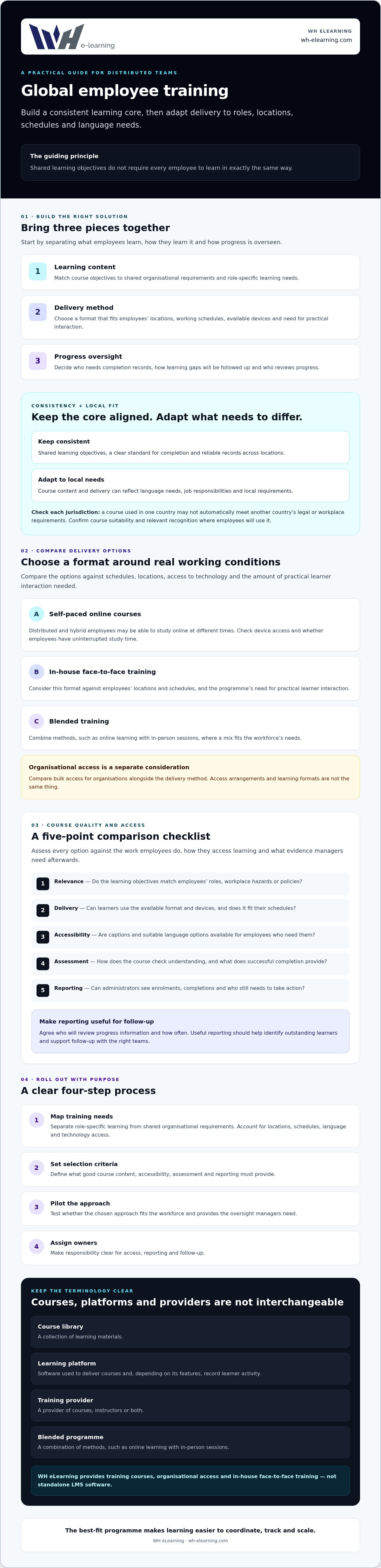
A global employee training solution brings together learning content, delivery methods and oversight to help employees in different locations build relevant skills and complete shared training. Its reach may be global, but its design shouldn’t assume that every employee has the same role, schedule, language needs or access to technology.
The term can describe several different things. A course library is a collection of learning materials. A learning platform is software used to deliver courses and, depending on its features, record learner activity. A training provider supplies courses, instructors or both. A blended programme combines methods, such as online learning with in-person sessions. These options can work together, but they aren’t interchangeable: a provider may offer courses without selling standalone platform software.
For a broader overview, see Training and development. For buyers, the practical first step is to define what employees need to learn and how the organisation will know whether they’ve completed it.
Which workforce training needs should a global solution cover?
Start by separating role-specific learning from shared organisational requirements. A manager, a warehouse operative and an office-based employee may need different role-related training. Topics such as workplace compliance, health and safety or HR policies may apply across teams.
Then check how people will access learning. Distributed and hybrid employees may be able to study online at different times, while frontline teams could have limited access to a personal device or uninterrupted study time. Match the format and scheduling to actual working conditions, rather than head-office assumptions. Decide, too, who needs completion records and how learning gaps will be followed up.
Does global training mean identical courses everywhere?
No. Consistency is better built around shared learning objectives, a clear standard for completion and reliable records across locations. Content and delivery can then be adapted to language needs, job responsibilities and local requirements.
A course used in one country may not automatically meet another country’s legal or workplace requirements. Check its suitability and any relevant recognition in each jurisdiction. This keeps the programme coherent without treating local differences as an afterthought.
How to assess course quality, accessibility and progress tracking
A polished course isn’t necessarily the right course. Assess each option against the work employees do, how they’ll access the learning and what evidence managers need afterwards. Use this checklist to compare global employee training solutions on practical grounds:
- Relevance: Do the learning objectives match employees’ roles, workplace hazards or policies?
- Delivery: Can learners use the format and devices available to them, and does it fit their working schedules?
- Accessibility: Are captions and suitable language options available for the employees who need them?
- Assessment: How does the course check understanding, and what does successful completion provide?
- Reporting: Can administrators see who is enrolled, who has completed the course and who still needs to take action?
Useful reporting should help someone act, not just produce a total. Ask whether managers can identify outstanding learners and follow up with the right teams. Agree who will review the information and how often, so progress gaps don’t go unnoticed.
How can buyers verify course relevance and credibility?
Start with the intended outcome: what should employees know or be able to do after training? Compare that with the course objectives, then check whether the examples and content fit the roles and locations involved. Ask who developed or delivers the material, what assessment learners complete and what certificate or record they receive.
Check accreditation for the specific course rather than assuming it applies across a provider’s entire library. Then confirm whether that accreditation or course is recognised in the jurisdiction where employees will use it. A completion record shows that learning was completed; it isn’t, by itself, proof that an employee can apply the skill competently at work. Where practical performance matters, consider how supervisors will assess it on the job.
What makes training accessible across a workforce?
Check access against employees’ real working conditions: device availability, internet access, time to study, captions and language preferences. The article on training a globally diverse workforce also discusses adapting learning to local needs, which is useful when reviewing content for different teams.
Ask whether translated material has been reviewed for accuracy and context. Machine translation can help extend access, but it shouldn’t be treated as verified professional localisation. For example, WH eLearning’s video courses include closed captions and can be machine-translated into more than 25 languages. Confirm which courses support the languages your employees need. If a topic calls for live demonstration or discussion, consider whether specialist in-house face-to-face training should complement online learning. You can review workplace training courses as one example when comparing course formats and access features.
Online, in-house or blended training: which model fits?
Choose a delivery model to suit the learning objective and workforce, not because a format is new or familiar. Online courses can help reach employees across locations; in-house face-to-face sessions allow direct discussion and instruction; blended training combines elements of both. Use the comparison below to assess which approach fits your requirements.
- Online courses: Reach: well suited to distributed teams. Scheduling: learners can study around work, provided they have suitable access and time. Interaction: usually less direct than in a live session. Administration: completion may be easier to monitor when course provision includes progress records. Practical skills: consider additional instruction if employees need hands-on practice.
- In-house face-to-face: Reach: works for employees brought together for a session. Scheduling: requires coordination around locations and work patterns. Interaction: supports questions, discussion and instructor-led activity. Administration: plan attendance and follow-up. Practical skills: can suit learning that benefits from demonstration or guided practice.
- Blended delivery: Reach: combines online learning for wider access with selected in-person sessions. Scheduling: offers flexibility, but both parts need coordinating. Interaction: adds opportunities to discuss or practise key topics. Administration: track the online and face-to-face elements. Practical skills: useful where course content and workplace practice need different forms of support.
No model suits every subject. A shared policy overview may work well online, while a task requiring employees to demonstrate a practical technique may call for instructor guidance. Consider how learners will engage, what assessment can show and whether their working environment provides the necessary time, devices and space.
When does online employee training work well?
Self-paced courses can give distributed teams a consistent way to access learning without arranging a live session for every location. They can also support employees working different schedules. Check that learners can access the material, that its format holds their attention and that the assessment tests understanding rather than simply registering a visit.
Online learning may not be enough for site-specific procedures or practical skills. Decide how employees will receive any additional instruction and how their ability to apply the learning will be checked.
When should organisations consider face-to-face or blended delivery?
Consider specialist-led sessions where employees need to ask questions, work through scenarios or practise skills with guidance. A blended approach can pair scalable online learning with face-to-face sessions for topics that benefit from human-led support. WH eLearning offers online workplace courses and in-house face-to-face training delivered by industry specialists.
Before choosing, describe your workforce, objectives, locations and delivery requirements. Ask providers to scope an approach against those needs, then compare what each option includes rather than relying on an unsupported cost assumption.
How to select and roll out a global employee training solution
A clear selection process helps turn workforce needs into a manageable rollout. Treat global employee training solutions as an ongoing programme, not simply a course purchase. Agree who owns each decision, test the learner experience and set a review point before expanding.
- Map training needs. Identify shared requirements and role-specific learning by location. Note who needs each course, their access to devices and time to learn, and any language or delivery needs.
- Set selection criteria. Rank course relevance, accessibility, assessment, reporting and regional suitability. Assign owners for course choice, learner access, progress reporting and follow-up so responsibilities don’t get lost between teams.
- Pilot with representative learners. Include a mix of roles and locations. Check that employees can access and understand the material, assessments suit the objectives, and administrators can see the progress information they need.
- Communicate the rollout. Explain who needs to take which training, how to access it and where to get help with access or language needs. Give managers a clear process for following up outstanding learning.
- Review and refine. Check participation, completion, assessment results and feedback. Use what you learn to adjust course choices, communications or delivery before extending the programme.
A pilot should test more than whether a course works technically. Ask learners and managers whether the content fits their roles and whether the assessment reflects the intended learning. Once you’ve set these criteria, explore practical workplace compliance training approaches as part of your evaluation.
What should buyers ask providers before choosing?
Be specific. Ask which courses and language options are included, whether captions are available, how assessment works and what reports administrators can access. Confirm how bulk access is administered, and whether progress views show enrolment, completion and outstanding training. Check accreditation course by course, and confirm suitability and recognition in each relevant jurisdiction rather than relying on broad claims.
How can organisations measure whether training is working?
Track participation and completion alongside relevant assessment results, but don’t treat completion alone as evidence of workplace competence. Add learner feedback and manager observations to understand whether employees can apply the learning. Set a review date, then revisit the programme when roles, workplace risks or requirements change.
As a practical next step, review WH eLearning’s workplace training courses against your agreed criteria.
How WH eLearning can support training across your organisation
Different teams may need different ways to learn. WH eLearning offers workplace courses across health and safety, HR and business compliance, alongside organisational access and in-house face-to-face training. Its library includes more than 100 video-based courses. This may suit organisations looking to coordinate relevant learning across teams, while keeping course selection and local suitability in view.
It’s important to understand what’s included: WH eLearning provides training courses, not standalone learning management system software. Its organisational access includes administrative progress and compliance tracking, but it isn’t a separate LMS product.
Which WH eLearning options suit different employee training needs?
For an individual or smaller team with a specific learning need, employees can enrol on courses such as Managing Safely Online, Working Safely Online, or relevant health and safety, HR and business compliance courses. Organisations can also purchase bulk access, which may help them assign learning across a workforce and review progress and completion.
Where discussion, demonstration or specialist instruction better fits the learning objective, industry specialists deliver in-house face-to-face training. This can complement online learning in a blended approach. The best fit depends on what employees need to learn and how they’ll apply it at work.
For more on related topics, explore this business compliance e-learning guidance and information about multi-language e-learning courses.
What should an organisation confirm before getting started?
Check the available courses against employee roles and learning objectives. Confirm which courses include the language options your workforce needs, as well as closed captions, assessment and progress reporting. Courses work across devices, and machine translation is available for more than 25 languages, but availability may vary by course. Machine translation can support access, but it isn’t verified professional localisation, so check whether the wording is suitable for your employees.
Before assigning training, confirm course-specific assessment, certificate and accreditation details, and whether any accreditation is recognised for the intended learners and locations. Don’t assume recognition applies to every course or jurisdiction.
To discuss your organisation’s training needs and available course options, contact WH eLearning about employee training.
Build a training approach that works across your workforce
Strong global employee training solutions balance consistency with local relevance. Choose courses and delivery methods around employees’ roles, access needs and learning objectives, then check course suitability and recognition in each location. Clear ownership, useful progress reporting and a representative pilot can help you refine the programme before a wider rollout.
WH eLearning offers more than 100 video-based workplace courses, with bulk organisational access that includes progress and compliance tracking. Courses include closed captions, and machine translation is available in more than 25 languages. Confirm which courses support your needs and check translation suitability. For learning that benefits from direct instruction, industry specialists also deliver in-house face-to-face training. WH eLearning provides training courses, not standalone LMS software.
Discuss employee training options with WH eLearning to explore relevant courses and delivery approaches for your organisation. With a clear plan and an approach that fits your teams, you can make workforce learning more accessible, trackable and practical.
Frequently Asked Questions
What are global employee training solutions?
Global employee training solutions combine courses, delivery methods and oversight to support learning across locations. They can include online course access, face-to-face instruction or both, alongside ways to monitor participation and completion. The right approach provides consistent learning objectives without assuming every employee has the same role, schedule, language needs or local requirements. A course provider and a learning platform are different things, so clarify what a supplier actually provides.
How do you choose an employee training solution for a global workforce?
Start by mapping which employees need training, what they need to learn and how they’ll access it. Compare options for course relevance, delivery, language support, accessibility, assessment and progress reporting. Check course accreditation and recognition for each relevant location rather than relying on broad claims. Before a wider rollout, test your preferred approach with representative roles or sites and assign owners for learner access, reporting and follow-up.
Can online employee training work across different countries?
Yes, online training can give employees in different countries access to shared learning, provided the course suits their roles and circumstances. Check that learners have suitable devices, time and connectivity, and that captions or language options meet their needs. Review course content for local context and requirements, too. Online delivery can make learning easier to coordinate, but it doesn’t mean one course is automatically suitable for every workforce or jurisdiction.
How can organisations track employee training completion across locations?
Use a reporting process that shows who has been enrolled, who has completed each course and where training remains outstanding. Agree who reviews the information and who follows up with employees or managers. For example, WH eLearning’s bulk organisational access includes administrative progress and compliance tracking. Check what reports are available and whether they provide the detail your organisation needs to coordinate training across teams and locations.
What is the difference between online, in-house and blended employee training?
Online training uses digital courses that employees can complete remotely, often at a time that fits their schedule. In-house face-to-face training brings learners together for direct instruction and discussion. Blended training combines online learning with in-person sessions, which can be useful when some topics need practical demonstration or discussion. Choose based on the learning objectives, workforce access and need for interaction, rather than assuming one format suits every subject.
Can employee training courses be delivered in multiple languages?
Some courses can be made available in multiple languages, but language coverage may differ by course. WH eLearning offers machine translation into more than 25 languages, and its video courses include closed captions. Confirm that the specific course supports the language your employees need. Machine translation can support access, but it isn’t the same as verified professional localisation, so assess whether the translated content is clear and appropriate for its intended learners.
Does one global training course meet every country’s compliance requirements?
No single course should be assumed to meet every country’s compliance requirements. Requirements and course recognition can vary by jurisdiction, so check the content, accreditation and acceptance of each course for the locations where employees will take it. A shared course may still support consistent learning objectives across an organisation, but local adaptations or additional training could be needed. Confirm course suitability before treating completion as evidence of meeting a local requirement.


