

A safe workplace depends on more than protective equipment. Ireland’s Safety, Health and Welfare at Work (General Application) Regulations 2007 set detailed workplace requirements and were made under section 58 of the Safety, Health and Welfare at Work Act 2005. The Regulations set out workplace requirements, including provisions relating to personal protective equipment.
It can be difficult to see how the Regulations fit alongside the Act, or which workplace risks they address. This guide explains the relationship: the Act establishes broad duties, while the Regulations set out requirements for specific areas of work. You’ll learn what those requirements cover, how they connect to hazard identification and risk assessment, and where PPE fits into managing workplace risks. The aim is to make the framework clearer, so you can understand the rules that apply to your workplace and the practical steps they involve.
Key Takeaways
- Use the Regulations’ topic-based structure to identify which workplace requirements are relevant to your operations.
- Understand where the PPE rules sit and how protective equipment fits into managing workplace hazards.
- Assess risks by considering the load, effort, work environment, activity and the people involved.
- Separate the Act’s overarching employer duties from the Regulations’ more specific workplace requirements.
Personal protective equipment
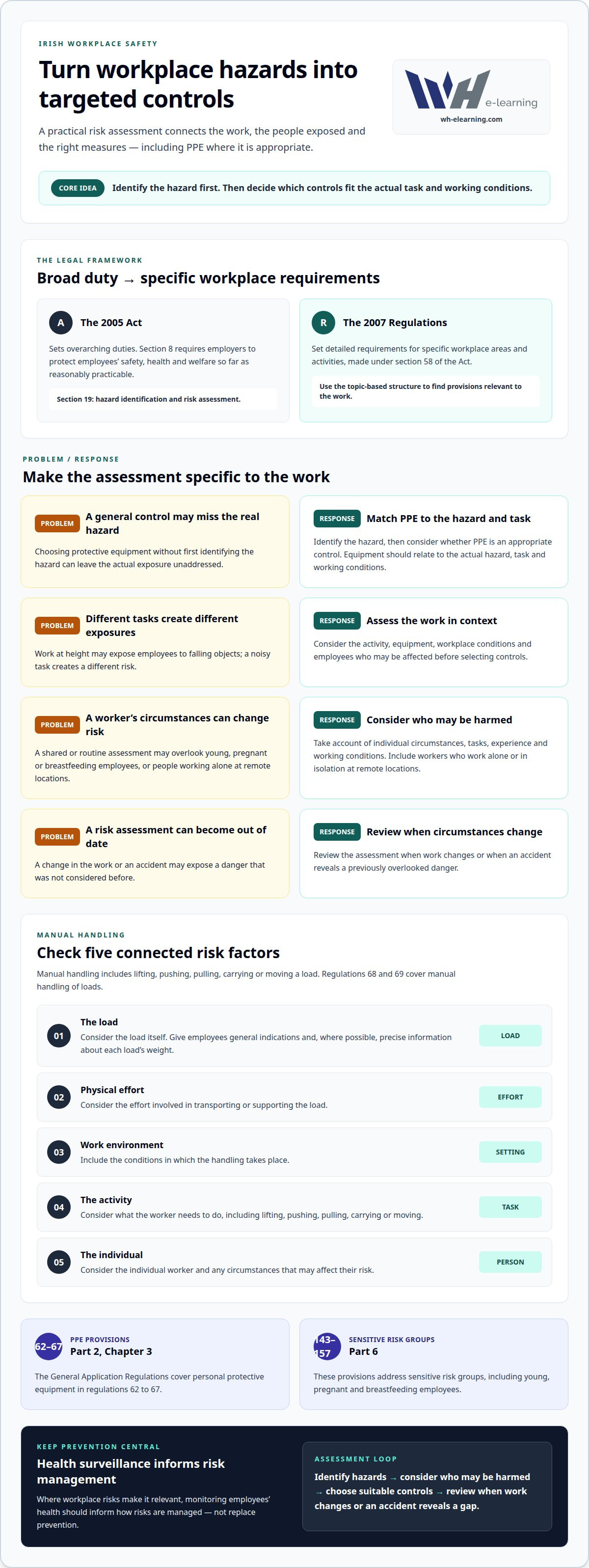
Personal protective equipment (PPE) is equipment worn or held to reduce exposure to workplace hazards. In Ireland, Part 2, Chapter 3 of the General Application Regulations covers PPE in regulations 62 to 67. An assessment should identify the hazard first, then consider whether equipment is an appropriate control. For example, work at height may expose employees to falling objects, while a noisy task may create a different risk. PPE should relate to the actual hazard, task and working conditions, rather than being selected as a general measure.
A risk assessment is a structured review of hazards, who may be harmed and how risks can be controlled. Section 19 of the Safety, Health and Welfare at Work Act 2005 deals with hazard identification and risk assessment. Consider the work activity, equipment, workplace conditions and the employees who may be affected. Include workers who work alone or in isolation at remote locations: according to the Irish Statute Book, employers must consider their risks when identifying hazards and assessing risks. Review the assessment when work changes or an accident reveals a previously overlooked danger.
Sensitive risk groups are workers who may face particular risks because of their circumstances. Part 6 of the Regulations addresses sensitive risk groups in regulations 143 to 157. Young employees, pregnant employees and breastfeeding employees may need individual consideration when assessing tasks, exposure and working conditions. For example, review whether a young worker’s experience affects their ability to recognise a dangerous situation, or whether a task presents a concern during pregnancy. Health surveillance means monitoring employees’ health where workplace risks make this relevant; it should inform how risks are managed, not replace prevention.
For official Irish compliance resources, consult the Irish Statute Book for legislation, including the General Application Regulations and the 2005 Act. Use the relevant provisions to identify the applicable rules, then connect them to the hazards and employee groups in your assessment. This keeps PPE decisions and workplace controls grounded in the Irish legal framework.
What are the General Application Regulations 2007?
Ireland’s General Application Regulations set detailed requirements for workplace safety and health. They were made under section 58 of the Safety, Health and Welfare at Work Act 2005 and came into operation on 1 November 2007.
Amendments to the regulations
An amendment is a legal change to an existing regulation. The 2007 amendment came into operation on 12 November 2007; the 2010 amendment followed on 29 April 2010. The 2012 amendment was to come into operation on 1 January 2013, and the 2016 amendment came into operation on 1 July 2016.
The 2020 amendment came into operation on 1 April 2020 and gives effect to Directive 2009/104/EC on work equipment. The Regulations were originally made with 8 Parts and 175 regulations. As amended, they comprise 14 Parts and 15 Schedules. A consolidated text is marked as updated to 24 May 2023. These changes cover areas including work equipment, manual handling and electrical safety.
Workplace duties for employers and employees
Workplace duties are the legal responsibilities that support safe work practices. The Regulations set requirements across workplace conditions and activities, while section 8 of the 2005 Act requires employers to protect employees’ safety, health and welfare so far as reasonably practicable.
The requirements that apply depend on the work and the relevant provision. Employers can use the chapter structure to find requirements for workplace conditions, work equipment and other hazards, then link them to the risk assessment. This helps clarify which controls and safe procedures are needed for each task.
Penalties depend on the specific breach and the legal enforcement route. There is no single penalty for every failure to comply.
First aid, exits and fire safety
First aid and safety signs are workplace provisions covered by the Regulations. Part 7 addresses safety signs and first aid in regulations 158 to 166. The relevant provisions should be read in context, alongside the workplace requirements in Part 2, regulations 4 to 26.
Emergency exits and fire safety are part of safe workplace arrangements, but the cited provisions do not set one specification for every premises. Requirements depend on the relevant workplace provisions and circumstances. Employers should identify the rules that apply to their premises and activities rather than treating first aid, exits and fire precautions as interchangeable measures.
Risk factors relating to loads, effort, work environment, activity and individuals
Risk factors are conditions or tasks that can contribute to harm at work. Ireland’s Regulations address workplace design, work equipment, physical agents and groups who may be particularly sensitive to certain risks.
Young people and sensitive risk groups
A sensitive risk group is a group whose circumstances may affect exposure to workplace hazards. Part 6 covers sensitive risk groups in regulations 143 to 157. Include young workers and shift patterns when considering who may be affected, their tasks, experience and working period. For example, assess whether a young employee understands a machine’s safe operation, or whether night work changes access to support.
Manual handling means transporting or supporting a load, including lifting, pushing, pulling, carrying or moving it. Regulation 68 gives this definition, while regulations 68 and 69 cover manual handling of loads. Consider the load, physical effort, work environment and individual worker. Employers must give employees general indications and, where possible, precise information about each load’s weight.
Workplace design, equipment and maintenance
Workplace design and equipment requirements concern the conditions and equipment used to carry out work. Workplace requirements and work equipment are addressed separately within the regulations. For a practical assessment, consider access, movement around machines, equipment condition and how the work is performed. A mobile machine, for example, may create different risks from fixed equipment.
Electricity is covered by Part 3, regulations 74 to 93; work at height falls under Part 4, regulations 94 to 119. These provisions address different hazards, so assess the operation and workplace conditions relevant to each task.
Chemical and biological agents are hazardous substances or organisms that may expose workers to harm. Noise is specifically covered by regulations 120 to 132. Under regulation 123, daily noise exposure action values are 80 dB(A) and 85 dB(A), with a limit value of 87 dB(A). Part 5 concerns physical agents, including noise and vibration; assess each exposure separately rather than treating one control as suitable for every hazard.
Relationship with the Safety, Health and Welfare at Work Act 2005
The Act is Ireland’s primary workplace safety law, while the General Application Regulations set detailed requirements for particular work risks. The Safety Health & welfare at Work General Application Regulations 2007 were made under section 58 of the Safety, Health and Welfare at Work Act 2005. Together, they connect broad statutory duties with practical rules for specific workplace conditions and activities.
Section 8 of the Act requires employers to protect employees’ safety, health and welfare so far as reasonably practicable. This overarching duty applies across workplace decisions, rather than to one item of equipment or one task. The Regulations add detail on workplace conditions, work equipment, electricity, manual handling and display screen equipment. Their provisions help identify which requirements relate to a particular activity.
A risk assessment is the process of identifying hazards and evaluating risks to employees. Section 19 of the Act deals with hazard identification and risk assessment. Employers can use an assessment to identify the work involved, the people exposed and the relevant risks. They can then use the applicable Regulations to determine which specific provisions inform their response. For example, a task involving a load calls for consideration of manual handling provisions, while screen-based work falls under the display screen equipment chapter.
The practical distinction is that the Act establishes the duty, and the Regulations specify requirements across defined topics. An instruction or workplace action should reflect both levels: identify the relevant general duty, then locate the specific provisions for the task. The Safety Health & welfare at Work General Application Regulations 2007 cover work equipment in regulations 27 to 61, manual handling in regulations 68 and 69, and display screen equipment in regulations 70 to 73. This structure helps employers connect legal requirements with actual work.
For employers, the key is to read the Act and Regulations together. The Act sets out the responsibility; the relevant chapter provides topic-specific detail to guide workplace decisions.
WH eLearning: Health and Safety Training Courses
WH eLearning offers health and safety training courses to help employees build practical workplace knowledge. Training can support understanding of safety responsibilities and everyday risk awareness, but it complements rather than replaces an employer’s legal duties or workplace risk assessment.
For staff who need an introduction to safe working practices, online foundation safety courses are one option. Organisations can also consider in-house face-to-face training when a group format suits their needs. Choose training that aligns with employees’ roles and the hazards they may encounter, so learning connects with real workplace tasks.
To discuss suitable training for your workplace, contact WH eLearning.
Build safer working practices through learning
Turn your understanding of the Safety, Health and Welfare at Work (General Application) Regulations 2007 into a practical learning plan. The next step is helping employees recognise how safe working practices connect with their roles, so they can apply their learning during everyday tasks. Training can support this development alongside your organisation’s risk assessments and procedures.
WH eLearning offers IOSH Managing Safely Online, IOSH Working Safely Online and health and safety training courses. These options support different learning needs, from building employees’ awareness of safe working to developing managers’ understanding of safety responsibilities. Consider which roles need training and what knowledge will help employees contribute to safer work practices.
Contact WH eLearning to discuss training that fits your organisation’s learning needs. Take the next step towards making safety knowledge part of everyday work.
Frequently Asked Questions
Do they apply to every employer?
The Regulations provide Ireland’s general workplace safety framework, but not every provision applies to every employer’s activities. Relevant requirements depend on the work, equipment and risks involved. For example, display screen equipment rules relate to screen-based work, while manual-handling provisions concern tasks involving loads. Employers should identify the requirements relevant to their actual workplace activities rather than assume every chapter applies in the same way.
What areas are covered under these Regulations?
The Regulations cover a wide range of workplace safety topics, including workplace conditions, work equipment, electricity, manual handling, work at height and display screen equipment. They also address physical agents such as noise and vibration, sensitive risk groups, safety signs, first aid, explosive atmospheres and accident reporting. Employers can use the relevant topic and chapter to find requirements connected with specific work activities.
What is the relationship between the 2005 Act and these Regulations?
The Act establishes the wider legal framework, and the Regulations provide requirements for specific workplace topics. The Regulations were made under section 58 of the Safety, Health and Welfare at Work Act 2005. For employers, the practical distinction is that the Act sets broad responsibilities, while relevant regulatory provisions add detail for activities such as using work equipment or handling loads. Read them together when considering workplace duties.
Where is accident reporting dealt with?
Accident and dangerous occurrence reporting is covered by Part 14, regulations 224 to 229, of Ireland’s General Application Regulations. This is the section to consult for the Regulations’ reporting provisions. Keep it distinct from the rules that address preventing workplace harm, such as provisions on equipment or physical agents. The reporting chapter concerns how accidents and dangerous occurrences are dealt with under this regulatory framework.
Which Part of the Regulations governs manual handling?
Manual handling is covered by Part 2, Chapter 4, in regulations 68 and 69. Regulation 68 describes manual handling as transporting or supporting a load, including lifting, pushing, pulling, carrying or moving it. This helps identify tasks that fall within the topic, whether an employee moves an item between work areas or supports a load during a work activity. Consider the actual task, not its job title.
Who do these Regulations apply to?
The Regulations apply within Ireland’s workplace safety framework to employers and employees, with the relevant provisions depending on the work and workplace circumstances. Employers use applicable requirements to manage hazards, equipment and work activities. Employees are the workers whose safety, health and welfare the framework protects. For example, rules concerning work equipment are relevant to the people using that equipment and the activities involving it.


