

Under Ireland’s Safety, Health and Welfare at Work Act 2005, employers must identify hazards, assess and manage risks, provide safe systems of work, and prepare a written Safety Statement. They must also give employees suitable information, instruction, training and supervision. These duties apply to the workplace and to the people whose work the employer directs.
Meeting the requirements is not just a paperwork exercise: employers need to put suitable safety measures into practice and keep them relevant to workplace risks. Employees also have duties, including taking reasonable care of their own safety and the safety of others affected by their work.
This guide explains employers’ main responsibilities, what the Act requires of designers, manufacturers, importers and suppliers, and how inspectors can enforce the law. It also outlines potential offences and penalties, helping you understand the requirements and plan practical next steps for workplace health and safety.
Key Takeaways
- Build your Safety Statement around identified hazards and the risk assessment under section 19, as required according to the Irish Statute Book.
- Understand how the Act assigns responsibilities to designers, manufacturers, importers and suppliers, not just employers.
- Know what inspectors can do when they identify a risk, including issuing formal enforcement notices.
- Learn which actions may count as offences and how penalties and prosecutions can follow.
What is the Safety, Health and Welfare at Work Act 2005?
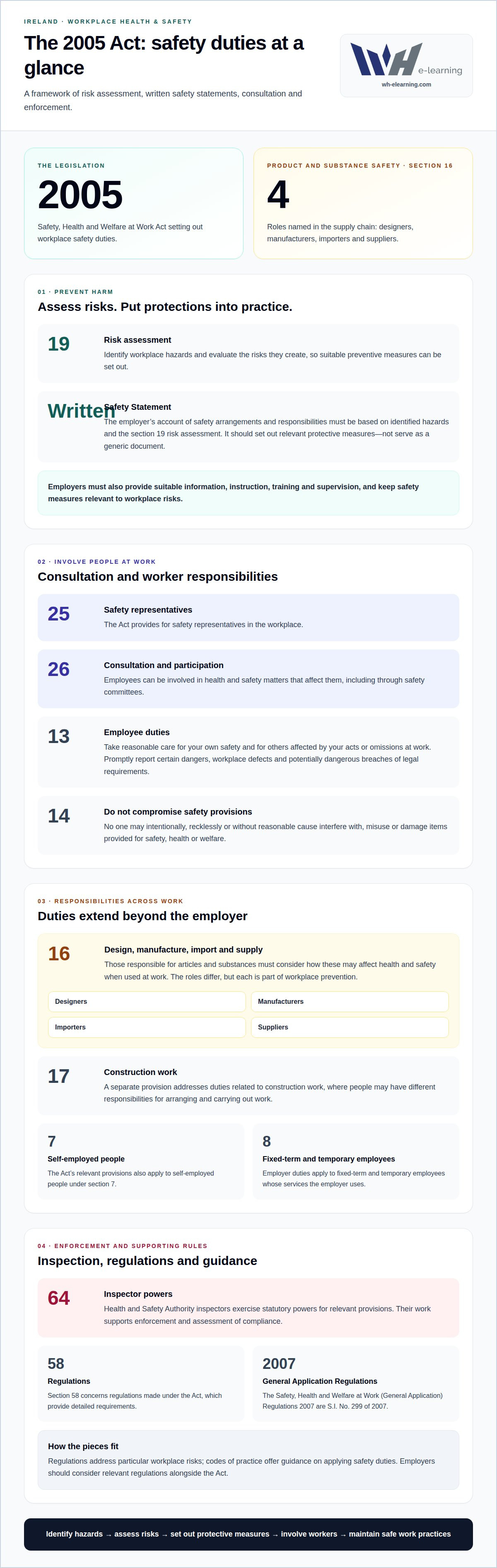
Ireland’s Safety, Health and Welfare at Work Act 2005 sets out workplace safety duties for employers, workers and others with responsibilities for work. It provides a framework of risk assessment, written safety statements, consultation and enforcement.
Health and Safety Authority Functions
The Health and Safety Authority (HSA) is Ireland’s authority responsible for overseeing enforcement of the Act. Its role includes supporting compliance and ensuring workplace safety requirements are applied. Inspectors exercise enforcement powers under the Act, including entering workplaces and examining relevant matters. The HSA’s role links legal responsibilities to action when inspectors identify concerns.
Safety Statements and Risk Assessments
A safety statement is an employer’s written account of workplace safety arrangements and responsibilities. It must be based on identified hazards and the risk assessment carried out under section 19, according to the Irish Statute Book. Risk assessment means identifying workplace hazards and evaluating the risks they create, so suitable preventive measures can be set out. The statement should explain the protective measures and arrangements relevant to those risks, rather than serve as a generic document.
Workplace Consultation and Safety Representatives
Workplace consultation is the process of involving employees in safety and health matters that affect them. Section 26 addresses consultation and employee participation, including safety committees; section 25 concerns safety representatives. These arrangements give workers a way to raise workplace concerns and take part in discussions about protective measures. Employees also have responsibilities: they must take reasonable care for their own safety and that of others affected by their work, according to the Office of the Attorney General.
Regulations and Codes of Practice
Regulations provide detailed requirements made under the Act, while codes of practice offer guidance on applying safety duties. Section 58 concerns regulations, and the Act works alongside regulations covering particular workplace risks. For example, the Safety, Health and Welfare at Work (General Application) Regulations 2007 are S.I. No. 299 of 2007. Employers need to consider relevant regulations alongside the Act; a code of practice can help explain how to approach a particular safety issue.
Compared with earlier workplace safety legislation, the 2005 Act sets out duties through provisions covering risk assessment, consultation and enforcement. Its relevant provisions also apply to self-employed people under section 7. Contractors’ responsibilities depend on their role, while employers must manage workplace risks and protect workers. The Act’s general workplace duties provide the basis for considering safety where visitors may be affected.
Duties of designers, manufacturers, importers and suppliers
Section 16 sets out general duties for designers, manufacturers, importers and suppliers of articles and substances. It extends workplace responsibility beyond the employer who uses equipment or materials. Each role sits at a different stage: design, production, import or supply. The Act therefore treats product and substance safety as part of workplace prevention, not solely an issue for employees after delivery.
For designers, the key consideration is how an article or substance may affect health and safety when used at work. Manufacturers, importers and suppliers also have duties under the same section, though their roles in the supply chain differ. Each should understand the item’s intended workplace use and the risks involved. Assessing those risks helps employers decide what controls and instructions workers need.
Construction work has a separate provision: section 17 concerns duties related to construction work. It matters where a project involves people with different responsibilities, such as those arranging work and those carrying it out. Temporary employees may also be within an employer’s duties: section 8 applies employer duties to fixed-term and temporary employees whose services the employer uses. Work arrangements do not remove the need to account for safety.
Employees have their own duties under section 13. They must take reasonable care for their own safety, health and welfare, and for others affected by their acts or omissions at work. They must promptly report certain dangers, workplace defects and potentially dangerous breaches of legal requirements. This supports cooperation between workers and employers, while leaving the employer responsible for managing workplace risks.
Other people at work also have responsibilities. Section 14 prohibits anyone from intentionally, recklessly or without reasonable cause interfering with, misusing or damaging items provided for safety, health or welfare. For example, damaging a protective item could undermine the safeguards intended for workers. Clear instruction helps employees understand how to use equipment properly and report problems through workplace procedures.
Inspector powers and enforcement notices
In Ireland, the Health and Safety Authority oversees enforcement of the Act. Section 64 gives inspectors powers for relevant statutory provisions.
Inspector Powers
Inspector powers are statutory powers used to apply workplace safety legislation. Under section 64, inspectors exercise powers for the purposes of relevant statutory provisions. This places inspections within the Act’s enforcement framework, rather than making them informal advice alone. The Health and Safety Authority oversees this work.
Inspectors can use these powers to assess compliance with the provisions they enforce. Employers should be ready to explain how workplace measures address hazards, including how training and supervision support safe work. For example, clear records of a training process can help show how employees receive relevant instruction. The specific inspection powers derive from section 64.
Enforcement Notices and Penalties
An enforcement notice is a formal direction issued under the Act to address a workplace safety matter. Section 66 provides for improvement notices, while section 67 concerns prohibition notices. The distinction is reflected in their purpose: an improvement notice directs attention to an issue requiring improvement, while a prohibition notice relates to preventing an activity. Both sit within the Act’s enforcement framework.
These notices make the required response clearer than general advice. An employer who receives one should identify the hazard or activity it addresses and act in accordance with its requirements. This links the inspector’s findings to practical measures in the workplace. The relevant section number helps identify the type of notice issued.
Enforcement may also lead to prosecution and a fine. The Act allows fines of up to €1000 per offence. Under section 82, the Health and Safety Authority may bring and prosecute summary proceedings for offences under relevant statutory provisions. Summary proceedings may generally be instituted within 12 months from the date the offence was committed. These provisions show why employers should treat a notice as a prompt for timely action, not simply as paperwork.
Offences, penalties and prosecutions
An offence is a breach of a duty or prohibition under workplace safety legislation. Section 14 of the Act prohibits any person from intentionally, recklessly or without reasonable cause interfering with, misusing or damaging items provided for safety, health or welfare. For example, damaging a protective item can compromise the measures intended to protect people at work.
A prosecution is legal proceedings brought in response to an alleged offence. Under section 82, the Health and Safety Authority may bring and prosecute summary proceedings for offences under relevant statutory provisions. Summary proceedings may generally be instituted within 12 months from the date the offence was committed. This means the alleged conduct and its timing can matter when enforcement action is considered.
A penalty is a legal consequence that may follow an offence. The Act allows fines of up to €1000 per offence. The amount is a maximum, not an automatic charge for every breach. The relevant offence, evidence and circumstances inform how proceedings are dealt with. A serious danger at work may prompt attention to the controls in place, including whether the risk assessment and safety statements address the hazard.
Practical preparation starts with clear records and follow-through. Keep safety statements aligned with workplace hazards, record how workers receive instruction, and address reported dangers through established procedures. If an inspector raises a concern, identify the activity or measure involved and respond to the notice’s requirements. These steps link prevention to the issue being examined, rather than relying on paperwork that does not reflect work practices.
Equip employees with relevant workplace knowledge through health and safety training, so they can understand hazards, follow safety measures and report concerns appropriately.
WH eLearning: Health and Safety Training Courses
WH eLearning offers health and safety training to help organisations build workplace knowledge alongside practical safety arrangements. Its video-based online courses include Certified Working Safely Online, and In-House Face-to-Face Training offers a classroom format. Choose training that matches the topic employees need to understand and the way your organisation delivers learning.
Training can help employees recognise hazards, understand safe working practices and know how to raise concerns. It complements risk controls and workplace procedures, but does not replace an employer’s responsibilities under the Act. WH eLearning also offers HR and Business Compliance Courses for organisations with broader compliance training needs.
For a relevant course or in-house training, contact WH eLearning.
Make safety part of everyday work
Strong workplace safety develops through consistent decisions, not a document left untouched after it is written. Use the requirements of the Safety, Health and Welfare at Work Act 2005 as a prompt to keep learning connected to the work people actually do. As roles, equipment and working practices change, relevant knowledge helps employees understand their responsibilities and contribute to safer routines.
Training can support ongoing efforts to improve workplace safety. Managers looking to develop their understanding of workplace safety responsibilities can take IOSH Managing Safely Online. The right learning option depends on the role and the knowledge your organisation wants to build.
Take the next step by identifying where further learning could help your team put safety into practice. Discuss workplace training with WH eLearning, and keep building a confident, safety-aware workplace.
Frequently Asked Questions
What are my duties as an employer under the 2005 Act?
Under Ireland’s Safety, Health and Welfare at Work Act 2005, you must manage workplace risks and protect employees’ safety and health. In practice, this means organising safe work, providing appropriate information and training, and keeping written safety arrangements relevant to actual hazards. For example, if work processes or equipment change, review how those changes affect risk and whether staff need updated instruction or supervision.
Can an employer require an employee to attend safety training?
Employers must provide instruction, training and supervision appropriate to the work. Section 10 of the Safety, Health and Welfare at Work Act 2005 addresses this, including training when an employee is recruited, changes tasks, or encounters new equipment or technology. Requiring relevant attendance supports that duty. Employees must be given paid time off for safety awareness training, according to Citizens Information. Training should relate to workplace risks and employees’ duties.
Do the duties apply to temporary and fixed-term staff?
Yes. Section 8 applies employer duties to fixed-term and temporary employees whose services the employer uses. Their contract length does not remove the need to account for them in workplace safety arrangements. For example, introduce a temporary worker to relevant hazards, safe procedures and reporting routes before they begin unfamiliar duties. The information and supervision provided should suit the work and the risks they may encounter.
Must an employee report a hazard?
Yes, employees must promptly report certain dangers, workplace defects and potentially dangerous breaches of legal requirements under section 13. For example, a worker who notices damaged equipment or an unsafe condition should raise it through the workplace’s reporting process without delay. Prompt reporting helps the employer respond to the issue and consider whether existing controls remain suitable. Employees must also take reasonable care for their own safety and others’.
What are the penalties for breaches of health and safety legislation?
The Act allows a fine of up to €1000 per offence. The Health and Safety Authority may bring and prosecute summary proceedings for offences under relevant statutory provisions. Summary proceedings may generally be instituted within 12 months from the date an offence was committed. The penalty is a maximum, not an automatic amount for every breach; the offence and circumstances affect how a case proceeds.
When did the Act come into force?
Ireland’s Safety, Health and Welfare at Work Act 2005 came into force on 1 September 2005. This is the date its provisions began operating, rather than simply the year shown in the Act’s title. For employers, the relevant point is that workplace duties stem from this legislation and related provisions. The Act also operates alongside regulations that address specific workplace risks and activities.


