

Instructor-led training isn’t the best fit for every learner or working day. Self-paced learning for employee development gives employees control over when they study and how quickly they progress, while still allowing organisations to set clear goals and milestones.
That flexibility can make learning easier to fit around daily responsibilities. But studying at your own pace also requires clear goals and engaging content, and it does not provide the live discussion and interaction of instructor-led training.
This guide explains what self-paced learning involves, how it can support employee development and knowledge retention, and where its limitations lie. It also compares self-paced and instructor-led learning to help you decide when either approach, or a blend of both, may suit your workforce.
Key Takeaways
- Use flexible study schedules to make workplace learning easier to fit around employees’ responsibilities.
- Match learning opportunities to role requirements and development goals to support employee growth.
- Reinforce knowledge with short lessons, opportunities to revisit material and regular checks for understanding.
- Choose self-paced, instructor-led or blended training according to the topic, the need for interaction and learners’ schedules.
What Is Self-Paced Learning?
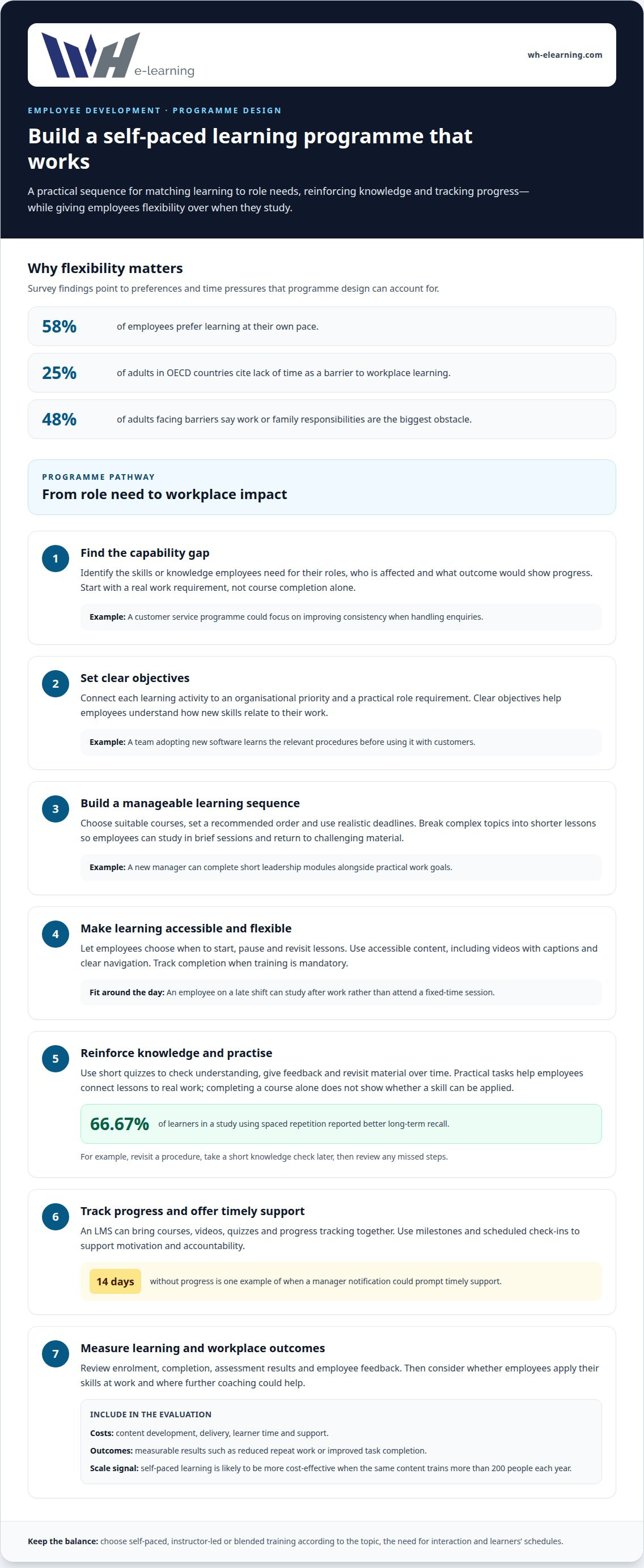
Self-paced learning lets employees choose when to study and how quickly to progress. One survey finding reports that 58% of employees prefer learning at their own pace.
Flexible schedules and work-life balance
Flexible training schedules let employees fit courses around work tasks and personal commitments. This matters because 25% of adults in OECD countries cite lack of time as a barrier to workplace learning. Among adults facing barriers, 48% say work or family responsibilities are the biggest obstacle. A worker on a late shift, for example, can study after work instead of attending a fixed-time session.
Online learning at an employee’s own pace
Online learning lets employees choose when to start, pause and revisit lessons. Video lessons and short modules make it possible to study in brief sessions and return to challenging material later. For US training, accessibility and compliance requirements depend on the organisation and course subject. Choose accessible content, such as videos with captions and clear navigation, and track completion when training is mandatory.
Self-paced programme design
A self-paced programme brings together clear objectives, relevant content and progress milestones. Start by identifying role-specific skills, selecting suitable courses and setting a recommended sequence with realistic deadlines. Break complex topics into shorter lessons, then use quizzes to check understanding. For example, a new manager could complete short leadership modules alongside practical work goals.
Platforms and learning tools
Learning platforms bring courses, videos, quizzes and progress tracking into one place. An LMS can show employees what remains and help managers monitor participation. To encourage motivation and accountability, set milestones and schedule check-ins; a manager notification after 14 days without progress can prompt timely support. These tools help establish a continuous learning culture without requiring every lesson to happen live.
Benefits of employee training and development
Training develops role-relevant skills and helps organisations respond to changing priorities. Self-paced courses can make learning easier to scale and fit around daily work.
Training aligned with organisational goals
Training aligned with business goals develops the skills employees need to deliver specific priorities. It has practical value when it addresses a real requirement of someone’s role. For example, a team adopting new software could learn the relevant procedures before using it with customers. Clear objectives help employees connect each learning activity to their work. Managers can support motivation by recognising progress and discussing how new skills apply.
Start by identifying the capability gap, the employees affected and the outcome that would show progress. A customer service programme, for example, might aim to improve consistency in handling enquiries. This gives the training a defined purpose, rather than making course completion the goal in itself.
Scalable onboarding and training updates
Reusable training materials help organisations deliver consistent onboarding as teams grow. The same introduction can support five or 500 new employees, without arranging a separate live session for each person. Learners can complete core topics in sequence, while managers use team sessions for questions and discussion. This approach can reduce repeated delivery effort and help new starters access essential information when they need it.
When a process changes, it can be easier to update the relevant module and direct employees to the revised material than to repeat an entire course. For example, a short lesson can explain a change to an internal procedure, followed by a knowledge check to reinforce the new steps.
Measuring effectiveness and return on investment
Measure training effectiveness by comparing learning results and workplace performance with the programme’s objectives. Review enrolment, completion, assessment results and employee feedback, then consider whether people apply their skills in their roles. For example, a manager can observe whether staff follow a newly taught process and identify where further coaching could help.
To assess return on investment, compare programme costs with measurable outcomes, such as reduced repeat work or improved task completion. Include content development, delivery, learner time and support in the cost picture. More than 200 people trained each year on the same content is a scale at which self-paced learning is likely to be more cost-effective. Consider lost work time too: flexible sessions can help employees learn without taking a whole team away from its tasks.
Information retention and practical application
Learning is more valuable when employees remember key ideas and use them at work. Spaced review and relevant practice can help reinforce learning.
Knowledge retention and spaced repetition
Spaced repetition revisits information over time, helping learners strengthen recall instead of relying on one training session. In a study of learners using spaced repetition, 66.67% reported better long-term recall. For example, an employee could revisit a procedure, complete a short knowledge check later, then review any missed steps. This method gives learners repeated opportunities to retrieve information, rather than only rereading it.
Short modules make review easier to organise around workplace tasks. A safety lesson, for instance, can introduce a procedure before employees practise recalling its key steps. Quizzes with immediate feedback can reveal misunderstandings while the material is fresh. Engagement matters too: relevant lessons, visible progress and manageable deadlines can encourage learners to return.
Practical application of learning
Practical application means using a newly learned skill in a real work task. Completing a course alone does not show whether an employee can apply what they learned. After a lesson on customer communication, for example, an employee might try the approach in a customer conversation and discuss what worked with a manager. This connects learning to daily responsibilities and helps managers assess skill development.
Career growth can also shape job satisfaction and employee retention. A reported survey finding says 94% of employees would stay longer at a company that invests in their career development; 70% would consider leaving for a company that invests in training. These figures indicate reported intentions, not guaranteed outcomes. Organisations can support development by linking learning goals to role progression, discussing practical achievements during reviews and offering relevant next steps. Follow-up conversations also help identify where further practice or coaching could improve workplace performance.
Self-paced versus instructor-led learning
Self-paced learning lets employees control their pace, while an instructor-led session follows the instructor’s schedule and pace. Online materials may be available 24 hours a day, 7 days a week, giving shift workers and distributed teams more flexibility than a fixed corporate session.
The formats also differ in interaction. Self-paced workplace learning is mainly individual study, with less live discussion; instructor-led learning offers direct discussion and group interaction. Learners can pause a video to review a procedure, while an instructor can answer questions as they arise. Each method suits different learning needs, tasks and levels of ability.
The main risks of self-paced learning are reduced interaction and the need for learner self-discipline. Without regular check-ins, employees may delay a course or misunderstand a topic without asking for clarification. Instructor oversight can provide structure, encourage participation and help a group resolve questions together.
Choose a format based on the learning outcome, not a blanket preference. A focused lesson on a familiar process may work well independently, especially when employees need flexibility. A new or complex task may benefit from instructor discussion, demonstration and practice. For example, employees could study procedures at their own pace, then use a live session to explore scenarios and ask questions.
A blended approach can combine both: assign videos as pre-work, then use an instructor-led session for discussion and application. This can help employees arrive prepared while preserving time for interaction. If your team needs practical discussion alongside online study, explore in-house face-to-face training as part of a blended learning plan.
Self-directed learning goes beyond choosing a pace: learners set development goals, select resources and methods, and assess their progress. Self-paced courses can use videos, infographics, quizzes and interactive elements to engage learners. Periodically released assignments and clear milestones can give learners a framework for progressing independently.
WH eLearning
WH eLearning helps organisations support employee development with practical workplace training. Its video-based online courses can be accessed on any device, allowing employees to learn flexibly and revisit material. Choose from Health and Safety Training Courses or HR and Business Compliance Courses to build knowledge relevant to workplace responsibilities.
When a topic benefits from live discussion and group interaction, In-House Face-to-Face Training can complement independent study. Multi-language Course Translation can help make content accessible to employees who use different languages. Together, these options support a balanced approach: self-paced learning to build knowledge, with face-to-face training where shared discussion is useful.
Contact WH eLearning to discuss training options for your organisation.
Turn learning into a lasting development plan
Make the next step practical: connect learning goals to the skills employees need in their current roles and future careers. A thoughtful approach to self-paced learning for employee development gives people room to build knowledge steadily, while managers support progress and identify where discussion or hands-on guidance would help.
For workplace health and safety learning, WH eLearning offers comprehensive online safety modules and health and safety training courses. These options help organisations shape training around their employees’ development needs.
Choose a learning focus, decide which format suits the topic, and give employees a clear way to practise their new knowledge. A well-chosen course can be a useful starting point for building skills and supporting continued growth.
Discuss training options with WH eLearning and take a considered next step for your team’s development.
Frequently Asked Questions
What is self-paced learning for employee development?
Self-paced learning for employee development is training that employees complete at their own speed and according to their schedule. They can work through lessons independently, pause to consider an unfamiliar idea and return to material when a task calls for it. For example, a newly promoted supervisor could study a reporting process before using it in a team handover.
What are the benefits of self-paced employee training?
It lets employees build skills around specific responsibilities instead of waiting for a scheduled group course. A staff member moving into a customer-facing role, for example, could complete relevant training before taking on new duties. Short assessments can reveal which topics need more attention, helping employees and managers plan the next development activity.
How does self-paced learning compare with instructor-led and blended training?
Self-paced learning supports independent study, while instructor-led training gives employees direct access to a trainer and group discussion. Blended training combines both formats. For example, employees learning a new workplace process could study its core principles independently, then join a trainer-led session to discuss questions together. Choose the approach according to whether the priority is individual review, shared discussion or both.


