

What if a healthier workplace begins with how colleagues respond to one another? Workplace mental health awareness training can help employees recognise when someone may be struggling and respond with empathy. It can also give managers practical ways to encourage open conversations and offer support.
Training is one part of a wider effort, not a complete solution on its own. A supportive culture also depends on everyday practices such as manageable workloads, regular wellbeing check-ins and clear routes to help. This article explains how to put those practices into action, what mental health training can teach and how to assess its potential outcomes. It also explores how awareness can reduce stigma, strengthen communication and make it easier for people to speak up when they need support.
Key Takeaways
- Learn how to recognise signs that a colleague may be struggling and respond with care while respecting their privacy.
- Build everyday workplace practices that make it easier to raise concerns, access support and manage pressure.
- Explore how training can strengthen understanding and communication, and how feedback can help assess its impact.
- Find practical ways to make staff learning part of a broader, sustained approach to workplace wellbeing.
1. How can I help create a mentally healthy workplace?
Notice changes in behaviour, then approach the person privately and calmly. Possible signs of distress include withdrawing from friends, sadness, anger, confusion or difficulty coping. These signs do not confirm a mental health condition, but they can prompt a considerate check-in. Ask an open question, listen without judgement and avoid pressing for personal details.
Offer practical support rather than trying to diagnose the person or solve everything. Ask whether adjusting their workload or helping with a work task would make the day more manageable. Agree on a suitable follow-up and explain how the employee can access workplace support or professional help. A consistent, respectful response helps create a culture where colleagues can speak up without being treated differently.
Workplace mental health awareness training should cover recognising possible signs of distress, empathetic conversations, listening skills and routes to professional support. It can also help employees develop coping and resilience skills and understand how to respond when a colleague is struggling. Focus on supportive actions, privacy and clear boundaries, rather than asking colleagues to diagnose one another.
Managers can learn to notice changes, start sensitive conversations, listen and guide employees towards appropriate support. Training can also cover responding to stress, developing coping skills and identifying options for professional help. Use regular check-ins to discuss work pressures, and make clear that a manager’s role is to support, not provide clinical care.
When an employee is grieving, acknowledge their loss with a simple expression of sympathy and let them choose whether to talk. Ask what practical support would help at work, such as adjusting immediate priorities, and agree when to check in again. Avoid assumptions about how grief should look or how quickly someone should return to their usual routine.
Under the U.S. Family and Medical Leave Act, covered employers must provide eligible employees up to 12 weeks of job-protected leave, according to the U.S. Department of Labor. Explain available workplace support clearly and handle sensitive conversations with care.
For a crisis in the United States, anyone can call or text 988, or get help online. Crisis intervention training focuses on suicide prevention and aims to strengthen crisis management. Make the route to urgent help easy for employees to find.
2. Building a mentally healthy workplace culture
Workplace culture grows from the choices leaders make every day. If employees can raise a blocked task or excessive workload early, managers can agree priorities before pressure builds. Respond consistently across teams: acknowledge the concern, identify practical help and follow up on agreed actions. Employees notice whether speaking up leads to support or silence.
Clear support routes make workplace culture more dependable. Explain how employees can raise concerns privately, who receives them and what happens next. For example, a confidential reporting channel should direct someone to a named workplace contact, rather than leave them unsure where to turn. Set boundaries for sharing sensitive details and explain how employees can access relevant support.
Show respect in everyday decisions, not just policy documents. Managers can use inclusive language in meetings, challenge discriminatory behaviour and apply workplace policies consistently. If someone is excluded from a discussion or treated unfairly, address the conduct promptly and explain what happens next. These actions show employees that wellbeing and inclusion are part of how work is managed.
Build learning into onboarding and regular staff development. New starters can learn where to find workplace support, while established teams can practise raising concerns and responding constructively. Use employee feedback to identify gaps, then adapt training to the needs people describe. Useful sessions connect directly to real workplace situations rather than relying on abstract advice.
Align wellbeing messages with working arrangements. For example, explain how flexible work or leave policies relate to support, and ensure managers know where to find the relevant guidance. Unions and worker organisations can also contribute through member services, outreach and community engagement. Health and safety training can sit within a wider staff-development plan, alongside clear workplace support routes.
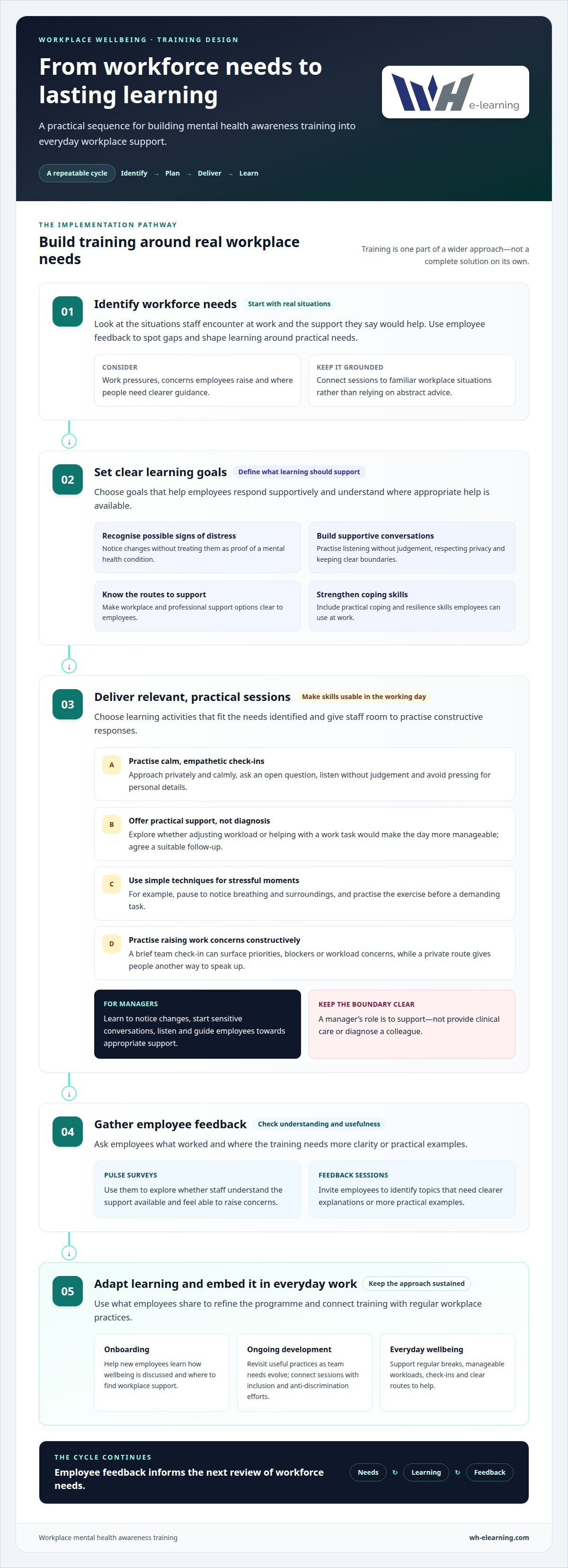
3. Creating mentally healthy workplaces
Implement training in a clear sequence: identify workforce needs, set learning goals, deliver relevant sessions and gather feedback. Use what employees share to adapt the programme and connect learning with everyday wellbeing practices.
Start with situations staff encounter at work. A team facing frequent deadlines may benefit from practical mindfulness techniques for stressful or anxious moments. Training can introduce simple exercises, such as pausing to notice breathing and surroundings, and practising them before a demanding task. Focus on accessible skills employees can use during their working day.
Make room for recovery as well as learning. Encourage short, regular breaks away from workstations and help teams protect time for them. A morning stand-up can also serve as a brief check-in: invite employees to flag priorities, blockers or workload concerns. Keep the conversation focused on work needs, while giving people who prefer it a private way to raise concerns.
Include mental health learning in onboarding and ongoing staff development. New employees can learn how wellbeing is discussed at work, while established teams revisit useful practices as needs evolve. Connect sessions with inclusion and anti-discrimination efforts. For example, discuss how exclusionary behaviour can affect colleagues and practise responding respectfully when it occurs.
Finally, assess whether the programme is meeting its goals. Gather employee feedback after training to identify topics that need clearer explanations or more practical examples. Pulse surveys and feedback sessions can show whether staff understand the support available and feel able to use it. Review the themes, adjust future sessions and communicate the changes made. Following through visibly connects training with daily workplace practice instead of treating it as a one-off event.
4. Workplace mental health training outcomes
Useful outcomes include better understanding, less stigma and more confident conversations. Training can also teach practical techniques that may help employees manage stress, focus and reduce burnout. A PwC study found employers receive a return of $2.30 for every dollar spent on mental health in the workplace. Treat this as a reported finding, not a promised result for every organisation.
Choose a programme based on its learning goals, audience and practical content, not its label alone. Effective options teach recognition, supportive communication and routes to professional help. Managers may need to practise handling work-related concerns, while employees may benefit from learning how to respond respectfully to colleagues.
Match the delivery format to the work. Online learning can suit staff who need flexible access; in-person sessions can support discussion and practice. A blended approach combines structured online material with facilitated discussion. Consider shift patterns, device access, language needs and opportunities for learners to ask questions.
U.S. employers should distinguish awareness training from legal obligations concerning leave and health benefits. The federal provisions discussed in this guide address those areas, rather than requiring a standalone awareness course. Employers still need to follow the rules that apply to their workforce.
There is no single standard price for workplace mental health awareness training in the United States. Costs depend on factors such as delivery format, course scope, group size and tailoring. Compare the learning and support included, not just the headline fee.
Poorly designed training can increase stigma if it labels colleagues, encourages amateur diagnosis or pressures people to share personal details. Protect privacy by setting clear boundaries: participation should focus on learning, not personal histories. Use respectful examples, explain support routes and avoid presenting one person’s experience as universal.
Measure impact with pulse surveys and feedback sessions, then review patterns in absenteeism, productivity and retention. Use the findings to refine content and workplace support. Explore staff training options as part of a wider, considered learning plan.
WH eLearning: Health and Safety Training Courses
WH eLearning supports organisations that are building broader staff learning alongside workplace wellbeing initiatives. Its Health and Safety Training Courses and HR and Business Compliance Courses can form part of ongoing employee development, complementing the practical support and culture-building steps covered above.
For teams that benefit from group learning, In-House Face-to-Face Training offers an in-person option. Multi-language Course Translation can help make course content accessible to employees who use different languages. These offerings support wider workplace learning; they are not a substitute for clinical care or crisis support.
Consider WH eLearning when your organisation is planning staff training in health and safety, HR or business compliance, or needs face-to-face delivery or translated course content. Contact WH eLearning to discuss your training needs.
Make your next step part of a lasting approach
A healthier workplace develops through repeated choices, not a single training session. Use employee feedback to decide what your organisation should strengthen next, then make wellbeing part of ongoing staff development. Workplace mental health awareness training can contribute when it supports practical action and fits your team’s needs.
For wider workplace learning, WH eLearning offers online health and safety training courses. These options can support related health and safety learning alongside your organisation’s wellbeing work.
Take the next step at a pace that suits your organisation. Contact WH eLearning to discuss training, and keep building a workplace where people can do their best work.
Frequently Asked Questions
How can I help create a mentally healthy workplace?
Make support visible in the everyday ways work is planned and discussed. For example, add a brief workload question to project reviews so employees can raise pressure before deadlines become unmanageable. Agree who will respond and how follow-up will happen. If a concern points to a wider team issue, address its cause, such as unclear priorities, rather than treating it only as an individual problem.
How can I help reduce workplace stress and fatigue?
Reduce avoidable pressure by clarifying priorities, reviewing conflicting deadlines and agreeing when employees can step away from work. If a team is tired after a demanding period, managers can redistribute urgent tasks and postpone lower-priority work. Encourage employees to raise obstacles early, then act on what they report. These steps address work conditions directly instead of expecting individuals to manage every source of stress alone.
What are the benefits of mental health awareness training for employees and employers?
Training can give employees clearer language for discussing wellbeing and greater confidence about where to seek support. For employers, it can help managers respond more consistently and identify workplace issues that need attention. For example, if staff repeatedly report unclear responsibilities, leaders can review role expectations. Learning is most valuable when it leads to practical changes rather than remaining a standalone session.
How can employers measure the effectiveness of workplace mental health training?
Set a clear learning objective before training, such as improving managers’ confidence in responding to concerns. Afterwards, ask employees whether they know the relevant support routes and can apply the learning to realistic scenarios. Compare feedback over time and consider whether agreed workplace actions have been completed. Interpret workforce trends carefully, as training is one of several influences on attendance, productivity and retention.
What are the best workplace mental health training programs and providers?
Choose a programme based on its learning goals, audience and practical content. Strong options teach staff to recognise signs of distress, communicate supportively and identify routes to professional help; the article names no specific providers.


