

Safety can be a retention strategy, not just a compliance task. Reducing staff turnover with better safety can begin when workers see that fatigue, injury risks and day-to-day concerns are taken seriously, but there’s no single timetable for retention gains. Progress depends on whether environmental health and safety (EHS) efforts improve everyday working conditions and involve employees, rather than stopping at written policies.
It’s understandable to want a clear return on safety investment, especially when staff turnover disrupts work and brings replacement costs. Safety, wellbeing and retention are closely connected: fatigue and stress can increase the risk of mistakes and injuries, while practical support can help people feel valued. This article explains how retention may change, how burnout and injuries can contribute to departures, and which costs employers should consider. It also explores how to connect safety efforts with training, employee involvement and everyday practices that encourage people to stay.
Key Takeaways
- Build regular manager conversations into retention efforts so workers can raise concerns about satisfaction, support and their future.
- Look for how fatigue, stress and injury risks affect daily work, then address contributing conditions before they drive people away.
- Assess turnover costs alongside disruption to operations to understand the wider value of keeping experienced staff.
- Connect EHS initiatives with practical training and employee involvement, then track whether workplace and retention measures improve.
1. How quickly can manufacturers see retention improvements from safety programs?
There’s no single timetable for retention improvements. Early signs may appear when workers see hazards addressed and managers respond to concerns, but lasting change depends on consistent action. For manufacturers, reducing staff turnover with better safety means connecting visible improvements in daily working conditions with regular employee feedback. U.S. manufacturers’ annual separation rate was 30.4% in 2017, making retention a practical workforce measure, not simply a safety metric.
Employers can identify safety-related reasons for departures by looking at exit interviews alongside voluntary turnover, incident frequency and severity, absenteeism, employee engagement and trust at department level. Ask departing employees whether fatigue, unsafe tasks, injury concerns or limited support influenced their decision. Compare these themes with feedback from current staff to uncover workplace patterns, rather than treating each departure as an isolated case.
Manager conversations help surface issues before resignation becomes the outcome. Among U.S. voluntary leavers, 45% said no manager or leader proactively discussed job satisfaction, performance or future prospects during the three months before departure. Build regular, meaningful check-ins into managers’ routines; ask about safety barriers, workload and what would help employees stay, then follow through visibly.
A stronger safety culture starts with worker participation. Involve employees in identifying frequent or serious hazards, recognise their safety contributions, and ensure managers act on reports. The CDC describes Total Worker Health approaches as associated with improved job satisfaction, reduced turnover intent and greater workforce stability. These steps support a workplace where people can stay focused, protect their mental health and sustain productivity.
In high-risk industries, safety programmes can support retention by reducing exposure to hazards and showing that employee wellbeing matters. A practical approach to reducing staff turnover with better safety applies expectations from a new hire’s first day, including for temporary staff, and reviews whether incidents, absence and turnover shift together. Healthcare offers an example: one mid-sized hospital system had nurse turnover above 25% before an integrated wellness and safety strategy; turnover fell by nearly 30% within two years of adoption.
2. Burnout, fatigue, injuries, and turnover
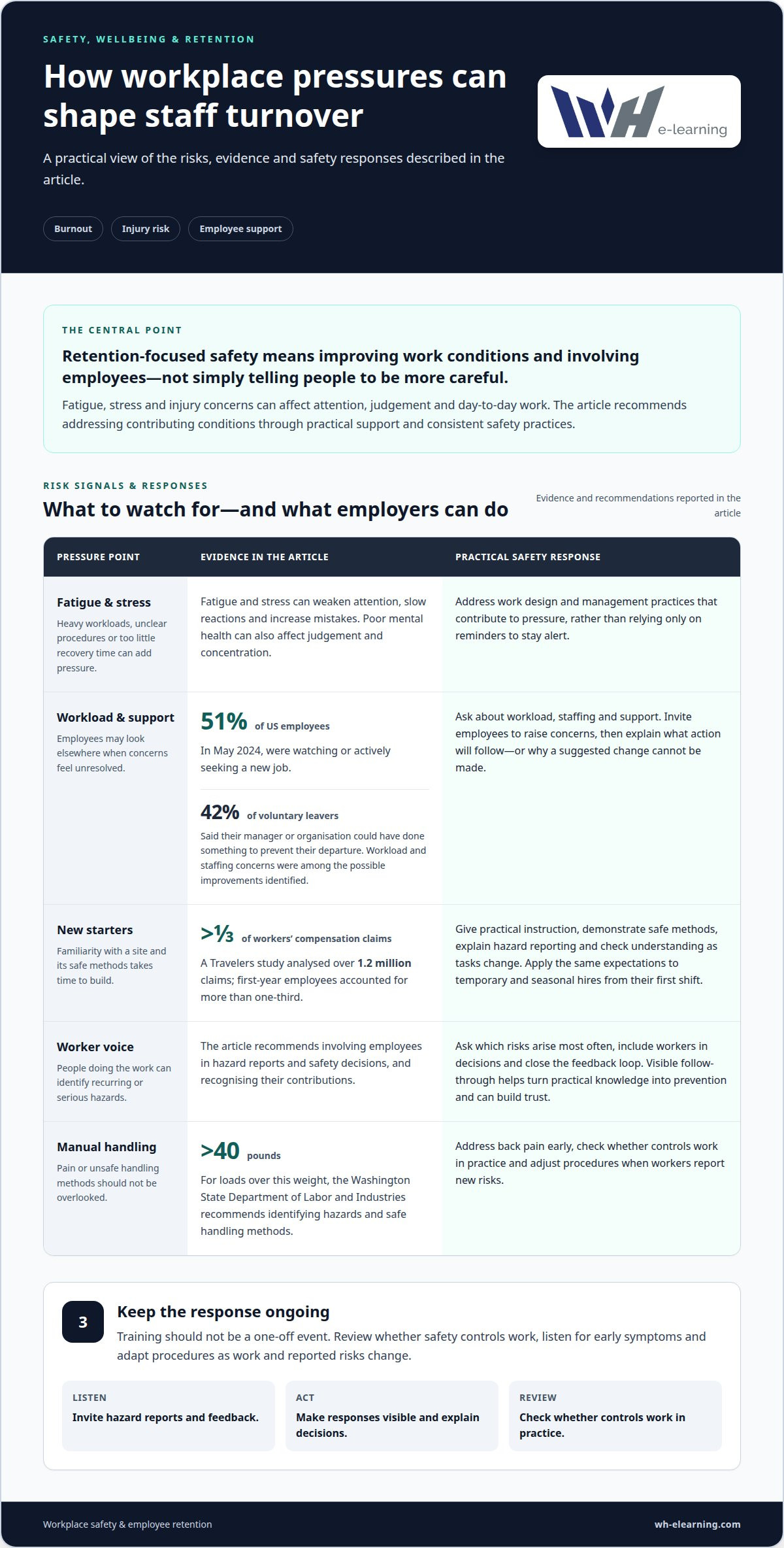
Fatigue and stress can weaken attention, slow reactions and increase mistakes, making demanding tasks less safe. Poor mental health can also affect judgement and concentration. These pressures may build when workers face heavy workloads, unclear procedures or too little recovery time. Reducing staff turnover with better safety means addressing work design and management practices, not simply telling employees to stay alert.
The retention risk is visible in job-search behaviour: in May 2024, 51% of US employees were watching or actively seeking a new job. In a separate US survey, 42% of employees who had voluntarily left during the past year said their manager or organisation could have done something to prevent their departure. Workload and staffing concerns were among the possible improvements identified by leavers.
New starters need particular attention. A Travelers study analysed over 1.2 million workers’ compensation claims, and first-year employees accounted for more than one-third. Familiarity with a site does not arrive on day one. Give new workers practical instruction, demonstrate safe methods, explain how to report hazards and check understanding as tasks change. Apply the same expectations to temporary and seasonal hires from their first shift.
Managers can involve employees by inviting hazard reports, asking which risks arise most often and including workers in safety decisions. Close the loop by explaining what action will follow a report, or why a proposed change cannot be made. Responding to feedback turns workers’ practical knowledge into better prevention and helps build trust.
Common mistakes include choosing fixes without input from the people doing the work, treating training as a one-off event, and overlooking early symptoms. For loads over 40 pounds, the Washington State Department of Labor and Industries recommends identifying hazards and safe handling methods. Address back pain early, review whether controls work in practice, and adjust procedures when workers report new risks. In high-risk workplaces, reducing staff turnover with better safety means pairing injury prevention with consistent support for workers’ development and wellbeing.
3. Costs and operational effects of turnover
Staff turnover costs more than recruitment. Each departure can take practical knowledge with it, interrupt team routines and leave colleagues covering essential tasks. In a distribution operation, for example, a vacant shift may delay picking, packing or dispatch. Include these operational effects alongside recruitment, onboarding and training when assessing the full impact.
The Washington State Department of Labor and Industries estimated that replacing a worker costs a company $3,500. That figure helps illustrate why repeated departures matter, but an organisation’s actual costs depend on the role, hiring process and training required. A critical specialist may take longer to replace than an entry-level employee, while a busy season can make a vacancy more disruptive.
Training also brings direct and indirect costs. New starters need time to learn about equipment, safe handling, site procedures and quality expectations. Experienced colleagues or managers may need to pause their own work to coach them. When employees leave before gaining confidence, the organisation must repeat that investment and may lose knowledge built through practice.
Distribution teams can make these effects visible by tracking voluntary turnover alongside absence, incident frequency and severity, and training completion. Compare results by department and role. If one shift has repeated vacancies, delayed dispatches and recurring safety issues, investigate workload, equipment, task design and onboarding together. This provides a clearer basis for action than a single company-wide turnover figure.
Retention efforts should also account for the mental and operational strain on employees who remain. Frequent vacancies can mean extra duties, less time for focused training and greater pressure during busy periods. Recognising employees’ contributions and addressing practical obstacles can help people feel valued, while consistent safety practices support reliable operations. These steps won’t eliminate every turnover cost, but they can help identify where preventable losses and disruption are building.
4. What is the ROI of workplace safety programs on retention and turnover costs?
Assess safety ROI using more than workers’ compensation premiums. Include injury-related absence, recruitment to replace leavers, onboarding, training and production disruption. Then compare those costs with the resources invested in prevention. This broader view helps show whether an initiative supports safer work and workforce stability, instead of treating insurance costs as the only financial measure.
There is evidence of a retention benefit: companies implementing safety programmes to reduce muscle, tendon and joint injuries reduced worker turnover by an average of 48%. That figure makes injury prevention relevant to retention planning, particularly where repetitive tasks create strain. It does not, by itself, show the financial return for every workplace; role mix, operating conditions and programme costs all shape the result.
Build a practical evaluation around a clear baseline. Before changes begin, record voluntary turnover, injury frequency and severity, absence, and participation in safety initiatives. Review the same measures afterwards, by department or job type. For example, if a warehouse introduces safer handling practices, track whether related injuries and turnover move in the same direction, while noting changes in staffing or workload.
Next, estimate the operational value of any improvement. Fewer departures can mean less repeated recruitment and onboarding, while fewer injuries can reduce disruption and help experienced staff remain in their roles. Record these effects alongside programme costs, and review them at consistent intervals. A logistics company described in an industry case saw injury claims and voluntary turnover decline within 18 months of integrated measures.
Use the results to refine the programme: keep measures linked to identified hazards, involve workers in reviewing controls, and provide focused instruction where practice needs to improve. Strengthen workplace safety knowledge with practical training as part of a wider effort to connect prevention, retention and operational performance.
WH eLearning: Health and Safety Training Courses
WH eLearning can help organisations turn safety priorities into practical learning through its Health and Safety Training Courses. Choose online learning to support consistent training across teams, or In-House Face-to-Face Training for focused group sessions. Courses are video-based, accredited and accessible on any device, with closed captions and machine translation into more than 25 languages.
When retention concerns overlap with workplace safety, training can reinforce safe practices and give employees a clearer understanding of their roles. HR and Business Compliance Courses can also support wider workplace learning, while Multi-language Course Translation helps make course content accessible to a diverse workforce.
Make safety part of the way work gets done
Turn retention goals into routine practice by assigning clear ownership for safety actions and reviewing progress with employees. Reducing staff turnover with better safety takes sustained attention: managers can revisit reported hazards, discuss what has changed and make safety part of everyday team conversations.
Training can help managers and workers build the knowledge to support this effort. WH eLearning offers comprehensive health and safety training courses, designed to help organisations strengthen safety understanding across roles and build a more resilient workforce.
Choose a practical next step that fits your team’s priorities, then build from what workers identify as most important. Contact WH eLearning to discuss safety training and explore a suitable way to support your workplace. Steady, visible action can help create a safer environment where people are better equipped to do their work.
Frequently Asked Questions
How quickly can manufacturers see retention improvements from safety programmes?
There’s no fixed timetable for retention to change. It depends on whether workers experience consistent improvements in their daily conditions. Manufacturers can monitor early signs by checking whether reported hazards receive a response, safety discussions lead to practical changes, and employees continue taking part. Compare these signals with workforce movement by team or shift to distinguish sustained improvement from a short-term fluctuation in departures.
What specific safety elements have the greatest impact on employee retention?
Workers are more likely to value safety efforts that address the risks they face, involve them in decisions and lead to visible action. For example, a team doing repetitive tasks can help identify where strain occurs and suggest practical adjustments. Manager support matters too: listening to concerns and explaining decisions helps employees see safety as part of everyday practice, not just a policy on paper.
How does workplace safety affect employee turnover and retention?
Safety influences whether employees feel protected, supported and able to do their jobs sustainably. Repeated exposure to hazards, unresolved concerns or pressure to work unsafely can weaken trust and contribute to decisions to leave. Responsive practices, by contrast, show workers that their wellbeing matters. This connection is especially relevant when employees face demanding tasks, changing conditions or uncertainty about raising concerns.
What workplace safety improvements reduce staff turnover most effectively?
Start with improvements that address a real workplace risk, rather than applying the same fix everywhere. For example, a distribution team could review lifting methods, equipment and task layout before choosing a change. Involve the people who do the task, then observe whether the adjustment works during normal operations. Practical controls are more effective when employees understand them and can apply them consistently.
Which safety metrics predict employee turnover?
No single measure predicts every departure. Look for patterns that emerge before employees leave, such as repeated reports about the same hazard, recurring near-misses, delayed corrective actions or declining participation in safety discussions. Break results down by team, shift or role to identify local pressure points. Compare these early warning signs with workforce movement to see where safety concerns and retention challenges coincide.
What are effective safety training practices for reducing injuries and turnover?
Effective training connects directly to employees’ tasks. Demonstrate safe methods using familiar equipment, give workers the opportunity to practise and ask them to explain the steps in their own words. Train new starters before they begin unfamiliar work, and revisit instruction when tasks or procedures change. Managers should reinforce learning on the job so training supports everyday decisions rather than remaining a one-off activity.


