

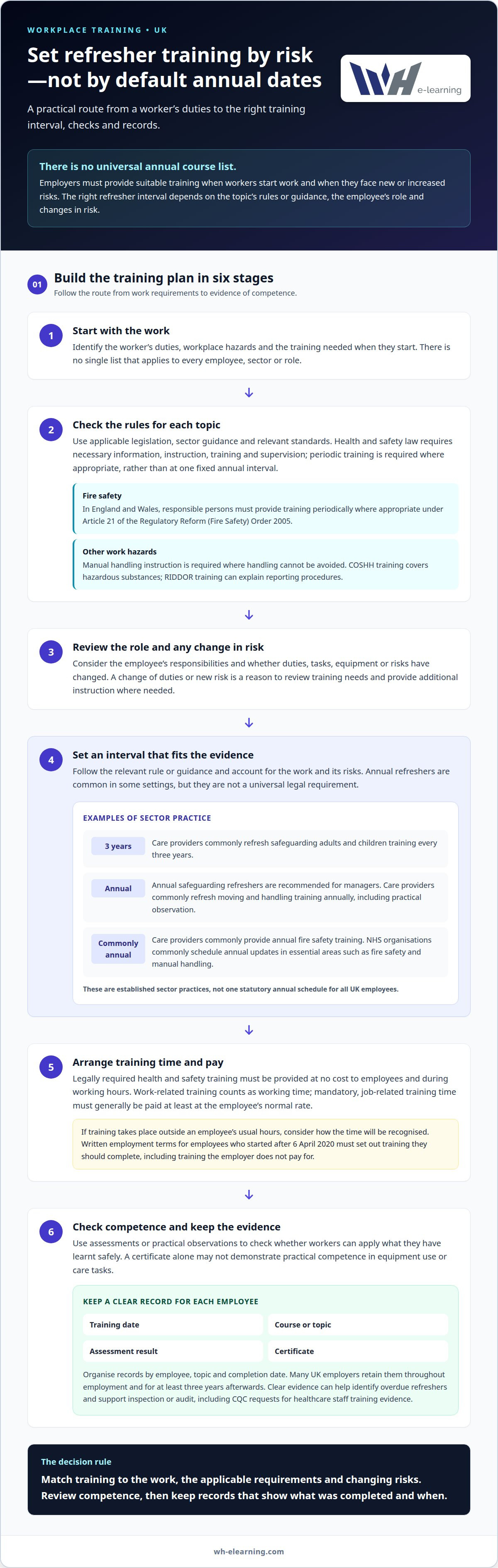
There’s no single annual refresher rule for every workplace. Employers must provide suitable training when workers start work and when they face new or increased risks.
It’s understandable to expect one yearly schedule, particularly when training records show annual renewal dates. But the appropriate interval depends on the rules or guidance for that topic, the employee’s role and any changes in risk.
This guide explains which training employers must provide, when annual refreshers are common practice rather than a universal legal requirement, and how training costs, pay and working time fit in. It also explains how sector-specific requirements can shape a compliant training plan.
Key Takeaways
- Set refresher intervals around the work, its risks and the rules for each training topic, rather than assuming every course needs a yearly renewal.
- Keep clear training records so you can track completion, identify learning needs and show how workers are prepared for their duties.
- Factor mandatory, job-related training into working time and pay, and understand how the circumstances of the training affect the arrangements.
- Use legislation, sector guidance and relevant standards to shape a training plan that fits your workplace and each employee’s role.
What is mandatory workplace training in the UK?
UK employers must provide training suited to workers’ duties and workplace risks, but there is no universal annual course list. Required topics and refresher intervals depend on the role, sector and applicable rules.
Training policies and record-keeping
A training policy records who needs training, when it is due and how competence is assessed. It helps employers show how they meet regulatory duties and address changing risks. Keep each employee’s training date, course, assessment result and certificate together. Many UK employers retain these records throughout employment and for at least three years afterwards.
Annual courses and workplace rules
Which workplace training courses must UK employees complete each year? There is no single annual list for every employee: required training depends on the job and its risks. In care, providers commonly refresh safeguarding adults and children training every three years, with annual refreshers recommended for managers. What annual safeguarding and equality training rules apply? Equality law requires reasonable adjustments for workers with disabilities or health conditions; it does not establish one universal annual equality course. From 30 October 2026, employers must take all reasonable steps to prevent sexual harassment.
Training records support supervision, not just paperwork. Managers can use assessments or practical observations to check whether workers can apply what they have learned safely. If someone changes duties or faces new risks, review their training needs and record any additional instruction. A certificate alone may not demonstrate practical competence in equipment use or care tasks.
What are the penalties for failing to provide required workplace training in the UK? Missing required training can contribute to a health and safety breach, for which the average court fine is £150,000. That figure is not an automatic penalty for every training gap; the consequences depend on the breach and its circumstances.
Keep records organised by employee, topic and completion date so they are ready for inspection or audit. The CQC may inspect healthcare staff training evidence and ask providers to demonstrate it. Clear records help show what has been completed, flag overdue refreshers and link training with supervision and competence checks.
Health and safety, fire safety, COSHH and RIDDOR training
The annual mandatory training requirements UK employers must meet depend on workplace hazards, duties and relevant legislation. There is no single yearly course list for every sector or role.
Health and safety training
Health and safety training prepares workers for the risks and tasks they encounter. Section 2 of the Health and Safety at Work etc. Act 1974 requires employers to provide necessary information, instruction, training and supervision. UK Government, legislation.gov.uk says training should be repeated periodically where appropriate and adapted to new or changed risks. In the NHS, annual updates commonly cover essential areas such as fire safety and manual handling.
Manual handling instruction is required where handling cannot be avoided under the Manual Handling Operations Regulations 1992. Regulation 13 of the Management of Health and Safety at Work Regulations 1999 requires periodic training where appropriate, but does not set one annual interval. Employers should consider changes to tasks, equipment and risks when reviewing refresher needs. This approach helps align annual mandatory training requirements UK organisations set with the work employees actually perform.
Sector-specific training requirements
Sector-specific training reflects the hazards and responsibilities workers face. Care providers commonly refresh moving and handling training annually, including practical observation, and provide annual fire safety training. NHS organisations also commonly schedule annual updates in essential areas. These are established sector practices, not one statutory annual schedule for all UK employees.
In England and Wales, Article 21 of the Regulatory Reform (Fire Safety) Order 2005 requires responsible persons to provide fire safety training periodically where appropriate. Fire marshal training should relate to workplace responsibilities and fire arrangements. COSHH training covers hazardous substances under the Control of Substances Hazardous to Health Regulations 2002. RIDDOR training can explain reporting procedures under the Reporting of Injuries, Diseases and Dangerous Occurrences Regulations 2013. In practice, annual mandatory training requirements UK workplaces follow should reflect applicable law and risk.
Mandatory training costs, pay and working time
Mandatory training involves more than course fees: employers must also consider attendance time, pay and working-hour limits. The rules differ between legally required health and safety training and other learning arranged for a role.
Employers must provide legally required health and safety training at no cost to employees and during working hours. This includes training needed to address workplace risks, such as safe handling instruction where manual handling cannot be avoided. Employers bear the cost, so employees should not have to pay for required safety training.
Work-related training counts as working time under the Working Time Regulations 1998 and forms part of weekly hours. Mandatory, job-related training time must generally be paid at least at the employee’s normal rate. Employers should consider how to recognise training that takes place outside an employee’s usual working hours. These arrangements matter when a course, induction or practical assessment falls outside a worker’s usual shift.
Written employment terms also matter. For employees who started after 6 April 2020, those terms must set out training they should complete, including training the employer does not pay for. Employers should make the arrangements clear, including whether relevant training time is paid or unpaid. A sector framework may also shape which courses staff need and how employers organise attendance.
How often is UK first aid training required or recommended? Emergency First Aid at Work and First Aid at Work certificates last 3 years. Annual first-aid refresher training is not mandatory, but UK Government guidance strongly recommends it to help qualified first aiders maintain skills and stay up to date.
Budgeting should account for course provision, paid attendance and any cover needed while employees train. For example, a fire safety course during a normal shift still takes working time, even if employees pay no separate fee. Plan around shift patterns and risk-based training needs, and make required learning accessible. Reasonable adjustments may also be needed so disabled workers can participate without substantial disadvantage.
Training requirements based on legislation, guidelines and standards
Legislation sets employers’ duties, while guidance and standards help organisations apply them to specific roles. The key distinction is whether a rule requires training, recommends it or sets a fixed refresher interval.
Legislation, guidelines and standards
These sources define required knowledge, competence and training arrangements for workers. Section 2 of the Health and Safety at Work etc. Act 1974 requires necessary health and safety information, instruction, training and supervision. In social care, Skills for Care guidance draws on legislation, standards and recommendations across different topics. Separating legal duties from recommended practice helps organisations plan training and present clear evidence.
Annual health and safety training
Is annual health and safety training legally required in the UK? No single law requires every worker to complete the same health and safety course each year. Regulation 13 of the Management of Health and Safety at Work Regulations 1999 requires periodic training where appropriate, without setting a universal annual interval. UK Government, legislation.gov.uk says training should be repeated when appropriate and adapted to new or changed risks.
Requirements across UK nations
Do annual training requirements differ across England, Scotland, Wales and Northern Ireland? Requirements can vary with the legislation and sector framework that applies. For example, the Regulatory Reform (Fire Safety) Order 2005 applies to England and Wales and requires fire safety training periodically where appropriate. Organisations should identify the rules relevant to their location and work, rather than treating one annual calendar as a UK-wide legal standard.
Training frequency by role and risk
How can employers determine the right training frequency for each role and risk? Match each role’s tasks to its hazards, then consider legal duties, guidance and changes to equipment or working conditions. The 1999 Regulations require periodic health and safety training where appropriate; higher-risk work may call for more frequent refreshers. UK Government guidance also strongly recommends annual first-aid refreshers to help qualified first aiders maintain skills.
For training shaped by workplace hazards and role-specific needs, explore Health and Safety Training Courses.
WH eLearning
WH eLearning helps organisations turn training needs into practical learning for their teams. Its online courses cover health and safety, HR and business compliance, while in-house face-to-face training offers another format for staff development. Multi-language course translation can help make learning accessible to employees who use different languages.
The library includes over 100 video-based courses, accessible on any device, with closed captions and machine translation into more than 25 languages. Organisations can use these options to support training plans shaped by job roles and workplace risks, alongside the relevant legislation and guidance.
If you’re planning workplace training or reviewing your team’s learning needs, contact WH eLearning to discuss your requirements.
Make training planning part of ongoing development
Turn training decisions into a practical plan that supports compliance and professional growth. Assign responsibility for keeping the plan current, and schedule regular reviews when roles, tasks or workplace risks change. This makes training easier to manage as part of everyday operations, rather than a last-minute response to an approaching renewal date.
Use your understanding of annual mandatory training requirements in the UK to guide decisions, then match learning to each role. WH eLearning offers certified health and safety management online and workplace safety online courses for relevant team learning.
If you're ready to shape your organisation's next training steps, contact WH eLearning about training. A clear plan can help your team build knowledge with purpose and keep developing with confidence.
The annual mandatory training requirements UK employers need to meet depend on the work and its risks: the Management of Health and Safety at Work Regulations 1999 require health and safety training to be repeated periodically where appropriate, rather than automatically every year, according to UK Government, legislation.gov.uk.
Frequently Asked Questions
Does “mandatory” always mean “legally required”?
No. “Mandatory” may mean that the law requires training, sector guidance recommends it, or an employer’s policy makes it a condition of a role. For example, an organisation may schedule annual data protection learning as internal policy, while legislation requires relevant staff to receive anti-money-laundering training regularly without setting an annual interval. State the basis clearly so workers can distinguish legal duties from organisational expectations.
Does manual handling training need to be renewed?
Refresh manual handling training when workers’ skills, tasks or risks make it necessary; annual renewal is not a universal legal rule. Guidance recommends refresher training at least every three years, or sooner if the work environment, equipment or tasks change. For example, introducing a different lifting aid may prompt a review before the existing refresher date.
What about agency workers, bank staff and temporary staff?
Agency, bank and temporary workers need suitable instruction and supervision for the risks they face at work. Include them in relevant induction and task-specific arrangements rather than assuming another organisation has covered every hazard. Agency and bank workers have no statutory right to request study time or paid time off to study. That does not remove the need to prepare them for their assigned work.
What are employers responsible for?
Employers are responsible for matching instruction to each worker’s duties, equipment and exposure to risk. They should provide clear information, suitable supervision and further training when tasks change or hazards increase. For example, a worker newly assigned to equipment needs instruction in its safe use. Employers must also consider reasonable adjustments so disabled workers are not placed at a substantial disadvantage during training.
Which UK laws require employers to provide annual staff training?
UK laws generally set topic-specific training duties, not one annual schedule for all staff. Act 1974 requires necessary safety instruction and training. Regulation 13 of the Management of Health and Safety at Work Regulations 1999 requires periodic training where appropriate. Fire safety rules in England and Wales also require periodic training where appropriate, rather than a universal annual course.
How should UK employers record and prove staff training compliance?
Keep organised records linking each worker to relevant courses, completion dates and assessment outcomes. Store certificates alongside them, and note practical competence checks where a task requires them. This gives managers a useful audit trail rather than a collection of certificates without context. Many UK employers retain training certificates throughout employment and for at least three years afterwards.


