

A fire evacuation plan only works when employees understand what to do. In Ireland, employers must provide fire safety information, instruction and training to all employees under the Safety, Health and Welfare at Work Act 2005 and the Fire Services Acts 1981 and 2003. Multilingual fire safety training in Ireland can help make that instruction accessible to staff who use different languages at work.
Clear training matters: employees need to recognise fire risks, understand emergency procedures and know how evacuation practice works. This guide explains what fire safety training covers, what Irish employers must provide and how to make learning meaningful across a multilingual team. A course’s value depends not just on language availability, but on whether staff can follow the information and relate it to workplace emergency arrangements. You’ll also learn what to look for in an accredited provider, including how translated course material and practical evacuation learning can support understanding. The result is a clearer basis for choosing a professional training solution that fits your workplace and helps staff respond with confidence.
Key Takeaways
- Understand the core topics fire safety training should cover, and what to consider when assessing certification and refresher learning.
- Learn how Irish employers can make safety instruction understandable and relevant to employees with different language needs.
- See how evacuation planning and practice help employees understand their roles in an emergency.
- Assess whether a multilingual provider’s accreditation, course delivery and translation approach fit your workplace.
What is Fire Safety Training?
Fire safety training helps employees recognise hazards, raise an alarm and follow workplace evacuation arrangements. Courses may cover fire prevention, alarm response, escape routes, assembly points and role-specific actions. For instance, staff need to know how to report smoke and which route leads from their work area to safety. Multilingual fire safety training in Ireland should make these instructions understandable to the people who need to follow them.
A course certificate records that a learner completed the specified training. It can support workplace training records, but it does not show on its own how someone will respond in an emergency. Employers should check that course content suits each learner’s role and the workplace’s procedures. Refresher learning can revisit key information when duties, premises or emergency arrangements change. The right timing depends on the course and workplace context, rather than a universal interval.
There isn’t one price for multilingual fire safety training in Ireland. The cost depends on factors such as delivery format, the number of learners and the language support required. Compare the scope of the course and translation included, rather than relying on the certificate alone.
Course duration and certificate details depend on the course. Check the topics covered, how learners complete the material and what the certificate records. A completion certificate should identify the training completed so employers can maintain useful records.
Online courses let learners access training without attending a classroom at a fixed time. Before enrolment, confirm that the learning platform works on the devices employees will use, such as a computer, tablet or smartphone. Captions and translated materials can help learners follow video-based lessons, but fire instructions must remain clear and consistent.
Safe Pass is a separate training requirement from workplace fire safety learning. A multilingual Safe Pass course may meet a different training need, but it does not replace site-specific fire instructions. Keep the purpose clear: learners need to understand the relevant course material and how it applies to their work.
Irish employer duties to provide understandable safety training
Irish employers must provide fire safety information, instruction and training to all employees. The relevant laws identified here are the Safety, Health and Welfare at Work Act 2005 and the Fire Services Acts 1981 and 2003. The 2005 Act also requires employers to give staff the training they need to work safely.
For employers, the practical question is whether each employee can understand the information and apply it at work. If an employee has limited English, language support can help make important instructions clear. For example, a worker should understand how to raise an alarm, leave the workplace and follow directions during an evacuation. Translated course content can support learning when it conveys the same essential safety information.
Training should relate to employees’ work and the workplace’s fire arrangements. An office employee and a worker in a busy production area may face different hazards and procedures. Make general fire safety learning more relevant by explaining site-specific arrangements alongside it. Clear language, familiar examples and an opportunity to ask questions help employees understand what action is expected.
Language access is one part of effective instruction. The format matters too: spoken explanations, written material, captions and translated content can support different learners. Consider whether employees can follow the course, recognise key instructions and relate them to their work. A certificate records course completion, but does not by itself show that an employee understands local arrangements.
Keep the legal framework and workplace practice connected. The 2005 Act addresses the training staff need for safe work, while the Fire Services Acts 1981 and 2003 are identified as relevant to workplace fire safety training. Employers should ensure employees receive suitable information and instruction, then communicate emergency procedures in terms they can understand. In a multilingual team, that means considering language needs when selecting course materials and explaining workplace-specific actions.
Workplace evacuation planning and practice
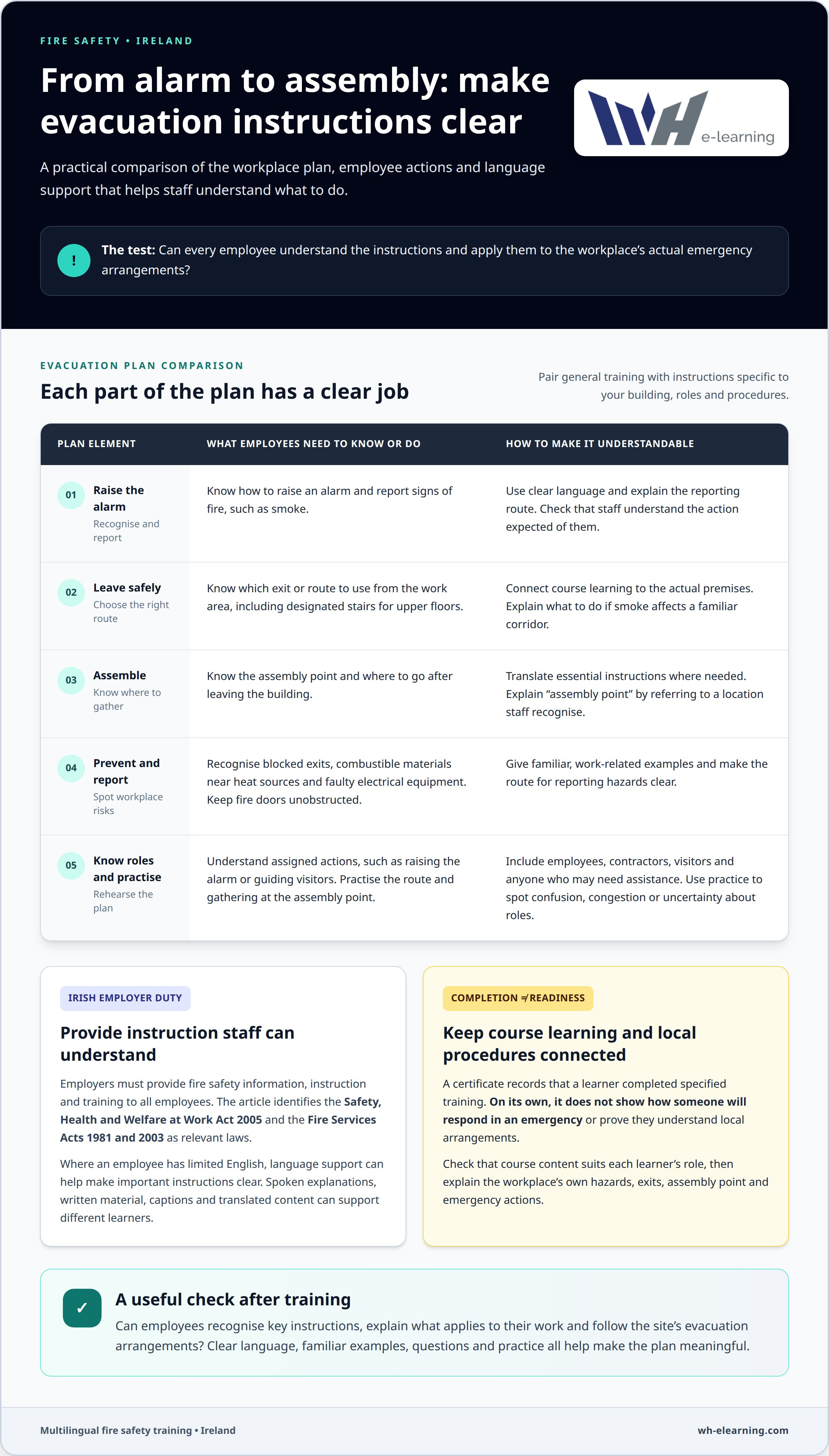
A workplace evacuation plan explains what employees should do when an alarm sounds. It should set out how to raise the alarm, which exits to use and where to assemble. For example, someone on an upper floor needs to know the designated stairs and assembly point. Clear instructions help employees leave safely without waiting for individual directions.
Prevention is part of the plan. Employees need to recognise hazards such as blocked exits, combustible materials near heat sources or faulty electrical equipment. A clear reporting route helps staff alert the responsible person to these risks. Training can also explain why fire doors must remain unobstructed and how to respond if smoke affects a familiar corridor.
Assigned responsibilities make evacuation procedures easier to follow. One designated person might raise the alarm while others guide visitors towards an exit. The plan should cover employees, contractors and visitors, including anyone who may need assistance. In a multilingual workplace, translate essential instructions and explain terms such as “assembly point” by referring to a location staff recognise.
Practice shows whether the written plan works in the actual building. Employees can rehearse responding to the alarm, choosing their route and gathering at the assembly point. Observers can note confusion, congestion at a doorway or uncertainty about who guides visitors. These observations help identify where instructions, signs or explanations of roles need attention.
After practice, discuss what happened and update the plan where needed. If employees used the wrong staircase, clarify the route and explain the change in languages they understand. Share revised instructions with staff whose roles or work areas are affected. A useful review links the alarm, exit route, assembly point and individual responsibilities in one clear procedure.
Choosing an accredited multilingual training provider
Irish workplace duties focus on suitable employee training, not a named trainer qualification. Choose a trainer with relevant fire safety expertise and experience explaining course material clearly to adult learners.
Start by matching accreditation to the specific course. The provider should identify the awarding or accrediting organisation, explain what the accreditation covers and describe how learners complete the course. A certificate may record participation or successful assessment, so understand what it represents. For example, a course with a knowledge assessment provides different evidence from attendance alone.
Next, assess how the provider handles translation. Course terminology needs to retain its safety meaning in every language. “Assembly point” should refer to the same designated location in every version, rather than a loosely translated alternative. Look for consistent terminology, translated captions or learning materials, and a clear process for updating translations when course content changes.
Assess the learning experience against the tasks employees need to perform. A useful course explains fire risks, alarm response and escape procedures in language learners can follow. It should also let learners revisit key topics and demonstrate understanding through an appropriate assessment. For instance, a translated quiz should test the same safety knowledge as its source-language version.
Practical access matters too. Confirm the course works on the devices employees use, such as mobile phones or workplace computers. Review whether captions, narration and written content support the languages and learning needs across the team. Then consider how completion records identify the course, learner and result. These details help employers connect training evidence with workplace records.
Choose a provider by considering accreditation, trainer competence, translation quality, assessment and accessible delivery together. A certificate alone cannot establish that every employee understands the material. Look for a course whose recognised learning standard and language support suit the work employees actually do.
WH eLearning: Health and Safety Training Courses
WH eLearning offers Health and Safety Training Courses for organisations building staff knowledge across workplace topics. Its video-based courses are accredited and accessible on any device, with closed captions and machine translation into more than 25 languages. This can help employers make learning more accessible for teams with different language needs.
WH eLearning offers Multi-language Course Translation for course content that needs language support, as well as In-House Face-to-Face Training for a classroom-based approach. The course library also includes HR and Business Compliance Courses, helping organisations address related workplace learning needs.
If you’re planning multilingual workplace training, contact WH eLearning to discuss your requirements.
Build a confident next step for your team
Make your next training decision part of a wider workplace learning plan. Consider which roles need additional health and safety knowledge, how employees learn best and how new learning will support existing procedures. A clear training pathway helps managers connect individual learning with the way their teams work.
For broader workplace development, WH eLearning offers online safety management courses, staff safety awareness programmes and comprehensive health and safety training options. These choices can complement multilingual fire safety training in Ireland, with a focus on learning relevant to employees and their responsibilities.
Take the next step by contacting WH eLearning about training. A thoughtful choice today can help your team continue building practical knowledge and confidence at work.
Frequently Asked Questions
What topics should workplace fire safety training in Ireland cover?
Training should help employees identify fire hazards, understand alarm signals and respond appropriately. Include workplace-specific examples, such as what to do if an alarm sounds during a delivery or while meeting a visitor. Explain how staff can report a hazard and where to find emergency instructions. Short scenario questions can help show whether learners know what action to take in different situations.
Is fire safety training in Ireland available in multiple languages?
Yes, multilingual fire safety training in Ireland can use translated learning materials and language support. Choose an option that helps employees understand the lesson, not simply one with a translated title. Check that key safety terms and assessment questions are clear in the learner’s language, and that employees can ask questions about instructions they may need to follow at work.
Which languages are commonly offered for fire safety training in Ireland?
The languages available can vary by course and provider. The right choice depends on the languages employees use and understand at work. Employers can identify those needs by consulting staff and considering differences across teams or shifts. Where employees use different languages, translated materials can support a consistent understanding of workplace procedures.
What are the best providers of multilingual fire safety training in Ireland?
The best fit is a provider whose course content suits your workplace and whose language support helps employees understand it. WH eLearning offers Health and Safety Training Courses and Multi-language Course Translation. Consider how translated content will suit your team’s learning needs and whether the training can complement the workplace’s own emergency arrangements. The course should serve employees’ actual roles, rather than provide a certificate alone.
Can fire safety training in Ireland be delivered online or on site in different languages?
Training is available online or face to face, with language support suited to the course and format. Online learning can suit employees working across locations or shifts, while an in-person session allows discussion about a particular workplace. For either format, align language support with the learning materials and make sure employees understand instructions relevant to their roles.
How often should employees in Ireland receive fire safety training and refresher training?
Plan refresher learning around workplace risk, changes to procedures and what employees need to remember for their roles. For example, a changed exit route or new alarm process calls for clear communication to affected staff. New starters also need relevant instruction before relying on existing knowledge. Review understanding after workplace changes or evacuation practice, then address any gaps through focused follow-up training.


