

A fall risk, not a job title, determines who needs working-at-height training in Ireland. Anyone whose work could involve a fall liable to cause injury needs appropriate training, and employers must ensure workers receive suitable instruction and information. Multilingual working-at-height training in Ireland can help make safety messages accessible to a workforce with different language needs.
It’s understandable to want a clear answer about who needs training and what it should cover. Hazards aren’t limited to obvious high places: a harmful fall can happen at, above or below ground level. Understanding the risks and suitable precautions helps employers plan work more safely and gives participants a clearer basis for carrying out their roles.
This article explains who needs training, common fall hazards, and the difference between restraint and fall arrest. It also outlines the language skills participants need to understand instructions and take part in training, helping you choose a suitable multilingual approach.
Key Takeaways
- Identify roles that involve a risk of an injury-causing fall, rather than relying on job titles alone.
- Recognise how fall hazards can arise in different work locations and why the right control depends on the risk.
- Understand how fall restraint differs from fall arrest, and what each approach is designed to do.
- Choose training that participants can understand, with language support suited to their ability to follow safety instructions.
Who Needs Working at Heights Training in Ireland?
In Ireland, anyone whose work could involve a fall liable to cause injury needs appropriate working-at-height training. The Safety, Health and Welfare at Work Act 2005 and Part 4 of the General Application Regulations 2007 frame employers’ duties to plan, supervise and arrange work with trained, competent people. This can include employees using a ladder, working on scaffolding or accessing a roof.
An online working-at-height course is listed as taking 1-2 hours. Online study suits learners who need to fit theory around work; classroom teaching offers trainer-led discussion, while practical training gives participants a chance to demonstrate equipment-related skills. A theory course alone does not replace practical instruction where the job calls for it.
Course content can cover ladder use, scaffolds, harnesses and fall prevention. Learners need to understand how hazards arise and how prevention differs from equipment used to arrest a fall. An assessment can check understanding of the course material, while practical assessment can examine safe harness inspection and fitting. The training approach should match the work participants actually perform.
Online delivery lets participants study course material on a device, rather than attending a classroom at a set time. Video-based lessons, closed captions and machine translation into more than 25 languages can support learners with different first languages. Clear language matters for understanding instructions about harnesses, ladders and fall risks; translated content should preserve essential safety meaning.
This training is relevant to employees and self-employed people whose tasks could expose them to a harmful fall. A maintenance worker using a ladder and a contractor working from scaffolding face different situations, but both need suitable instruction for their work. Online learning can cover theory and assessment; classroom and practical sessions can add trainer interaction or equipment demonstrations where needed.
Definition and hazards of working at height
In Ireland, work at height includes tasks at, above or below ground where a fall could injure someone. Managing the risk starts with recognising the work setting, access route and possible fall points.
Defining Work at Height
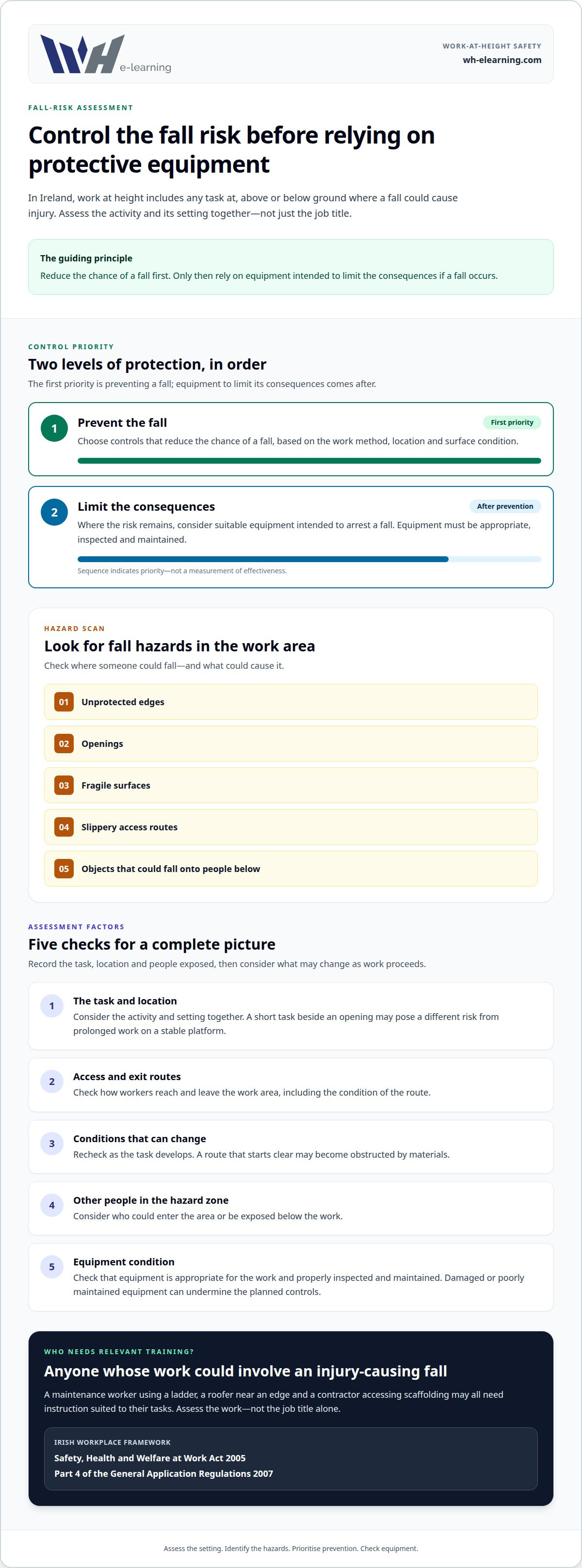
The definition concerns the possibility of an injury-causing fall, not a particular platform or job title. A task beside an open edge, above a work area or below ground can all fall within this scope. Assess the location and activity together: a short task near an opening may pose a different risk from prolonged work on a stable platform.
Identifying and Managing Fall Hazards
Hazard identification should consider where someone could fall and what could cause that fall. Examples include an unprotected edge, an opening, a fragile surface, a slippery access route or objects falling onto people below. Record the task, location and people exposed, then choose controls that address the actual risks rather than relying on general knowledge alone.
Risk management also considers how workers reach and leave the work area, what changes during the task, and whether others could enter the hazard zone. For example, a clear route at the start may become obstructed by materials. Ireland’s Safety, Health and Welfare at Work Act 2005 and Part 4 of the General Application Regulations 2007 are relevant to workplace safety and work-at-height training.
Controls should reduce the chance of a fall before relying on equipment to limit its consequences. The assessment needs to account for the work method, surface condition and suitable equipment. Employers must also ensure that equipment used for work at height is appropriately inspected and maintained. A damaged harness or poorly maintained access equipment can undermine the planned controls.
Clear training helps workers recognise changing hazards and communicate them promptly. Workplace safety training can build understanding of hazard identification and risk management alongside task-specific instruction.
Participant eligibility and English-language requirements
Select participants according to the work they do, not their job title alone. A maintenance worker using a ladder, a roofer near an edge and a contractor accessing scaffolding may all need relevant training. Employers can map each role to its tasks, work location and fall risks, then identify who needs the course. This also helps distinguish workers who need general awareness from those who require instruction for specific equipment or tasks.
English isn’t automatically the right training language for every participant. The key question is whether learners can understand the explanations, safety terms and assessment instructions in the course language. Someone who follows everyday English but struggles with technical terms, for example, may find a translated version easier to understand. Learners should be able to follow instructions and demonstrate understanding, not simply complete course screens.
For a mixed-language group, choose a shared course language only if every participant can follow it comfortably. Otherwise, select language options according to learners’ comprehension needs. Online courses can support independent study, while in-house face-to-face training gives a trainer the opportunity to explain terms in context. The right approach depends on the group’s language skills and the work being taught.
Organisations can account for language needs during enrolment. Record each participant’s preferred training language, then arrange access to the corresponding course version. Logging this choice alongside completion records can help supervisors see who has completed training and in which language. Keep those records aligned with work assignments, such as ladder use or scaffold access.
Before starting, participants need platform access and enough understanding of the selected language to work through the material and assessment. Closed captions can help learners follow spoken explanations, while translated content can make key ideas more accessible. For a group with different first languages, separate language versions may be more useful than expecting everyone to rely on English. Prioritise clear understanding of hazards, instructions and assessment questions.
Which providers offer multilingual working at height training in Ireland?
In Ireland, choose training that clearly explains its course language and delivery format. The right fit depends on whether participants need online theory, trainer-led teaching or practical equipment instruction. A distributed team may value flexible online access, while workers who need to demonstrate harness use require practical learning alongside theory.
Compare training by what the course actually covers. It should address hazards and controls relevant to working at height, including safe access, fall prevention and equipment used for the tasks. Check that examples suit the participants’ work, such as roof access, scaffold work or ladder use. General health and safety content alone may not cover these specific needs.
Language support needs to go beyond translated headings. Participants must be able to understand explanations, safety terms, assessment questions and instructions. Check how the learning experience makes these accessible, including through captions or translated course material. For a multilingual workforce, matching the training language to learners’ comprehension can make key concepts easier to follow and assessments easier to complete.
Delivery also matters. Online courses can suit learners who need to study separately, while in-house face-to-face training lets a group discuss work-specific situations. Practical instruction is a separate consideration: theory-based learning does not demonstrate that someone can inspect or fit a harness. Choose a format that reflects the tasks and skills participants need to learn.
Before selecting a course, identify participants’ roles, preferred learning languages and required practical skills. Then compare the provider’s course content, language support, assessment and delivery against those needs. This makes the decision more useful than choosing by format or language alone. To explore accessible multilingual training options, consider how each course can support your team’s health and safety learning.
WH eLearning: IOSH Working Safely Online
WH eLearning offers certified online safety modules for organisations building broader workplace safety awareness. It can complement task-specific working-at-height instruction, while Multi-language Course Translation helps make course content more accessible to learners with different first languages. The course library includes video-based learning, closed captions and machine translation into more than 25 languages.
Choose this route when your team needs accessible health and safety learning alongside role-specific training. WH eLearning also provides Health and Safety Training Courses and HR and Business Compliance Courses, supporting organisations with broader workplace learning needs. Course choice should reflect the work, what participants need to learn and the language they can follow comfortably.
For a suitable next step, contact WH eLearning to discuss your training needs.
Build language access into your next training decision
Build language accessibility into safety training plans from the start. As roles, teams and work assignments change, training choices can keep pace by considering what each group needs to understand and apply. A multilingual working-at-height training approach in Ireland can support this planning alongside task-specific instruction.
WH eLearning offers IOSH Working Safely Online, IOSH Managing Safely Online and Health and Safety Training Courses. These options can support broader workplace learning alongside training selected for particular tasks. The right combination depends on your organisation’s learning priorities and the roles being supported.
For a practical next step, identify the learning your team needs and the languages that will make it accessible. Then contact WH eLearning about training to discuss the options. A considered plan can help your team move forward with greater clarity and confidence.
Frequently Asked Questions
What does working at height training cover in Ireland?
Working-at-height training covers recognising fall risks and understanding suitable precautions for the task. Course examples can include access equipment, work areas and the consequences of a fall. Look for learning that helps participants apply safety principles to their roles, such as maintenance or construction work, rather than relying only on general awareness. An assessment can check understanding of the material, but practical skills need practical instruction.
Which Irish regulations require working at height training?
Ireland’s Safety, Health and Welfare at Work Act 2005 and Part 4 of the General Application Regulations 2007 are the relevant legal framework for working-at-height safety and training. Employers must ensure the work is planned, supervised and carried out by trained, competent people. For example, planning should take account of the actual task and the competence needed to carry it out safely.
What qualifications or certifications are offered for working at height in Ireland?
Certification depends on the training course and its assessment. A course certificate records completion, but it doesn’t by itself demonstrate every practical skill. Someone expected to use a harness, for example, may need practical instruction and assessment as well as theory. Employers should match evidence of learning to the worker’s duties, equipment and site requirements, rather than treating every certificate as proof of competence for every task.
Which languages are available for working at height training in Ireland?
Language options depend on the course’s translation provision. WH eLearning courses can use machine translation into multiple languages, and closed captions are included across its courses. Specific translated language names aren’t provided here, so the practical consideration is whether participants can follow the course explanations and assessment wording in their chosen version. For example, captions may help someone follow spoken course material more easily.
How much does working at height training cost in Ireland?
The price applies to the listed online course, not to every possible training format or a separate practical session. Before choosing, consider what learners need: theory, practical equipment instruction or both. Those requirements affect which training is suitable, so compare the course content with the tasks participants will perform.
How long does working at height training take, and how is it delivered?
An online working-at-height course is listed as taking 1-2 hours. Online study gives learners a self-paced way to complete theory and assessment, while classroom delivery supports trainer-led discussion. Practical training adds equipment-based learning where relevant to the role. For instance, a worker who needs to handle a harness may require practical instruction alongside online theory, rather than relying on a self-paced course alone.


