

A security awareness programme is only useful when it prepares people for decisions they face at work. Cyber security awareness for employees should help staff recognise phishing and social engineering, handle information carefully, and know how to report suspicious activity. It’s about building practical habits, not simply completing a course.
It’s understandable to focus on technical safeguards, but employees also need clear guidance they can use in everyday situations. This article explains what cyber security awareness training covers, how it can address human risks and social engineering, and how to make a programme relevant to your organisation.
You’ll also learn how to tailor training to employees’ roles, reinforce it over time and connect awareness with the security measures already in place. The aim is to help people pause, spot warning signs and respond appropriately.
Key Takeaways
- Help staff recognise suspicious messages and unusual requests, and give them a clear way to report concerns.
- Make training practical and relevant to employees’ roles so they can apply safer habits in everyday work.
- Use lessons from incidents and changing threats to keep the programme useful, rather than treating training as a one-off task.
- Build a supportive security culture where people can raise concerns promptly and learn from mistakes.
How do cybersecurity awareness programmes address social engineering threats?
Training in cyber security awareness for employees helps people recognise deceptive requests before they lead to compromised accounts, data breaches or disrupted work. It works best alongside technical safeguards and clear steps for reporting suspicious activity.
Phishing and social engineering risks
Phishing is a deceptive message designed to prompt an unsafe action. Social engineering manipulates people into sharing information or granting access. Both exploit trust, urgency or routine, so susceptibility isn’t simply a matter of technical knowledge.
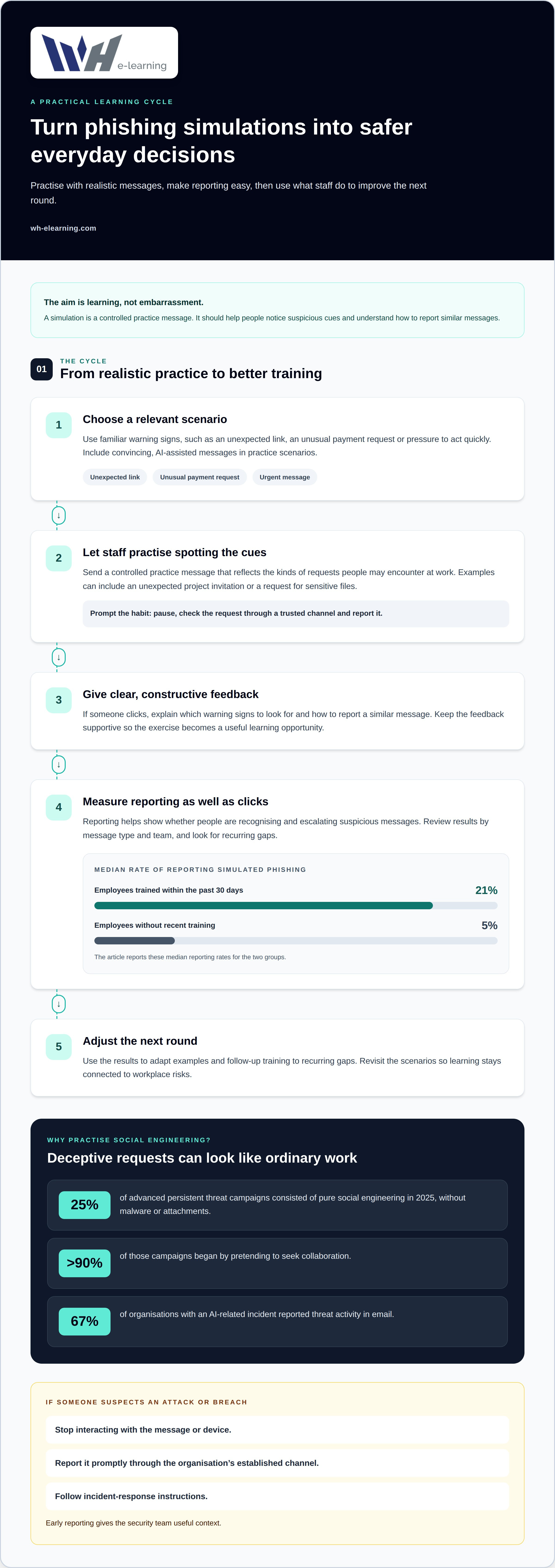
In 2025, 25% of advanced persistent threat campaigns consisted of pure social engineering, without malware or attachments. Over 90% of these campaigns began by pretending to seek collaboration. Training can use examples such as an unexpected project invitation or a senior colleague requesting sensitive files. Staff learn to pause, check the request through a trusted channel and report it. This makes cyber security awareness for employees relevant to everyday decisions, not just technical teams.
Types of cyberattack
Cyberattacks use different methods to disrupt services, steal information or gain unauthorised access. Malware is harmful software; ransomware is malware that locks or encrypts data and demands payment. Phishing tricks people into revealing information or opening unsafe content.
A distributed denial-of-service (DDoS) attack overwhelms an online service with traffic, making it difficult to use. Identity-based attacks misuse stolen credentials or impersonate trusted users. Training helps employees connect warning signs with practical actions, such as avoiding unexpected downloads, protecting sign-in details and reporting unusual access requests. These habits matter across work accounts and devices.
Phishing simulations
Phishing simulations send controlled practice messages so employees can learn to recognise suspicious cues in realistic examples. They can highlight patterns such as unexpected links, unusual payment requests or messages that pressure recipients to act quickly.
A useful programme treats a simulation as a learning opportunity, not a test designed to shame staff. If someone clicks, clear feedback can explain the warning signs and show how to report similar messages. Employees trained within the past 30 days reported simulated phishing at a median rate of 21%, compared with 5% among employees without recent training.
Measure effectiveness through reporting as well as clicks: a higher reporting rate can show that people are recognising and escalating suspicious messages. Review results by message type and team, then adjust examples and follow-up training to address recurring gaps. Since 67% of organisations with an AI-related incident reported threat activity in email, include convincing, AI-assisted messages in practice scenarios. Regularly revisiting cyber security awareness for employees helps keep that learning connected to current workplace risks.
What is cyber security awareness training?
Awareness training gives employees practical guidance for handling digital risks, from passwords to sensitive information. A useful programme plans learning, delivers it in relevant formats and measures how well people apply it.
There’s no single training platform that suits every business. Compare options based on course relevance, accessibility, reporting tools and how easily the content can be adapted to employees’ roles.
Costs for US businesses depend on factors such as workforce size, course scope and delivery method. Define the programme’s needs first, then compare options against those requirements.
Onboarding and refresher training
Onboarding introduces security expectations when someone joins, while annual refresher training revisits key practices. Together, they help make essential actions clear to everyone, including staff who work remotely.
Cover practical examples: creating a strong password, protecting sensitive files and reporting an unexpected sign-in prompt. Tailor guidance to each role, since employees handling customer records face different tasks from colleagues managing suppliers. For remote teams, include safe use of home networks and work devices. A clear, repeatable format makes the same core guidance accessible across locations.
Simulations and gamified learning
Simulations let employees practise responding to realistic cyberattack scenarios, while gamified learning uses challenges or progress markers to encourage participation. Both can turn abstract risks into familiar decisions.
For example, a simulated suspicious email can prompt learners to identify warning signs and choose how to report it. A short quiz can reinforce password habits or safe file sharing. Measure completion, reporting and recurring mistakes, then revise scenarios to address weak spots. The aim is learning, not embarrassment: explain what the exercise demonstrates and how to respond next time.
Effective delivery combines concise online lessons, role-based examples and face-to-face discussion where teams benefit from it. Remote employees need the same clear guidance, adapted to the devices and tools they use.
If someone suspects an attack or breach, they should stop interacting with the message or device, report it promptly through the organisation’s established channel and follow incident-response instructions. Early reporting gives the security team useful context.
Broader workplace learning can also include HR and business compliance training, helping connect security habits with everyday responsibilities.
Human factors in data breaches
People can expose an organisation’s data through mistakes, compromised accounts or deliberate misuse. An awareness training programme helps staff spot risky situations and follow safer data-handling practices.
Human contributions to breaches
Human factors include actions or oversights that give attackers a route to information, such as approving a fraudulent payment or sharing credentials. Social engineering exploits trust and routine, while an insider may misuse legitimate access deliberately or accidentally.
The FBI Internet Crime Complaint Center reported 24,768 business email compromise incidents in 2025. For an organisation, a convincing supplier email can trigger a payment or expose customer records. Cybersecurity training should show employees how to verify unusual requests and report concerns promptly.
Financial and reputational impacts
A data breach can disrupt operations, require investigation and recovery, and damage relationships with customers or suppliers. The impact depends on what information was exposed, how systems were affected and how quickly the organisation responds.
For example, customers who learn their personal details were exposed may question whether the organisation can protect them. Clear internal reporting helps teams assess the incident and communicate accurately. A prepared response also helps limit confusion, avoid unsupported claims and focus resources on restoring affected services.
Privacy and regulatory compliance
Data privacy means handling personal information carefully, while regulatory compliance means following the requirements that apply to the organisation. Staff need to understand what information is sensitive and which work tasks involve it.
For example, send a customer file only to an authorised recipient using an approved process. Training should explain how to recognise misdirected messages, avoid unnecessary sharing and escalate suspected exposure. Clear procedures help employees handle personal data consistently and support the organisation’s wider compliance work.
Protecting corporate and customer data
Protecting data combines secure handling with appropriate access controls. Employees should use only the information needed for their role, store files in approved locations and avoid sharing passwords or access details.
Unusual activity can include an unexpected request to download a large customer file or access records unrelated to someone’s duties. Employees should report these anomalies through the organisation’s established channel rather than investigating independently. This gives security teams a timely opportunity to assess activity and protect corporate and customer information.
Building a security awareness programme
A useful programme connects learning to the risks, roles and reporting processes employees encounter. Build it as a cycle: identify priorities, deliver relevant guidance, measure behaviour and revise the content.
Start by mapping likely risks to everyday tasks. For example, finance staff may receive payment-change requests, while remote employees may access corporate systems from home. Set clear learning objectives for each group, such as protecting account credentials, handling sensitive files and reporting suspected compromise. The NIST Cybersecurity Framework can guide and evaluate the people, processes and technology behind a programme.
Choose learning formats that suit the message. Short lessons can make one topic easier to absorb; microlearning lessons can be completed in 5-10 minutes. A team discussion can explore how to report suspected malware, whilst a practical scenario can test whether staff recognise a suspicious request. The FTC’s ten-step approach is also identified as a way to formulate cybersecurity guidelines.
Make reporting part of the programme, not an afterthought. Employees need to know which internal channel to use, what details to include and what to do while awaiting instructions. For example, a report about an unexpected attachment should include the message and say whether it was opened. Remote staff need the same reporting route as office-based colleagues.
Measure more than course completion. Review whether employees report suspicious activity, follow procedures and understand role-specific risks. Combine these indicators with incident trends and feedback to spot gaps. If staff struggle to identify a supplier impersonation attempt, revise the example and reinforce the verification process.
Schedule regular reviews after incidents, changes to work practices or new threats. NIST Special Publication 800-53 and the CIS Critical Security Controls include security awareness training as a component. Use them as reference points alongside organisational priorities, then update learning materials and guidance so employees receive consistent, relevant information.
WH eLearning
WH eLearning can support broader workplace learning that reinforces clear responsibilities and consistent procedures. Its HR and Business Compliance Courses can complement a security awareness programme, while In-House Face-to-Face Training provides an opportunity for direct discussion. Multi-language Course Translation can help make course content accessible to staff who learn in different languages.
These options suit organisations developing a broader learning plan alongside their own cybersecurity policies and reporting processes. They don’t replace specialist cybersecurity measures, but can help strengthen related workplace knowledge and support a more consistent approach to training.
To discuss workplace training options, contact WH eLearning.
Keep workplace learning moving forward
Make security awareness part of a wider commitment to learning, rather than a task that ends when a course is complete. A programme for cyber security awareness for employees works alongside clear internal policies and reporting routes. Broader workplace training can reinforce the responsibilities people apply each day.
For related professional development, WH eLearning offers online safety management, workplace safety certificates and general health and safety training courses. These support learning in workplace safety and responsibilities, complementing the security guidance your organisation develops for its own systems and risks.
Choose the next learning step that fits your team’s needs and build from there. Contact WH eLearning about training to explore suitable options.
Frequently Asked Questions
How can cybersecurity training help prevent phishing attacks?
Cybersecurity training helps reduce phishing risk by giving staff repeatable checks to use before acting. For example, inspect the full sender address, confirm unexpected payment changes through a known phone number and report suspicious messages using the organisation’s designated route. Teach staff not to open attachments simply because a message appears in an existing email thread. Attackers can exploit trust in familiar conversations.
How can organisations build a cyber-aware, compliant workforce?
Build a workforce that follows applicable requirements by connecting each role’s data-handling duties with plain-language policies and practical learning. Customer-service staff, for example, can practise storing identity documents correctly, while managers review approval responsibilities. Keep training completion and policy acknowledgements in an organised record, then address gaps with targeted follow-up. Clear ownership helps turn written rules into consistent workplace behaviour.
How can organisations keep training content up-to-date with new and emerging cyber threats?
Keep content current by reviewing incident reports, changes in tools and credible threat advisories, then updating scenarios employees actually encounter. If a new collaboration app becomes part of daily work, add guidance on file sharing and unexpected access requests. Remove outdated screenshots and examples, explain what changed, and brief managers so they can give consistent answers across departments.
How does culture support cybersecurity?
A supportive culture makes secure behaviour part of normal work, rather than an extra task people fear getting wrong. Leaders can model careful information handling and use the same reporting process expected of staff. Respond constructively to reports, including near misses, so employees feel able to speak up early. Recognising thoughtful decisions helps teams treat security as a shared responsibility.
What are best practices for making cybersecurity training effective?
Make training relevant to real tasks, accessible to the workforce and easy to apply immediately. Use short scenarios based on the tools and information each team handles, followed by a clear action learners can practise. Ask employees which instructions feel unclear, then improve the material. Managers can reinforce learning in team discussions, helping turn course concepts into everyday routines.
What are the most common types of cyber threats employees should know about?
Employees should recognise phishing and other social engineering, malware, ransomware, distributed denial-of-service attacks and identity-based attacks. These can take different forms: a fake login page, an infected download, a system locked for ransom, disrupted online services or misuse of stolen credentials. Knowing these categories helps staff describe concerns clearly and choose the right internal reporting route.


