

What if the training gap on your production line isn’t a training gap at all? A missed quality target or safety concern may point to a skills need, but it could also reflect unclear procedures, faulty equipment or pressure on a shift. Creating a training needs analysis for manufacturing starts by separating these causes, then identifying which roles need what support and why.
Broad course assignments can take up time without addressing the problem behind them. It can also be difficult to consult employees across shifts, and a performance issue may be mistaken for a lack of training when the real cause is a process or equipment problem.
This guide explains how to identify and prioritise genuine knowledge and skills gaps, connect them to safety, quality and operational objectives, and turn findings into a practical training plan. You’ll learn how to gather evidence, involve employees across shifts, rule out non-training causes and assess whether learning is making a difference. The result is a clearer basis for deciding who needs training, what it should cover and how to evaluate its impact.
Key Takeaways
- Start with the tasks and capabilities each role requires, rather than assigning the same training across the workforce.
- Use evidence from relevant teams and shifts to identify where performance gaps occur and validate what’s causing them.
- Separate skills needs from issues such as unclear instructions, equipment availability or workload before choosing a response.
- When creating a training needs analysis for manufacturing, prioritise gaps by risk, operational impact, affected roles and urgency.
- Turn findings into an action plan, then evaluate learning alongside evidence of workplace performance.
Why creating a training needs analysis for manufacturing starts with the work
A useful training needs analysis (TNA) begins with the work people are expected to do, not with a list of available courses. Compare the capability required for each role with current knowledge, skills and demonstrated behaviour, then consider which gaps matter to business priorities. This keeps learning focused on a real need instead of making training the default response to every performance concern.
A manufacturing training needs analysis compares role requirements with current capability and business priorities to identify learning that can improve work performance.
Use actual role profiles and task requirements as your reference point. A production operator, a maintenance technician and a shift supervisor may all work around the same equipment, but their responsibilities differ. One may need to follow an operating sequence, another to diagnose equipment faults, and another to allocate work and respond to issues. A shared course may support common knowledge, but it won’t necessarily address these distinct needs.
Connect possible learning priorities to outcomes such as safer work, consistent quality, less avoidable downtime or changes in the workforce. New equipment, revised processes and the loss of experienced workers can all prompt a fresh look at capability. A missed target, however, doesn’t prove that employees need training. The cause could be unclear instructions, equipment problems or competing production demands. Identify what learning can reasonably change before choosing a response.
What does a manufacturing training needs analysis identify?
It identifies the difference between what a role requires and what a person or team can currently demonstrate. Use task-based expectations to assess knowledge, practical skills and behaviours, rather than relying on job titles or assumptions. A training need exists when there’s a meaningful gap that instruction, practice or guidance could address. If the obstacle is outside the learner’s control, training alone is unlikely to resolve it.
Why shop-floor needs differ from office-based training needs
Production work takes place across shifts, roles and changing equipment, often under pressure to keep operations moving. That affects how people can be consulted, observed and supported to learn. Don’t assume everyone has the same language, literacy or accessibility needs. Make learning materials and consultation accessible to the workforce. Broader principles are covered in this occupational safety and health training course guide.
For a fair picture, gather input from workers and supervisors who represent the relevant shifts and tasks. A day-shift view may not capture a handover issue or different operating conditions overnight. Ask employees what makes a task difficult, observe work where appropriate, and compare feedback with role expectations and available performance evidence. This grounds the analysis in the job as it’s actually done and helps distinguish a capability gap from a problem in the way work is organised.
That distinction is the foundation for the next steps: gathering evidence, validating the cause and deciding which needs deserve priority.
How to conduct a manufacturing training needs analysis step by step
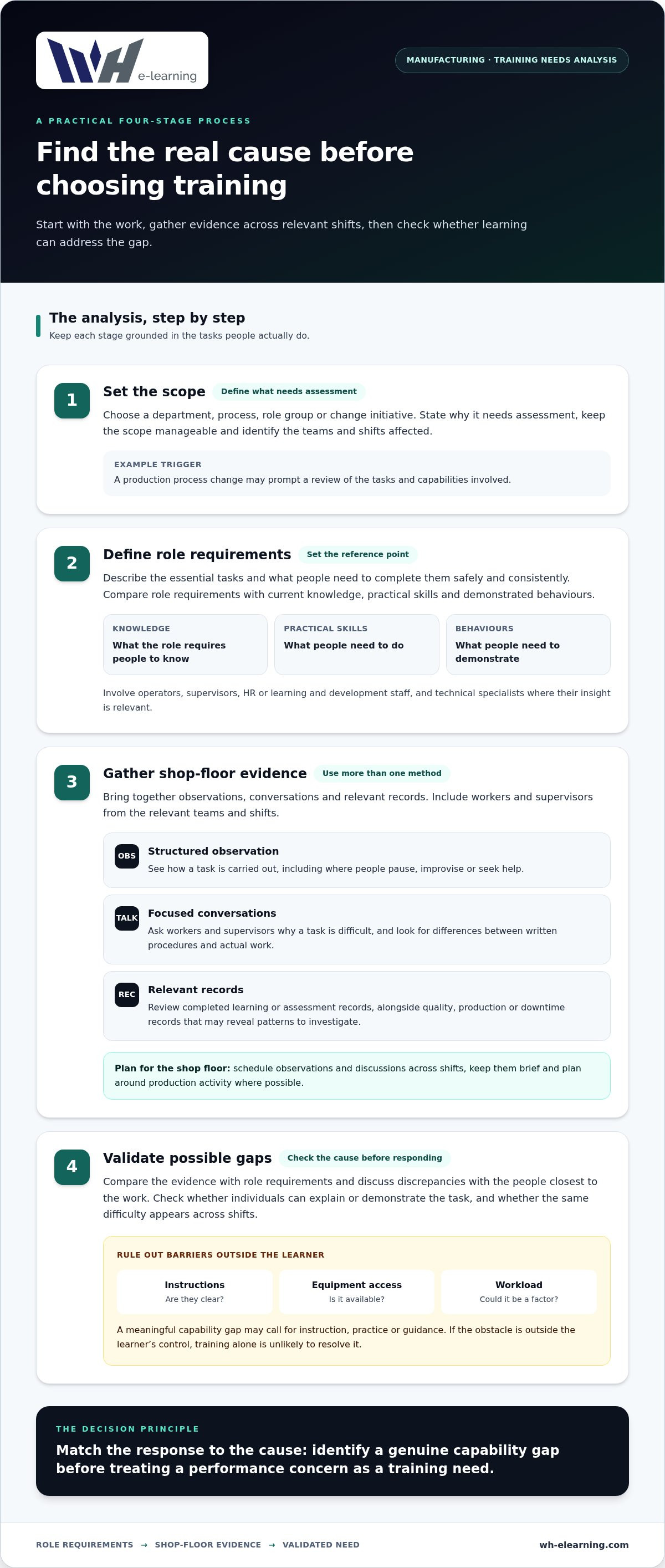
A clear process makes the analysis easier to manage and keeps it grounded in day-to-day work. Start with a defined question, collect evidence from the people doing the work, then check that any proposed learning addresses a genuine capability gap. Include workers and supervisors from relevant shifts so the findings don’t reflect just one team’s experience.
A reliable manufacturing training needs analysis combines clear role expectations with evidence gathered from work across relevant teams and shifts.
- Set the scope. Choose a department, process, role group or change initiative, and state why it needs assessment. For example, a production process change may prompt a review of the tasks and capabilities involved. Keep the scope manageable and identify which teams and shifts are affected.
- Define role requirements. Describe the essential tasks and the knowledge, practical skills and behaviours needed to complete them safely and consistently. Involve operators, supervisors, HR or learning and development staff, and technical specialists where their insight is relevant. This step-by-step manufacturing training needs analysis can also help structure the process around business goals and skills evidence.
- Gather shop-floor evidence. Use more than one method. Structured observation can show how a task is carried out in practice, including where people pause, improvise or seek help. Focused conversations with workers and supervisors can explain why a task is difficult and reveal differences between written procedures and actual work. Skills records show what learning or assessments have been completed, while relevant quality, production or downtime records can help identify patterns to investigate. Schedule observations and discussions across shifts, keeping them brief and planning around production activity where possible.
- Validate possible gaps. Compare the evidence with the role requirements, then discuss discrepancies with the people closest to the work. Ask whether individuals can explain or demonstrate the task, and whether the same difficulty appears across different shifts. Before deciding on training, check whether instructions, equipment access, workload or other working conditions could account for the issue. A practical risk assessment for line managers is a related safety process, but it doesn’t replace a capability assessment.
- Record the findings. Capture the role or task, expected capability, evidence observed, people or shifts affected, and any unresolved questions. Note whether learning appears appropriate or whether another response needs investigating. This gives decision-makers a clear basis for comparing needs and setting priorities.
For a broader view of possible learning formats once needs are established, explore workplace learning courses and training options.
How to distinguish a training gap from a manufacturing process problem
A performance issue is a signal to investigate, not proof that employees need training. When creating a training needs analysis for manufacturing, compare what people are expected to do with what happens in practice, then test different explanations before choosing a response. The same symptom, such as a missed quality check, could point to a knowledge gap, an unclear instruction or a process that makes the correct action difficult.
Use a diagnostic table to organise the investigation. Treat each possible cause as a question to check, rather than a conclusion:
| Observed issue | Possible cause | Evidence to gather | Suitable response |
|---|---|---|---|
| A step is missed during a task | Unclear or hard-to-follow instructions | Compare the work instruction with observed practice; ask workers where they become unsure | Clarify the procedure; provide learning if employees also lack the relevant knowledge |
| Work is delayed while a task is completed | Equipment or tools are unavailable | Check access, availability and timing across affected shifts | Address access or equipment arrangements before assigning training |
| Errors occur during busy periods | Workload, staffing or competing priorities | Compare when issues happen with work patterns and ask employees about constraints | Review work planning and supervision; consider learning only if a capability gap remains |
| A fault recurs despite correct task steps | Maintenance or equipment condition | Review fault and maintenance records; observe the equipment in use | Investigate and resolve the equipment issue |
| The same task is performed inconsistently | A knowledge or practical skill gap | Compare observed performance with the agreed requirement and discuss the task with workers and supervisors | Provide focused instruction, practice or coaching that addresses the specific gap |
What evidence points to a genuine skills or knowledge gap?
Look for a recurring difference between an agreed role requirement or work instruction and demonstrated performance. For example, if a worker follows the available procedure but can’t explain a key step or carry it out consistently, a learning need may exist. Check whether the issue relates to a specific skill or knowledge requirement, and validate the pattern with employees and supervisors before assigning learning. A single mistake isn’t enough to establish a workforce-wide need.
When should the response be something other than training?
Check procedures, tooling, maintenance, staffing, supervision and access to information. If workers understand the task but can’t complete it because a tool is missing or an instruction is ambiguous, address that barrier first. Immediate operational controls may be needed to manage the issue, while longer-term learning can build capability where evidence supports it. These actions can sit alongside each other, but they solve different problems.
Be cautious when interpreting KPI changes. If a measure improves after training, that timing alone doesn’t prove training caused the improvement; other changes may have contributed. Compare task-performance evidence with the original gap, and consider what else changed. For a deeper approach to investigating causes, use root cause investigation strategies for operational teams.
How to prioritise manufacturing training needs and build an action plan
Once you’ve validated the needs, decide what must happen first and what can be planned for a later phase. A transparent approach helps managers explain why one gap takes priority, while keeping the plan realistic for staffing, shift coverage and production demands. When creating a training needs analysis for manufacturing, assess each need against the same criteria rather than relying on the loudest request or the easiest course to arrange.
Choose priorities without overwhelming production teams
Assess each validated gap against its potential risk, operational impact, urgency and the number of roles or shifts affected. Record the reasoning so priorities remain clear and can be reviewed if circumstances change. A high-impact need may require prompt action, while broader development can be scheduled in stages to avoid overloading teams or disrupting essential work.
Group employees for learning only when their required capabilities and intended outcomes genuinely align. Two roles may use the same equipment but have different responsibilities, so a shared session may not meet both needs. Before setting dates, consider how to release people from tasks, cover shifts and provide equivalent access for employees who aren’t on site at the same time.
For each priority, build a short action-plan entry that captures:
- The gap and evidence: what capability is needed and what showed it’s missing.
- The target group: which roles, teams or shifts are affected.
- The response and owner: the proposed learning or other action, and who is responsible for arranging it.
- Timing and completion evidence: when it will take place and how completion will be recorded.
- Measures: how learning and workplace application will be assessed.
This makes the plan manageable, not just comprehensive. It also separates essential learning from useful development that can be revisited later, once priority needs and operational capacity are clearer.
Turn assessment findings into measurable learning objectives
Write objectives around something a learner can explain, demonstrate or apply at work. For example, an objective might be to describe the required steps in a task or demonstrate a defined procedure against agreed criteria. Match the assessment to the capability: a knowledge check can test understanding, while observation or practical demonstration can show whether a task can be carried out.
Set a baseline and choose indicators that relate directly to the identified need. Track learning completion where relevant, but don’t treat it as proof of competence. Workplace measures might include observed task performance or a relevant quality trend, provided the indicator is meaningful for that gap. Review results over time and consider other operational changes before attributing improvement to training alone.
For wider course-planning context, the workplace safety training courses guide can help frame learning choices. Health and safety training courses can form part of a plan when your analysis identifies a relevant learning need.
How to deliver and evaluate manufacturing training after the analysis
The training plan should guide both delivery and evaluation. Match the format to the capability people need to develop, the workforce taking part and the practical conditions around their work. A knowledge requirement may suit online learning, while a task that depends on hands-on practice may need demonstration and guided application. Consider shift patterns too, so each group can access learning without assuming everyone can attend at the same time.
Select a delivery approach that fits the workforce
Video-based online learning can deliver knowledge across devices, allowing employees to learn in a format that fits their circumstances. Closed captions and machine translation into more than 25 languages can support access across a varied workforce. For practical or role-specific learning, specialist-led in-house face-to-face sessions may be more suitable. Some plans may combine approaches, using digital learning to build understanding and in-person practice to support application.
Choose the method only after defining the learning objective. A course can support relevant knowledge, but it shouldn’t substitute for practical instruction where employees need to demonstrate a task. Equally, an in-person session may not be the most efficient option for every shared knowledge need. Keep delivery proportionate to the gap, and plan how workers on different shifts will receive equivalent opportunities to participate.
Review whether learning addressed the identified need
Return to the objectives set in the action plan. Check participation and assessment results, then gather workplace evidence showing whether employees can apply what they’ve learnt. Depending on the objective, this could include supervisor feedback, an observed task or a relevant work record. Use the same criteria that defined the gap, so evaluation tests the intended capability rather than relying on a general impression.
Completion records help show who has taken assigned learning. WH eLearning’s corporate licences include employee progress and compliance tracking, which can support oversight of that activity. However, a completed course or passed knowledge check doesn’t by itself establish practical competence. Pair learning records with a suitable assessment or workplace observation, and give employees a chance to explain what is helping or hindering application.
Review the findings after delivery. If learners complete the training but the original difficulty remains, consider whether the content, method or workplace conditions need attention. If performance improves, avoid assuming training alone caused the change; compare the result with the original objective and note other relevant changes. This turns evaluation into a useful next step, not just a record-keeping exercise.
Creating a training needs analysis for manufacturing is most effective when the learning response and its evaluation stay connected to the identified gap. To explore learning options that may support your plan, view WH eLearning’s workplace training options.
Make your next training decision evidence-led
Use your analysis as a working tool, not a document that sits untouched once a course has been assigned. Set a date to review whether the learning is being applied, listen to the people doing the work and update priorities as roles or processes change. Regular reviews help keep development relevant without adding training that doesn’t address a real need.
Start small: choose one priority capability, agree what successful application looks like and decide how you’ll observe it. This gives your team a practical way to test the approach before extending it to other roles. Creating a training needs analysis for manufacturing is an ongoing investment in a workforce that can meet changing operational needs.
When you’re ready to match an identified learning need with a suitable option, explore practical workplace training options with WH eLearning. WH eLearning offers more than 100 online workplace courses, giving you options to consider once your analysis has clarified what your team needs to learn.
Frequently Asked Questions
What is a training needs analysis in manufacturing?
A manufacturing training needs analysis is a structured way to identify where employees’ current capabilities differ from what their roles require, and whether learning can address that difference. It can focus on a particular process, team or change, rather than treating the whole workforce as having the same needs. The findings help managers decide which learning actions are relevant, which issues need another response and how progress will be checked.
How do you conduct a training needs analysis for manufacturing employees?
Start with a defined workforce or task, then gather evidence against the capabilities needed to do that work. For example, compare a skills record with an observed task and ask employees what makes it difficult. Include people who understand both the job and its requirements, such as workers, supervisors and technical specialists. Record what the evidence supports, what still needs investigation and who will make the next decision.
What information should a manufacturing skills matrix include?
A useful skills matrix links people or role groups to specific tasks and the capability level each task requires. Include a clear proficiency scale, the date and source of each assessment, and any relevant learning or assessment completed. For instance, distinguish between someone who has attended instruction and someone whose task performance has been observed. Keep entries current, and restrict access to personal information to those who need it for workforce planning.
How can manufacturers assess training needs across different shifts?
Plan evidence gathering so each shift has a fair chance to contribute. Use the same task criteria and core questions across teams, then note differences in equipment, workload or work conditions that could affect performance. Brief handovers or short discussions can capture details missed in scheduled meetings. Compare evidence across shifts before deciding that a need applies to everyone or that one team alone requires additional support.
How do you know whether a manufacturing problem requires training?
Training may be appropriate when employees lack knowledge or a practical skill needed for a task, and evidence shows learning could address that gap. A useful check is whether the issue persists when instructions, equipment and working conditions allow the task to be done as intended. If employees know the required steps but can’t access a tool or clear guidance, fix that barrier rather than treating attendance on a course as the solution.
How should a manufacturing company prioritise training needs?
Compare validated needs using consistent criteria: potential risk, effect on operations, urgency and the roles affected. Record why each need is placed ahead of another, including any constraints on releasing staff or covering shifts. For example, a capability required by several teams may be scheduled in phases, while a more urgent need receives attention first. Keep lower-priority development visible in the plan so it can be reviewed rather than forgotten.
How can a company measure whether manufacturing training has worked?
Measure the capability the training was meant to build. Combine participation or assessment records with evidence such as a practical demonstration, supervisor observation or a relevant work-quality measure. Compare results with the starting point, and consider other changes that may have influenced performance. A completed course shows that learning was undertaken, not that an employee can apply it consistently. If the gap remains, review the learning approach and workplace conditions.


