

Can a safety course prepare people for work if they struggle to follow it in English? For Portuguese-speaking employees, clear language helps make essential workplace guidance accessible. Online health and safety training in Portuguese can support learning across roles and locations, but choosing relevant content and planning how to use it at work matter just as much as the format.
Training coordinators need learning that fits busy schedules, supports understanding and makes progress easier to manage. Online courses offer video-based learning on different devices, with closed captions and machine translation into more than 25 languages. Face-to-face training provides opportunities for in-person discussion and practical activities. The right fit depends on the topic, the team and how employees will use what they learn.
This guide explains which health and safety topics online learning may cover, how Portuguese-language content and captions can support learners, and what to consider when comparing online and face-to-face training. It also sets out practical steps for organising enrolment and monitoring progress, whether you’re arranging learning for individuals or a wider team. The aim is to help you make training accessible and manageable while keeping its purpose in focus: helping employees understand the guidance they need.
Key Takeaways
- Match safety learning to employees’ roles, tasks and workplace risks so assigned courses are relevant to their work.
- Use course learning outcomes to assess whether online health and safety training in Portuguese fits the knowledge your team needs.
- Compare online and face-to-face training by flexibility, interaction, practical activities and delivery logistics.
- Follow a five-step rollout: assess needs, select learning, assign learners, track progress and review the approach.
- Consider how video courses, device access, captions and translation can support Portuguese-speaking learners and help coordinators manage progress.
Why online health and safety training in Portuguese matters at work
A safety message only helps if employees can understand and use it. In a multilingual workforce, English-language materials can make it harder for some staff to follow key points, ask questions or connect guidance with their daily tasks. Online health and safety training in Portuguese can make structured learning more accessible for Portuguese-speaking employees and give coordinators a practical way to organise learning across roles and locations.
Online health and safety training is structured learning delivered through digital course materials. It may introduce core principles, explain common hazards and assess learners’ understanding. The wider field covers the prevention of work-related injury and ill health, as outlined in this Occupational Safety and Health Overview. For an organisation, the goal isn’t simply to record course completion. Employees need to understand the information, see how it relates to their work and access the learning in a language they can follow.
Portuguese-language workplace safety learning helps employees understand essential guidance and relate it to safe practices in their own work. Achieving that depends on choosing relevant content, rather than assigning the same material to everyone by default. A course can provide a useful foundation, but it can’t account for every local procedure, piece of equipment or working condition.
Who benefits from Portuguese-language safety learning?
Employees who prefer to learn in Portuguese may find explanations easier to follow and unfamiliar terms easier to review. Managers and training coordinators can also benefit from a structured way to organise learning for multilingual teams across roles or sites. A shared digital approach can help them plan and monitor assignments, while each employee’s learning still needs to suit their responsibilities.
Language needs and job requirements are related, but they aren’t the same. Two colleagues may both prefer Portuguese but face different hazards because their tasks differ. Use employees’ roles and work activities to identify relevant learning, then consider language accessibility as part of how that learning is delivered.
What should effective workplace training help learners do?
Useful training should help employees recognise hazards, understand why they matter and follow safe working practices in the situations they encounter. A general introduction may build awareness, while a role-specific course can focus on risks connected with particular duties. Match course content to employees’ tasks and workplace context instead of relying on a course title alone.
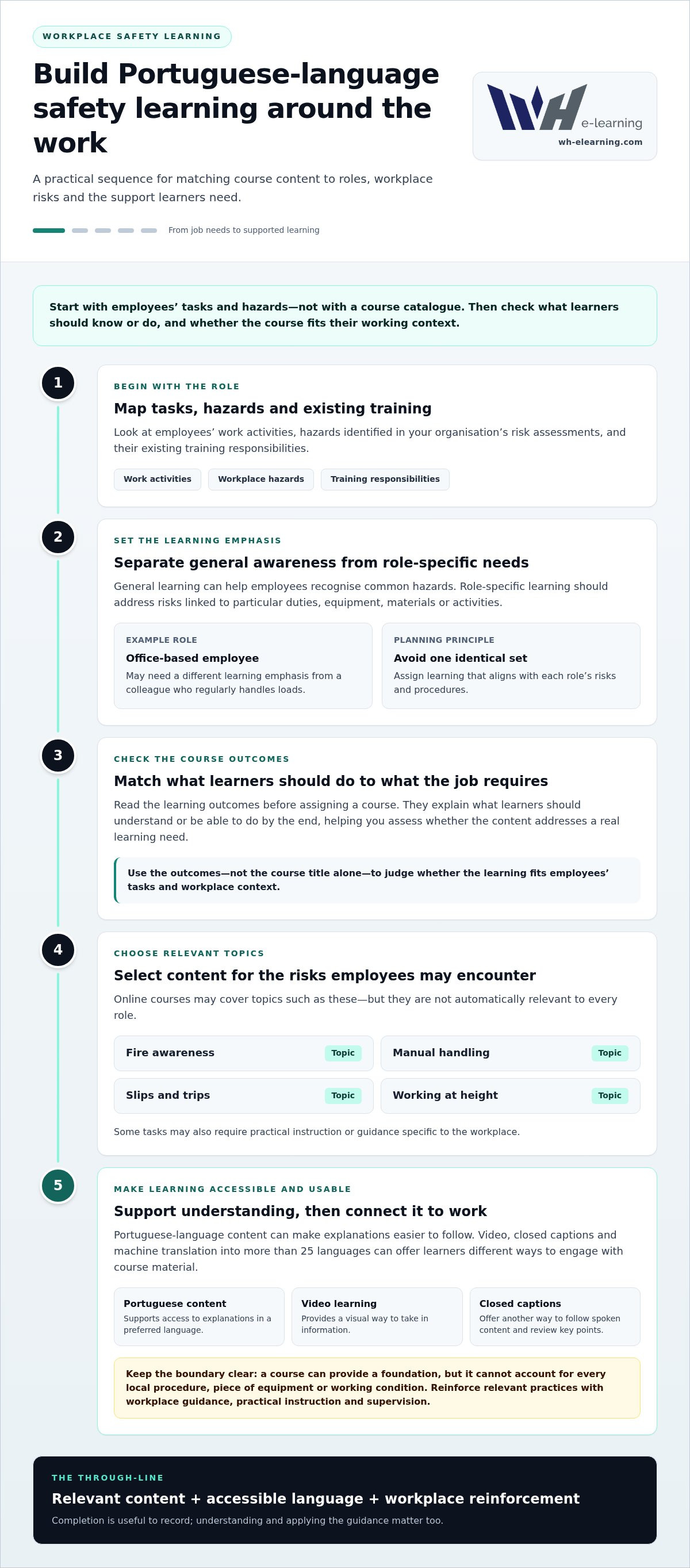
Training supports safe work; it doesn’t replace workplace procedures, practical instruction or supervision. Connect learning to the guidance employees use on the job, and ensure managers reinforce relevant practices. Completion is useful to record, but understanding and application matter too. Keep those outcomes in view when deciding what to assign and how to support staff afterwards.
What online Portuguese health and safety training can cover
Online health and safety courses can cover a range of workplace topics, but a broad catalogue isn’t a training plan. Choose courses according to employees’ duties, the hazards they may encounter and the learning they already receive. Topics might include fire awareness, manual handling, slips and trips, or working at height. These aren’t automatically relevant to every role, and some tasks may require practical instruction or workplace-specific guidance as well.
Before assigning a course, read its learning outcomes. They show what learners should understand or be able to do by the end, helping coordinators compare course content with actual job needs. Learning objectives connect course content to job tasks by showing what employees should know or do in their working context. A relevant course addresses a genuine learning need, not just a familiar-sounding topic.
How to match course topics to employee roles
Start with employees’ tasks, hazards identified in your organisation’s risk assessments and existing training responsibilities. Separate general awareness, such as recognising common workplace hazards, from role-specific learning linked to particular equipment, materials or activities. Assign courses that align with the risks and procedures identified for each role, rather than giving everyone an identical set of modules. This keeps learning focused and helps avoid gaps and unnecessary repetition.
An office-based employee and a worker who regularly handles loads, for example, may need different learning emphasis, even if both benefit from an introduction to general safety principles. Course outcomes can help you decide whether a module provides the right foundation or whether employees need further instruction tailored to their duties.
How translated video and captions support learners
For Portuguese-speaking staff, translated course content can reduce language barriers and make explanations easier to follow. Video gives learners a visual way to take in information, while closed captions offer another way to follow spoken content. Captions can also help learners review key points or study where audio isn’t convenient. These features provide different ways to engage with the material, but don’t replace clear workplace procedures or task-specific support.
Accessibility involves more than selecting a language option. Consider whether the translation is clear, whether learners can use the course on available devices and whether captions help them follow the material. WH eLearning’s video-based courses are accessible on different devices, include closed captions and use machine translation in more than 25 languages. For wider guidance on designing learning for multilingual teams, explore multi-language e-learning courses.
The OSHA Training Resources page offers an example of online training resources from a US workplace safety agency. Use it as a general reference, not as guidance on local requirements. To explore relevant online health and safety courses, compare their outcomes and format with your team’s roles and learning needs.
Online or face-to-face safety training: which approach fits your team?
Start by identifying the learning objective. If employees need consistent knowledge they can review around their work, online learning may be a practical fit. If they need to practise a task, ask questions in the moment or take part in a demonstration, an in-person session may be more suitable. The formats can also complement one another. Match delivery to the skill or knowledge employees need, rather than treating one format as best for every situation.
| Consideration | Online learning | Face-to-face learning |
|---|---|---|
| Flexibility | Learners can access course materials at a time and place that suits the delivery plan. | Usually requires learners and the trainer to attend a scheduled session. |
| Learner interaction | Supports individual, self-paced study; interaction depends on the course format. | Can make live discussion and immediate questions part of the session. |
| Practical activities | Can build understanding through structured digital content and assessment. | Can support demonstrations and guided practice where the learning objective calls for them. |
| Delivery logistics | Useful for coordinating learning across locations, with organisational progress tracking available. | Requires planning for a trainer, venue and employee attendance. |
When online Portuguese training is a practical fit
Online learning can suit teams spread across sites, employees with varied schedules or organisations aiming to deliver consistent foundational knowledge. Video-based courses are accessible on different devices, making it easier for learners to fit study around their work. For Portuguese-speaking employees, online health and safety training in Portuguese can make learning more accessible while helping coordinators organise a shared programme.
For organisations, progress tracking can show which employees have started or completed assigned learning and provide a clearer view of training status. It’s a coordination tool, not proof that someone can apply a skill at work. Pair course records with suitable workplace instruction and supervision, especially when duties involve practical tasks.
When in-person learning may complement online courses
Some learning objectives call for more than a digital explanation. A practical demonstration, guided activity or facilitated discussion can help employees explore a task, raise questions and practise under supervision. This may be particularly relevant when learning involves equipment or work procedures specific to the organisation. Online learning can still provide a consistent knowledge base before or after an in-person session.
WH eLearning offers in-house face-to-face training delivered by industry specialists. In-house health and safety training can form part of a planned approach that reflects your team’s needs. Consider how a session fits with online learning, existing procedures and employees’ day-to-day responsibilities. To explore the digital option, view online workplace courses and identify which learning objectives suit that format.
How to roll out online health and safety training in Portuguese
A clear rollout helps employees understand what they need to learn, why it matters to their work and how to complete it. Use this five-step process to organise online health and safety training in Portuguese around your team’s needs, rather than treating course assignment as a one-off administrative task.
- Assess needs. Review roles, tasks, workplace hazards, risk assessments and existing training records. Note which employees prefer Portuguese and where knowledge gaps may remain.
- Select learning. Compare course content and learning outcomes with the needs you’ve identified. Choose relevant courses and arrange other instruction where digital learning alone won’t address the task.
- Assign learners. Match employees to learning based on their responsibilities and explain what they’re expected to complete. Give staff access instructions and a reasonable period to fit learning around their work.
- Track progress. Review participation and completion status across assigned learner groups. Follow up where progress has stalled, and help resolve practical barriers such as unclear instructions or difficulty accessing the course.
- Review. Consider whether learning remains relevant as tasks, procedures or workplace risks change. Use the review to adjust future assignments and identify where additional support may help.
How to prepare a team before assigning courses
Group employees by the work they do, the hazards they may encounter and the learning they need. Record language preferences alongside those role-based needs, so Portuguese-language access supports relevant learning rather than substituting for suitable course selection. Use existing training records to identify gaps, recognise learning already completed and avoid unnecessary repetition.
Before launch, tell learners why they’ve been assigned a course, what completion involves and how to access it. Managers should make time for learning within work arrangements and set a clear completion expectation. A short briefing can help employees know where to begin and whom to approach if they need help understanding the assignment.
How to monitor participation and follow up
Organisation-level tracking can show coordinators which employees have started or completed assigned courses and which groups may need follow-up. Use the information to send appropriate reminders, then consider whether a learner needs clarification, more time or help accessing the material. Follow-up should help employees progress, not simply prompt a tick in a training record.
A practical measure of training progress is whether assigned learners complete relevant learning and can connect its key points to their work. Course records provide one part of that picture. Review them alongside workplace procedures, manager observations and ongoing risk management, then address gaps through appropriate guidance or further learning. This avoids treating course completion as a guarantee of compliance or safe behaviour.
Plan a rollout around your team’s learning needs with online health and safety courses from WH eLearning.
Build accessible Portuguese-language training with WH eLearning
Once you’ve identified relevant learning for your team, make it straightforward to access and manage. WH eLearning offers more than 100 video-based workplace courses, including health and safety topics. Courses can be accessed on different devices, include closed captions and use machine translation in more than 25 languages. These features give Portuguese-speaking learners additional ways to engage with course content and help coordinators include language access in the wider training plan.
Online health and safety training in Portuguese can support a consistent learning experience across a workforce, but course selection still matters. Consider course content, intended outcomes and the learner’s role together. Translation can make course material more accessible; it doesn’t replace relevant workplace procedures, task-specific guidance or manager support.
Ways individuals and organisations can access learning
Individuals can enrol in a course that suits a specific learning need, while organisations can purchase bulk access to coordinate training across employees. Organisational access includes tools for tracking employee progress and compliance status. These records support administration and follow-up, but they don’t guarantee compliance or show on their own how well someone applies learning at work.
After successfully completing a course assessment, learners receive digital certification. Keep that record with relevant training documentation and workplace follow-up. For example, a coordinator can review completed courses by learner group, then consider whether a team needs further instruction or a different learning approach. This keeps course completion in view without treating it as the only measure of effective training.
Choose a wider health and safety learning pathway
A Portuguese-language course can form part of a broader workplace safety learning plan. Start with the needs identified for each role, then consider how accessible online learning fits with other training, workplace procedures and ongoing risk management. A wider view of occupational safety and health training can put individual courses in context and support a joined-up approach to learning.
WH eLearning’s course library brings together health and safety and other workplace topics in a video-based format, with device access, captions and translation features to support different learners. Individuals can enrol independently, while organisations can use bulk access and progress tracking to coordinate learning across teams. Choose the route that fits your needs, then review course outcomes and learner progress as part of your training plan.
Explore the available learning options through WH eLearning courses.
Make accessible safety learning part of your next step
Start with a practical question: what would help your team use safety guidance more confidently in day-to-day work? The answer can shape how you prioritise online health and safety training in Portuguese, gather feedback and adapt learning as tasks or workplace needs change. Treat training as an ongoing part of supporting safe work, not simply a course to assign and file away.
Choose a relevant learning priority, make the next steps clear to employees and use their questions to inform future training. This helps build an accessible learning experience while keeping attention on what matters: guidance employees can understand and connect with their work.
Explore online health and safety courses from WH eLearning and choose a relevant next step for your team.
Frequently Asked Questions
Can employees complete online health and safety training in Portuguese?
Yes. Portuguese-speaking employees can use translated course materials to study safety topics in a language they understand. WH eLearning offers machine-translated learning, video courses and captions, with courses accessible on different devices. Before assigning a module, check that its subject fits the employee’s duties and explain how its guidance relates to your workplace. Managers can reinforce key points by connecting course content to local instructions and everyday tasks.
What does online health and safety training in Portuguese cover?
That depends on the course and the work employees do. Learning might cover general hazard awareness or a more focused subject, such as fire safety or manual handling. A team working with loads, for example, may need different learning from colleagues whose work is mainly office-based. Review course outcomes alongside your risk assessments and existing instructions, then choose material that supports your safety arrangements rather than replacing them.
Is online health and safety training suitable for a whole workforce?
It can suit a workforce that needs a consistent way to access learning across different roles or sites. That doesn’t mean every employee should receive the same courses. Group learners by their responsibilities, assign relevant modules and use completion information to plan follow-up. Where employees need to practise a procedure or discuss a task, complement digital learning with suitable in-person instruction so the format matches the learning objective.
How can a company track Portuguese-language training progress?
Set out who is assigned each course and the expected completion date, then review organisational progress records to identify outstanding learning. A straightforward follow-up process can help distinguish between someone who needs a reminder and a learner who needs help accessing or understanding the material. Treat completion data as an administrative aid, not proof that every risk is controlled. Keep it alongside other training records and ongoing workplace risk management.
Are online health and safety courses accessible on mobile devices?
WH eLearning courses can be accessed on different devices, helping employees fit study around their working arrangements. Video content and closed captions offer additional ways to engage with course material. To make access practical, tell staff how to open their assigned learning and allow suitable time to complete it. Managers should also consider whether employees can use a device comfortably and whether the course content suits their work.
Do learners receive a certificate after completing an online course?
Yes. WH eLearning provides digital certification after a learner successfully completes the course assessment. Employees should follow the instructions for their selected module and complete its assessment. Coordinators can retain the certificate with relevant training records. It documents successful course completion, but doesn’t guarantee practical competence. Roles requiring hands-on skills may need additional instruction or supervised practice.
Can online training be combined with face-to-face health and safety sessions?
Yes. A blended approach can use online courses for structured learning and in-person sessions for discussion, demonstrations or practical activities. Employees might study key concepts digitally before practising a relevant procedure with an instructor. WH eLearning offers in-house face-to-face training delivered by industry specialists. Plan each part around the skills employees need to apply, and connect it with workplace procedures and responsibilities.


