

A full training folder still may not show whether staff are ready to carry out their roles safely. Health and safety compliance training records are most useful when they link learning to role-specific responsibilities and competence, not just attendance or certificates.
When evidence is spread across spreadsheets, paper files and certificates, it can be difficult to see what’s current, what each role requires and where follow-up is needed. A clear, consistent record helps managers prepare for a CQC inspection and explain how training supports safe practice.
This guide gives you a practical checklist for recording training dates, completion evidence, role requirements, assessment and review actions. It also explains how to organise records so managers can identify gaps and show how learning is followed up. Training records support the wider picture of staff competence, but they are only one part of it.
Key Takeaways
- Link each staff member’s learning to their role and the skills their work requires.
- Record consistent details, including course dates, completion status and assessment outcomes.
- Choose a paper, spreadsheet or digital approach that your organisation can keep accurate and up to date.
- Use a repeatable review to identify missing information, unclear statuses and training gaps.
- Connect learning with assessment and follow-up. A completion certificate is useful evidence, but it does not prove competence on its own.
Health and safety compliance training records: what CQC inspection readiness means
Inspection readiness isn’t about producing a pile of certificates. Managers should be able to explain what learning staff need for their roles, what they’ve completed, how understanding was assessed and what happened when a gap was found. Well-organised health and safety compliance training records make it easier to answer those questions with relevant evidence, rather than searching through disconnected files.
A training record can document learning, completion, assessment and review. It supports an inspection discussion, but it cannot prove safe practice on its own. A certificate may confirm course completion; evidence of applying the learning could include an observation, practical sign-off, supervision or another appropriate workplace assessment. Keep these forms of evidence distinct.
Start by mapping learning needs to staff responsibilities and the service provided. Two employees may complete the same general course, but one may need additional learning or assessment because of their particular duties. Records should show not only what training is on file, but why it is relevant and whether follow-up is outstanding.
What can health and safety training records show?
Useful records identify the learner, their role, the subject covered and when the learning took place. They can also show the delivery method, completion status and, where relevant, assessment results or a certificate reference. These details help managers spot overdue or incomplete learning and entries that may need correcting.
To record more than attendance, include the result of a knowledge check or practical assessment where one is used. Consider a staff member’s ability to apply learning in relation to their actual duties, rather than assuming course completion alone demonstrates this.
Why connect records with CQC inspection preparation?
Organised evidence helps managers explain how they identify learning needs, monitor completion and respond to gaps. Regulation 18 of the Health and Social Care Act 2008 (Regulated Activities) Regulations 2014 concerns staffing, including ensuring staff are suitably qualified and competent. Regulation 17 relates to good governance and effective systems for monitoring quality and managing risk.
CQC doesn’t prescribe one training-record form, platform or universal course list. Providers should be able to explain how their approach reflects their service, staff roles and the needs of people using the service. A clear record can support that discussion, but it does not replace evidence about practice.
For inspection preparation, use current CQC guidance and relevant UK requirements as the reference point for your service. Check that your records explain the link between staff responsibilities, identified learning needs and actions taken when gaps arise. This keeps evidence focused on your organisation’s approach, rather than on a generic template or certificate alone.
Try a simple sense-check with one staff member. Start with their role, identify relevant learning, find the completion record, review any assessment or workplace sign-off, then check whether a gap led to follow-up. If a link is missing or unclear, record what needs attention. This turns a document store into a useful account of training oversight.
What to include in health and safety compliance training records
A useful record should quickly answer three questions: who took part, what learning they completed and what happened next. Consistent health and safety compliance training records make missing details easier to spot and help connect course completion with any assessment or follow-up required for the role.
Core fields for a clear training record
Use the same fields for each learning activity, with enough detail to distinguish courses or sessions. This matters particularly when staff complete several topics or repeat training over time.
- Learner and role: staff member’s name or unique identifier, job title and, where useful, team or work location.
- Learning details: course or session title, subject, delivery date and format, such as online, classroom or practical instruction.
- Source and evidence: trainer or course provider, completion status and the evidence held, such as an attendance record or certificate reference.
- Outcome and next steps: assessment result where applicable, refresher or follow-up action, responsible manager and review date if one is needed.
Agree status labels and use them consistently, for example “completed”, “in progress”, “overdue” and “not required for role”. Define what each label means. “Completed” should mean the learning activity is finished; it should not automatically mean the person has demonstrated every practical skill needed for their work.
Evidence beyond attendance and certificates
Attendance confirms participation, but it doesn’t necessarily show what a learner understood or can do. If a course includes a knowledge check, record the result and any action needed if the required standard wasn’t met. For practical tasks, add an appropriate workplace observation or sign-off when it forms part of your competence process.
For example, if an assessment identifies a gap, record the agreed action, who will follow it up and when it will be reviewed. This links the identified need to the response, rather than leaving managers with a result and no next step. A certificate is useful completion evidence, but it should sit alongside relevant assessment and workplace evidence.
Protect training records as personal information. Limit access to people who need the information for their work, keep records accurate and handle them in line with applicable UK data protection requirements and your organisation’s procedures. Use staff details and training outcomes only for appropriate purposes, and review access arrangements when responsibilities change.
Review the fields periodically. Remove labels that cause confusion, make sure actions have an owner and retain only the information your organisation needs under its applicable requirements. WH eLearning provides online health and safety training courses that can form part of your staff learning process.
Paper, spreadsheets or digital records: choosing a workable approach
The right approach is one your organisation can keep accurate, secure and up to date. CQC compliance doesn’t depend on using a particular platform. Consider your staff numbers, locations, record-keeping routines and how quickly managers need to find information. This comparison can help you choose a workable system for health and safety compliance training records.
- Paper files: Familiar and straightforward for a small, single-site team. Finding and updating information can take time, and access depends on where files are stored. Take care to keep records current and avoid conflicting versions.
- Controlled spreadsheets: Searchable and simple to update when one person maintains a master record. Access can be restricted, but shared copies, accidental edits and unclear versions can undermine accuracy.
- Digital training records: Can support central visibility, filtering and status reporting across teams or sites. Access permissions and correction processes need to be managed, and records still depend on accurate information being entered.
When a paper or spreadsheet process may be enough
A straightforward process can work when ownership is clear. Assign a named person to maintain records, use consistent fields and labels, and set a routine for checking updates. For paper files, use a simple index by staff member or topic. For spreadsheets, designate one master version, control editing access and make changes through an agreed process.
Look out for duplicate files, missing updates and information that’s hard to retrieve. A system that works for one site may become difficult to maintain as teams or locations grow. Test the process by finding a staff member’s latest training evidence without relying on the person who filed it.
When digital training oversight can help
Digital oversight can make it easier to see progress across a dispersed workforce and identify outstanding learning. WH eLearning corporate access includes administrative features for tracking learner progress and compliance status. These support training oversight alongside your organisation’s role mapping, assessment and follow-up processes.
Set access permissions that fit people’s responsibilities, and define who can correct an entry and how the change is recorded. Digital status reporting helps managers see completion information, but it doesn’t replace checks that records are accurate or evidence that learners can apply their training in practice.
Match the method to your day-to-day process
Before changing systems, map how training evidence is created, updated, reviewed and retrieved. Consider whether managers need to compare records across locations, how often information changes and who will maintain the process. Start with the simplest approach that reliably meets those needs, then review it as the organisation changes.
Whichever method you use, test retrieval and updating before an inspection. Can the responsible manager find the current record, identify its status and locate any follow-up action? If not, improve the process before adding complexity. Consistent maintenance matters more than the format.
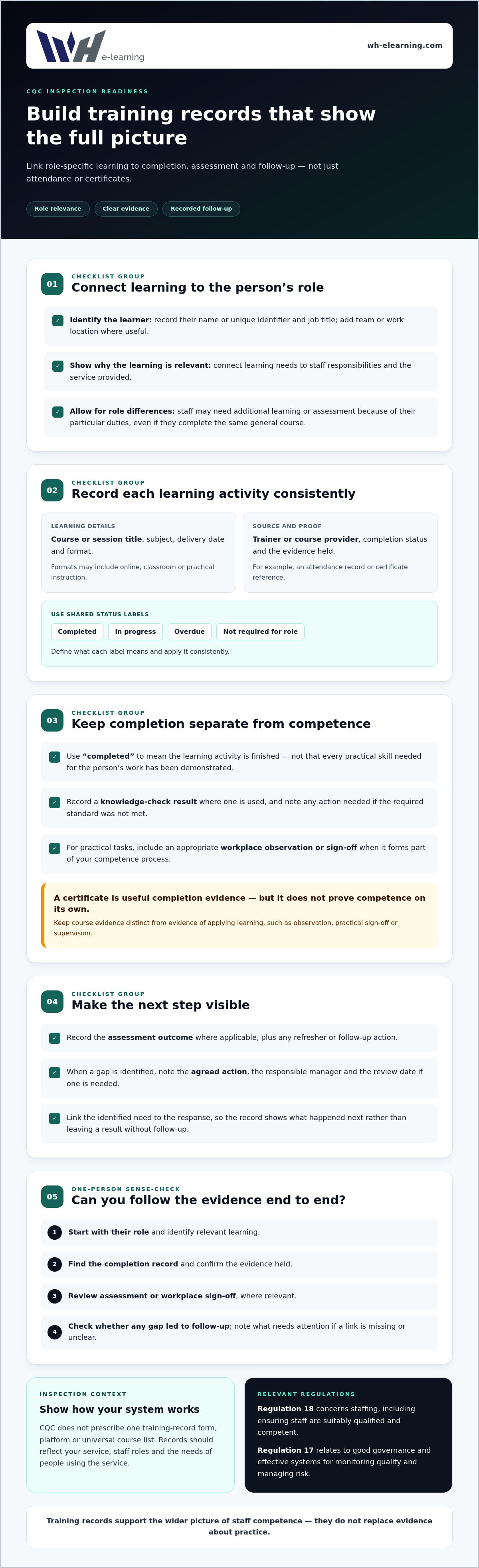
CQC inspection checklist: review training records step by step
A repeatable review takes managers from a staff list to clear evidence and follow-up, rather than leaving them to check files at random. Use this process before an inspection and as part of routine oversight. It helps you explain how learning needs are identified, completion is monitored and gaps are managed. Keep the review relevant to staff roles and the service’s current responsibilities.
A practical pre-inspection records review
Start with the people doing the work, then check whether their records reflect their roles. Review a representative sample across teams, locations and responsibilities, including recent starters where relevant. Confirm that evidence can be retrieved and matched to the correct learner, and that each status is clear. Record every gap with a named owner, next action and realistic review date.
- Reconcile the staff list. Compare the current staff and role list with the training matrix or equivalent record. Follow up anyone missing, listed under inconsistent details or shown in a role they no longer hold.
- Check role relevance. Review whether the recorded learning fits each person’s responsibilities. Note any learning needs created by changed duties or service requirements.
- Test the evidence. Select records from the sample and retrieve the supporting evidence. Check learner details, course or session, dates, completion status and any relevant assessment or follow-up record.
- Look for inconsistencies. Flag missing fields, conflicting dates, duplicate entries and statuses that don’t make clear whether learning is complete, outstanding or not relevant to the role.
- Review controls. Confirm that access is appropriate and retention arrangements align with current requirements and organisational policy. Don’t assume one retention period suits every record.
Turn record gaps into a managed action plan
Not every gap has the same significance. Prioritise actions according to the staff member’s role, the potential risk and whether the learning relates to current duties. For each item, record what needs to happen, who will arrange it and when a manager will check progress. Once training is completed, retain the completion evidence and any relevant assessment outcome.
Use a regular management review to check open actions, identify recurring gaps and consider whether changes in responsibilities have created new learning needs. Close an action only when the agreed evidence is available, not simply because training has been booked. This creates a clear trail from the issue identified to the response taken.
Keep the review proportionate: a sample can reveal problems with record quality, while reconciling staff and roles helps identify wider coverage gaps. Use the findings to improve the process, not just to prepare a folder for inspection. When your review identifies learning to assign, explore WH eLearning health and safety training courses.
Maintain inspection-ready training records with a consistent learning process
Inspection readiness is easier to sustain when training records follow the same cycle as staff learning. Treat each record as part of an ongoing process, not a document to gather just before an inspection. This helps managers see why learning was assigned, whether it was completed and what further action is needed. It also keeps health and safety compliance training records connected to roles and day-to-day oversight.
- Identify needs. Use staff responsibilities, service risks and changes in duties to identify relevant learning. Record why a course or activity is appropriate for the role.
- Assign learning. Set out who needs to complete it and how completion will be monitored. Make the expected outcome clear, including whether further assessment or practical follow-up is part of the plan.
- Record outcomes. Capture completion and retain relevant evidence, such as a course certificate or assessment result.
- Review gaps. Check progress, identify overdue or incomplete learning and assign an owner to follow up.
- Refresh evidence. Review learning needs when responsibilities or workplace requirements change, and update records to reflect the action taken.
Make training delivery easier to oversee
For organisations coordinating learning across a workforce, corporate access to online courses can support a consistent approach. WH eLearning provides more than 100 video-based courses, including health and safety topics. Corporate licensing includes administrative features for tracking learner progress and compliance status, helping managers monitor course activity as part of their wider training process.
Courses include closed captions and machine translation into more than 25 languages, which can support access for learners with different needs. Consider these features alongside the learning requirements of each role. Progress information shows course activity, but managers should still record any relevant assessment, workplace observation or follow-up separately.
Choose learning that fits staff roles and follow-up
Match course content to the responsibilities and learning needs you have identified. A general course may support foundational knowledge, while a particular role may also call for specific instruction or practical assessment. Build the expected next step into the plan, so completion leads to an appropriate review rather than simply closing a task.
Successful course completion includes digital certification, giving the organisation evidence that the learner completed the course. Keep that evidence with the learner’s training record, but don’t treat a certificate alone as a complete competence record or proof of safe practice. Consider how the learning has been understood and applied in the role.
For organisations planning staff learning, WH eLearning health and safety courses can support a consistent cycle of assigning, recording and reviewing learning.
Make your next review the start of steady progress
Use your next training-record review to make one practical improvement. You might clarify who owns follow-up or schedule a regular check of role-based learning needs. Small, consistent steps help keep health and safety compliance training records useful between inspections, not just when evidence is requested.
Turn what you find into a forward-looking learning plan. Identify where staff need support, decide how you’ll check progress and set time to review whether the learning is meeting its purpose. This keeps training connected to the work people do and gives managers a clear next step.
Plan health and safety learning for your team with WH eLearning health and safety courses. Add relevant learning to your organisation’s process for assigning, recording and reviewing training.
Frequently Asked Questions
Does CQC require health and safety training records?
Providers should be able to show how staff are supported to work safely and meet the needs of their roles. CQC doesn’t prescribe one universal record format, so health and safety compliance training records may be held in a suitable paper, spreadsheet or digital system. For applicable regulated activities in England, consider Regulation 18 and current CQC guidance. Course evidence shows that learning took place, while competence may need to be demonstrated through role-relevant practice.
What should a health and safety training record include?
Include enough detail to identify the learner and explain the learning: their name or staff identifier, role, training subject, delivery date, trainer or course source and completion status. Add assessment evidence if the activity includes an assessment. For example, a record might show that a knowledge check was passed, with a separate note for any support still needed. Record relevant follow-up or refresher actions, and tailor fields to the course and role rather than relying on one generic template.
How long should health and safety training records be kept?
There isn’t one retention period to apply automatically to every training record. The appropriate period can depend on the type of record, relevant legal or regulatory requirements, contractual duties and your organisation’s policy. Set out your retention approach in a documented schedule, including who reviews it and how records are securely disposed of when no longer needed. Check current authoritative guidance and applicable requirements before setting or changing a period.
Can a training certificate prove that a member of staff is competent?
A certificate can show that someone successfully completed a course, but it doesn’t automatically demonstrate that they can apply the learning in their particular role. For a practical task, a manager might also use supervision, an observation or a role-specific sign-off, where appropriate. The evidence should fit the learning and responsibilities involved. If a check identifies a development need, record the agreed support and follow-up rather than relying on the certificate alone.
How often should health and safety training records be reviewed?
Review records regularly, using a schedule that fits your training needs, role changes, course requirements and organisational policy. Also update them when a staff member takes on new responsibilities, so relevant learning can be considered promptly. A useful review checks for overdue learning, missing evidence and actions that haven’t been completed. Assign an owner to each action and note a review point, so gaps don’t remain open without clear responsibility.
Are spreadsheets suitable for managing training records?
A controlled spreadsheet can suit a team if it has consistent fields, a named owner, appropriate access controls and a dependable review routine. For example, one maintained master file is easier to manage than several emailed copies. As records grow or staff work across locations, finding information, preventing conflicting versions and keeping updates current may become harder. Digital tracking can improve progress visibility, but CQC doesn’t require a particular software type.


