

Tips uncover 43% of occupational fraud cases, and employees provide 55% of those tips, according to the ACFE’s Occupational Fraud 2026: A Report to the Nations. That makes everyday decisions, such as pausing before changing payment details or reporting an unusual request, an important part of fraud prevention training for employees.
Suspicious activity can blend into routine work. Generic awareness sessions may explain what fraud looks like, but employees also need clear steps for situations they actually face. Training should make it straightforward to pause, verify a request through a trusted channel and report concerns promptly, without asking staff to investigate on their own.
This guide explains how to build practical, role-relevant training that turns awareness into repeatable action. You’ll learn how to use realistic workplace scenarios, clarify reporting routes, reinforce key behaviours and track participation and learning progress. The aim is a programme employees can apply in daily work and training leads can manage without unnecessary complexity.
Key Takeaways
- Build fraud prevention training for employees around the real tasks and risks different roles encounter, rather than relying on a one-size-fits-all checklist.
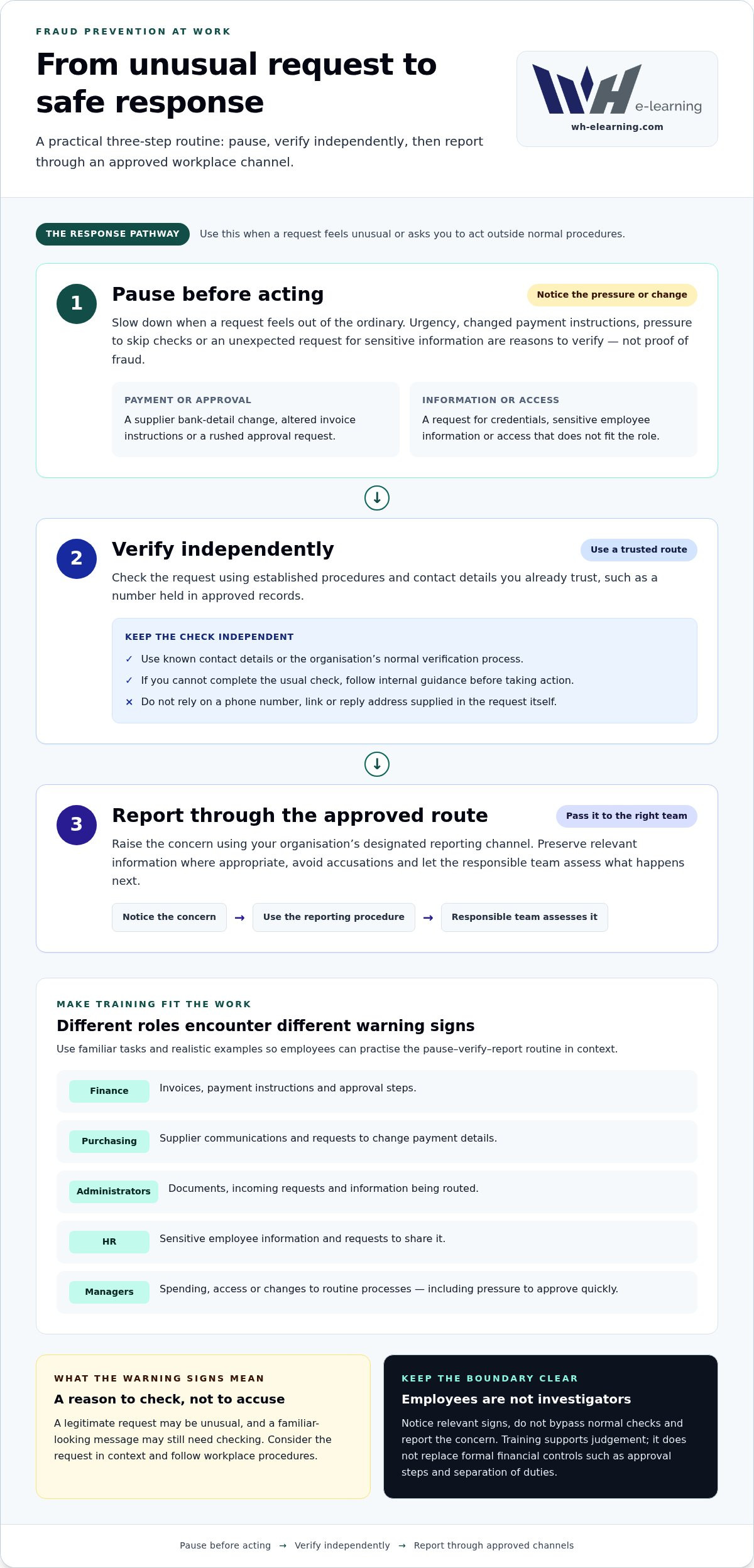
- Teach a simple response to suspicious requests: pause before acting, verify independently using trusted contact details, then report through approved channels.
- Use realistic examples involving emails, calls, invoices and supplier changes to help staff recognise warning signs in familiar workplace situations.
- Set clear learning objectives so employees know how to identify a concern, carry out a check and use the reporting route.
- Review course completion alongside assessment results, employee questions and reporting activity to understand progress without treating completion as proof of changed behaviour.
Why fraud prevention training for employees matters in everyday work
Fraud attempts often arrive within ordinary tasks: a payment is due, a supplier’s details need updating, an approval is waiting or a request for information seems routine. A convincing message can prompt someone to act quickly, especially when it appears to come from a colleague or trusted organisation. Practical training helps staff recognise when a request deserves a pause, check it against established procedures and raise a concern through the right channel.
Fraud prevention training teaches employees to recognise suspicious activity, verify unusual requests and report concerns through approved workplace procedures.
The aim is not to turn every employee into an investigator. Awareness training develops judgement and confidence, but it does not replace formal financial controls, such as approval steps and separation of duties. Nor is it cybersecurity tooling: filters and access protections can help reduce risk, while training helps people respond thoughtfully when something looks unusual or a control needs to be followed.
That distinction matters in practice. A course cannot establish whether a particular transaction is fraudulent, and employees shouldn’t try to prove it themselves. Their role is to notice relevant signs, avoid bypassing normal checks and pass the concern to the designated person or team. Clear procedures make that response easier and more consistent.
Which workplace risks should employee training address?
Training is most useful when it reflects the tasks and information employees handle. Scenarios might include a message requesting a supplier bank-detail change, an invoice with altered payment instructions, someone impersonating a senior manager to rush an approval, or access being used in a way that doesn’t fit the employee’s role.
These scenarios are illustrative, not proof of wrongdoing. A legitimate request may be unusual, and a familiar-looking email may still need checking. Use examples that show what to pause over, which verification steps apply and how to report a concern. Avoid unsupported claims about how common each scheme is.
Why fraud prevention is not only a finance responsibility
Finance staff may review invoices and payments, but other roles also encounter potential warning signs. Purchasing teams communicate with suppliers; administrators route documents and requests; HR staff handle sensitive employee information; managers approve spending, access or changes to routine processes. Each role has a different view of activity, so relevant training should connect warning signs to the work people actually do.
Keep the message calm and practical. Training should build confidence to follow procedures, not encourage suspicion of colleagues or customers. If something seems wrong, employees should preserve relevant information where appropriate, avoid making accusations and report through the organisation’s approved route. The responsible team can assess the concern and decide what happens next.
How workplace fraud schemes work and which warning signs employees can spot
Many workplace fraud attempts follow a simple pattern: someone presents a plausible identity or request, then encourages an employee to take an action that benefits the requester. That action might be approving a payment, sharing information, opening an attachment or changing account details. The message may arrive by email or telephone, or appear within a routine invoice or supplier update.
Urgency, unusual payment instructions, pressure to bypass normal checks and unexpected requests for sensitive information are reasons to verify, not proof of fraud on their own. A single detail may have a legitimate explanation. Consider the request in context, follow the organisation’s procedure and report concerns rather than making an accusation. The Association of Certified Fraud Examiners’ ACFE Employee Fraud Awareness Training also focuses on awareness as part of detection and prevention.
Recognising impersonation and payment-request warning signs
A familiar name or senior job title can make an unusual request feel routine, but names and authority can be imitated. For example, an employee might receive a call from someone claiming to be a manager who needs a payment released before a deadline. An invoice might show new bank details, or a supplier email might ask for funds to be sent through an unfamiliar route.
Pause if a request creates pressure, changes payment details or asks you to skip an approval step. Check it through a known, independent route, such as a contact number already held in approved records. Don’t rely on a number, link or reply address supplied in the message itself. If you can’t complete the normal check, follow internal guidance before taking action.
Spotting manipulation in routine workplace communications
Not every suspicious message contains spelling mistakes. It may look polished and use the right names, but still request secrecy, immediate action, login credentials or sensitive employee information. An unexpected attachment, a sender address that differs subtly from the usual one, or a request that doesn’t fit the normal process can all prompt a closer check.
Consider a message that appears to come from a colleague asking for a staff list to be sent to a personal address. The wording may sound plausible, yet the destination and request may be outside normal procedure. Confirm through a separate, familiar channel and use the established route to report anything that remains concerning. Refresh examples to reflect the organisation’s workflows rather than treating them as a fixed checklist of scam formats.
Effective fraud prevention training for employees helps staff recognise these patterns without assuming that every irregularity signals misconduct. Make clear which details to record, who receives a report and what to do if someone has already acted. For organisations delivering broader workplace learning, video-based workplace courses provide a flexible way to support training across roles.
How employees can prevent fraud: pause, verify and report
A short, repeatable response can help employees handle a suspicious request without feeling they need to decide whether it is definitely fraudulent. The sequence is simple: pause, verify and report. A quick response isn’t always the safest response. Taking time to complete the usual check can prevent an avoidable mistake, even when a request sounds urgent or comes from someone with apparent authority.
- Pause. Don’t approve a payment, change account details, share information or open an unexpected attachment until you’ve considered whether the request fits normal procedures.
- Verify. Check the request independently using a trusted contact method or internal directory already held by your organisation. Don’t use reply details or telephone numbers supplied in the request.
- Report. If anything remains unclear, use the approved reporting route and pass on relevant details so the responsible team can assess the concern.
This approach makes fraud prevention training for employees practical: staff learn what to do when a request feels unusual, rather than being expected to identify a scheme with certainty. Keep the steps aligned with workplace procedures, including who can approve transactions and where concerns should be raised.
How to verify an unusual payment or information request
Compare the request with established approval and supplier-change procedures. If an invoice includes new bank details, contact the supplier using a number already recorded in your organisation’s trusted records, not a number in the email. If the request comes by telephone, end the call and use a known contact route to check it. A separate channel helps avoid relying on the same message you’re trying to verify.
If the details conflict, stop the change and escalate the discrepancy. Don’t let deadline pressure turn an exception into an informal approval.
What to do after noticing or making a suspicious transaction
Report the concern promptly to the designated manager, finance contact or reporting channel. Include the time, the type of request and what action, if any, was taken. Preserve relevant messages or records in line with internal guidance, but don’t forward sensitive material widely, delete evidence or begin your own investigation.
If you’ve already shared information or authorised a transaction, raise it immediately through the internal route. A blame-free response helps the organisation act on the information sooner. Don’t confront a suspected individual or make unsupported accusations; provide the facts and let the responsible team decide what steps to take.
Organisations can reinforce these practical actions through accessible workplace learning. Video-based workplace courses can support training delivery, while clear internal procedures guide employees through verification and reporting in their roles.
How to build fraud prevention training around employee roles
Start with the work people do, not a long catalogue of fraud schemes. Map routine tasks that involve approving payments, changing supplier records, handling personal information or responding to requests from colleagues. Then identify where an employee might need to pause, check a detail or raise a concern. This makes fraud prevention training for employees relevant to daily decisions and easier to apply.
Set observable learning objectives so employees can practise clear actions. For example, by the end of a session, staff should be able to:
- Recognise a request that doesn’t fit their usual process.
- Complete the relevant check using the organisation’s procedure.
- Identify the correct route for reporting a concern.
Use short scenarios based on approved workplace procedures. After each one, ask what the employee noticed, which check they would carry out and why. Discuss the reasoning, not just whether the answer was right. This helps staff transfer the learning to unfamiliar situations. Broader business compliance e-learning can provide context for planning learning as part of a wider workplace programme.
Tailor learning scenarios to different employee responsibilities
Finance and purchasing teams can practise responding to payment-change requests and invoice discrepancies using the organisation’s supplier verification and approval steps. Reception, HR and administrative teams can work through scenarios involving an apparent colleague or manager requesting sensitive information. Give managers practice reinforcing procedures, receiving reports calmly and directing concerns through the right channels, rather than asking staff to resolve them alone.
Keep examples specific enough to feel familiar, but avoid implying that every unusual request is fraudulent. Where a workflow differs between teams, explain the right action for that role. Invite employees to discuss points of uncertainty, then use their questions to clarify guidance and improve future scenarios.
Make training accessible and straightforward to complete
Choose concise learning formats that staff can access across relevant devices and work settings. Video-based workplace learning can support flexible delivery, while captions and language support can help more employees engage with the material. WH eLearning’s workplace courses include closed captions, work across devices and offer machine translation into more than 25 languages. Its online health and safety courses are another example of accessible workplace learning, although their subject matter is distinct from fraud awareness.
Build a simple cycle: map tasks, set objectives, practise scenarios, gather questions and update examples when processes change. Organisational access can also support administration through progress tracking, but completion records show participation, not whether employees will consistently apply the learning. Explore workplace compliance e-learning as one way to deliver accessible staff learning.
How to reinforce fraud prevention learning and track progress
Training is a starting point, not proof that employees can apply every lesson in practice. Separate three measures: whether staff took part, whether they understood the material and whether workplace procedures support the right actions. Course completion helps with administration. It doesn’t, by itself, show that fraud has been prevented or that behaviour has changed.
Review several signals together. Assessment results can show which concepts need clarification; employee questions can reveal uncertainty about procedures; feedback on reporting routes can highlight practical barriers. A low number of reports isn’t automatically a sign of success or failure. It may reflect fewer concerns, low confidence in the reporting process or uncertainty about what should be reported. Consider the wider context before drawing conclusions.
What should organisations measure after training?
Track participation and assessment completion to understand who has completed the learning and where follow-up may be needed. Add short scenario questions that ask employees to select an appropriate next step, such as checking a request through an approved process or raising a concern through the right channel. Review answers for patterns, not just an overall score: repeated uncertainty about one step may point to a gap in the training or the underlying guidance.
Pair these learning measures with relevant process feedback, such as whether staff know where to report or whether a procedure is clear in practice. Use staff training progress tracking to support administrative oversight, while keeping participation data distinct from evidence of understanding and workplace behaviour.
When and how should fraud training be refreshed?
Refresh examples when internal procedures change or new concerns point to a learning gap. Questions raised during training and lessons from reported incidents can help identify which steps need clearer explanation. Keep sensitive incident details confidential, and use examples that teach the relevant response without naming individuals or encouraging speculation.
Reinforcement can be straightforward. Revisit a short scenario in a team meeting, clarify an approval or reporting step, or include a focused refresher when a workflow changes. Make it easy for employees to ask questions and understand that reporting a concern is useful even if it turns out to have an innocent explanation. This keeps fraud prevention training for employees connected to current work rather than making it a one-off exercise.
For organisations building a wider learning plan, business compliance e-learning offers further ideas for structuring workplace learning. WH eLearning’s online courses and progress tracking can support programme administration and ongoing staff development.
Make the next step practical
Strong fraud awareness grows through everyday practice, not a single training session. Choose one workflow to review first, such as payment approvals or handling sensitive information. Check that employees know where to find the procedure, how to raise a concern and what support they can expect after reporting it. Then use their questions to shape the next learning activity.
Keep the approach proportionate. A clear process, relevant practice and space to ask questions can help staff feel more prepared to act thoughtfully. As your wider learning plan develops, WH eLearning offers more than 100 online workplace courses across different topics, including HR and business compliance.
Explore WH eLearning’s workplace compliance courses to support your organisation’s broader staff learning needs. Practical fraud prevention training for employees can become part of a thoughtful programme that helps people act with confidence. Choose a workflow to address first, then build relevant learning around the procedures employees need to follow.
Frequently Asked Questions
Is fraud prevention training mandatory for employees?
There isn’t one universal training requirement that applies to every employee and organisation. Whether training is required depends on the organisation’s sector, jurisdiction, relevant policies and applicable obligations. Employers should check current requirements with their compliance team and a suitably qualified adviser. Even where no specific course is prescribed, role-relevant learning can help staff understand internal procedures, approval limits and how to raise a concern.
How often should employees receive fraud prevention training?
There’s no single refresh interval that suits every organisation. Set a schedule based on employees’ exposure to risk, changes to procedures and feedback from assessments or workplace questions. Include relevant guidance during induction, then consider targeted refreshers when responsibilities or workflows change. If a sector-specific rule may apply, verify its current requirements before stating a frequency as a compliance obligation.
What should an employee do if a payment request looks suspicious?
Don’t release the payment or alter supplier details until the request has been checked under your organisation’s process. For example, if an invoice uses a new account, compare it with approved supplier records and raise any discrepancy with the responsible finance contact. If you’ve already authorised payment, report that promptly through the internal route. Share the facts, not assumptions, and leave investigation to the appropriate team.
Can employee training prevent all workplace fraud?
No training can guarantee that workplace fraud will never happen. Learning can help employees notice concerns and respond consistently, but it works alongside sound approval processes, clear reporting routes and suitable organisational controls. For example, staff may recognise an unusual request, yet a weak approval process could still leave room for it to proceed. Review both training and procedures regularly, and adjust them when gaps become apparent.
How can fraud prevention training be made relevant to different teams?
Start by identifying the tasks, information and decisions each team handles. A finance scenario might involve a supplier payment change, whilst an administrative example could involve an unexpected request for staff information. Keep the organisation’s core response guidance consistent, but tailor the examples and relevant approval routes. Ask learners which steps feel unclear, then revisit scenarios when workflows change so training continues to reflect real responsibilities.
How can an organisation tell whether fraud prevention training is working?
Use several indicators rather than treating completion as proof of success. Review participation, assessment answers, learner feedback and whether staff know where to report concerns. Consider incident reports in context: an increase may indicate that employees feel more able to speak up, not necessarily that training has failed. Use these signals to identify where guidance needs improvement. They support programme review, but can’t prove that training has eliminated fraud.


