

A member of staff raises a sensitive concern. They’re unsure where to start, and their manager isn’t certain which steps to follow. Grievance procedures training online can turn a written policy into clear, practical actions for everyone involved.
Grievances can be difficult to handle. Employees need to know how to raise a concern, while managers need a consistent way to listen, respond and follow workplace procedures. Online learning makes guidance easier to access and revisit, but it works best when it reflects how your organisation handles concerns in practice.
This guide explains how to prepare, deliver and reinforce online grievance training for UK workplaces. It covers role-specific responsibilities, realistic scenarios and ways to make learning accessible with video lessons, captions and translated content. You’ll also learn how to connect training with your procedures and use progress tracking to support organisational oversight.
Key Takeaways
- Build grievance procedures training online around your organisation’s policy, so people know where to find guidance and who to approach.
- Help learners distinguish a formal grievance from everyday feedback, informal disagreement and disciplinary processes.
- Use a clear learning sequence to show employees and managers how to raise or receive a concern, record relevant details and explain next steps.
- Cover impartial listening, confidentiality and sensitive situations. Make clear that training alone doesn’t resolve a complaint or guarantee a fair process.
- Make online learning accessible with role-specific content, video, captions, translated learning and short scenario checks.
What grievance procedures training online should help people understand
Where can an employee raise a concern? What should a manager do when someone shares one? These are the practical questions grievance procedures training online should answer. The aim is to help people understand how to raise, receive and manage workplace concerns, and where their organisation’s policy explains what happens next.
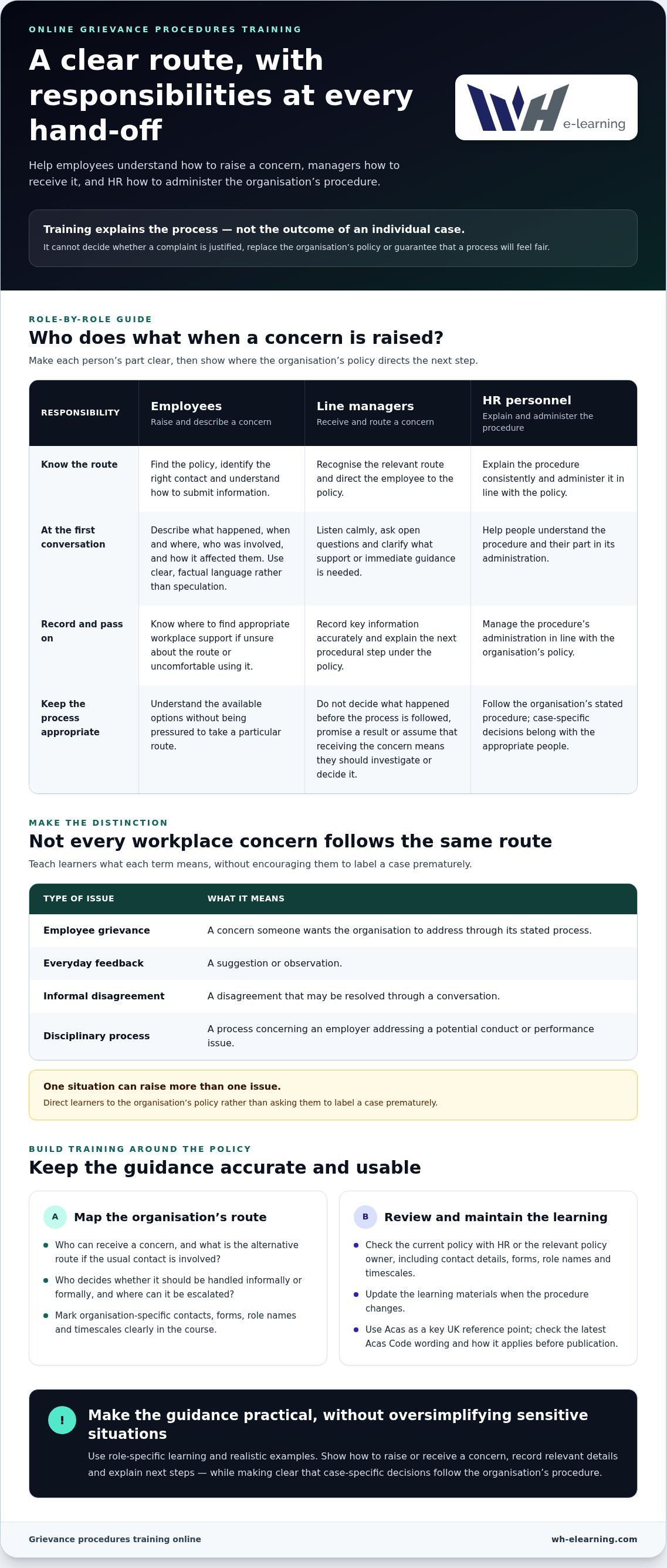
Training should help employees find the right route and managers respond consistently. It explains the process, not the outcome of an individual case. A course can’t decide whether a complaint is justified, replace the organisation’s policy or guarantee that a process will feel fair. It should clarify everyone’s role while leaving case-specific decisions to the appropriate people.
Clear distinctions matter. An employee grievance is a concern someone wants the organisation to address through its stated process. Everyday feedback may be a suggestion or observation, while an informal disagreement may be resolved through a conversation. A disciplinary process is different: it concerns an employer addressing a potential conduct or performance issue. One situation can raise more than one issue, so training should direct learners to the policy rather than encourage them to label a case prematurely.
What should employees learn about raising a grievance?
Employees should know where their policy says to raise a concern, such as with a named manager or another designated contact. Training can show them how to describe what happened, when and where it occurred, who was involved, and how it affected them. Encourage clear, factual language rather than speculation. Employees should also know where to find appropriate workplace support if they’re unsure about the route or feel uncomfortable using it.
Not everyone will be ready to make a formal complaint immediately. Learning should explain how to locate the policy and understand the available options without pressuring someone to take a particular route. A simple example, such as repeated interruptions in team meetings, can help learners practise describing specific events and their impact without exaggeration.
What should managers learn about their role?
Managers need to listen calmly, ask open questions and avoid deciding what happened before the organisation’s process has been followed. They should know how to direct an employee to the relevant policy, record key information accurately and explain the next procedural step without promising a particular result. Receiving an initial concern doesn’t automatically mean the manager should investigate or decide it.
For example, a manager who receives a complaint about a colleague can acknowledge the concern, clarify what support or immediate guidance the employee needs, and explain who will take the matter forward under the policy. They should avoid sharing details more widely than necessary or implying that the issue has already been resolved.
These outcomes make the process easier to follow without oversimplifying sensitive situations. Employees learn how to raise a concern clearly; managers learn how to receive it responsibly and pass it into the appropriate procedure. Both groups should know where to find the organisation’s guidance when a real concern arises.
Prepare online grievance training around your policy and UK workplace context
Start with the organisation’s current grievance policy, not a generic course outline. Identify who can receive a concern, the alternative route if the usual contact is involved, who decides whether it should be handled informally or formally, and where it can be escalated. This gives grievance procedures training online a practical anchor: learners can connect general guidance to the process they’re expected to follow at work.
Review the policy with the people responsible for keeping it accurate, such as HR or the relevant policy owner. Check that contact details, forms, role names and timescales still apply. If the procedure changes, update the learning materials too. Out-of-date instructions can leave employees unsure where to go and managers unclear about what to do next.
Map the policy into clear learning outcomes
Translate policy sections into plain-English actions without changing their meaning. Separate learning by role so employees, line managers and HR personnel can see what they’re responsible for. Employees need to locate the reporting route, managers need to follow the correct handover steps, and HR personnel need to understand their part in administering the organisation’s procedure.
- Employees: find the policy, identify the right contact and understand how to submit information.
- Line managers: recognise the relevant route, record information appropriately and know when to pass the matter on.
- HR personnel: explain the procedure consistently and manage its administration in line with the policy.
Use clearly marked spaces in the course for organisation-specific contacts, forms and timescales. This makes it easier to tailor the learning without embedding details that may change into generic guidance. If the procedure sets different routes for particular circumstances, reflect those distinctions accurately.
Keep UK legal and workplace guidance accurate
Use Acas as a key UK reference point. The Acas Code of Practice on Disciplinary and Grievance Procedures offers guidance relevant to workplace procedures. Before publication, check the latest Acas wording and how it applies to the organisation and learners. Citing a source doesn’t replace checking that course explanations remain current.
The Employment Rights Act 1996 and Equality Act 2010 may form part of the legal context, but avoid turning a short learning module into a broad legal summary. Check statements against current legislation and authoritative guidance, including whether they apply in the relevant UK jurisdiction. Rules and individual circumstances can differ, so learners should follow their organisation’s procedure and seek appropriate HR or legal advice for a specific dispute.
A course supports understanding; it doesn’t replace policy reviews, tailored HR advice or decisions about an individual case. Organisations developing wider workplace learning can also explore online HR and business compliance courses as part of a broader training programme.
How to structure online grievance procedures training step by step
Effective grievance procedures training online should take learners through a clear sequence, from recognising a concern to understanding what happens after it’s raised. Connect each stage to the organisation’s policy, and make the learning active: learners should practise choosing a route and responding appropriately, not just read instructions.
- Recognise the concern. Help learners notice when an issue may need attention and pause before making assumptions about how it should be handled.
- Find the policy and identify the route. Practise locating the relevant guidance and using it to identify the right contact or next step.
- Raise or receive the concern. Show employees how to share a concern clearly, and managers how to listen, clarify and respond calmly.
- Record relevant details. Explain how to capture factual information, such as what happened and when, in line with the organisation’s process.
- Explain what happens next. Help learners communicate the next procedural step without promising an outcome or deciding the case prematurely.
Teach the employee journey through the procedure
Use a fictional example, such as an employee who feels their contributions are repeatedly overlooked in team meetings. Ask learners to find the policy, identify the appropriate route and practise describing the concern. Prompt them to separate observable facts from the impact on them and what they hope the organisation will address. This helps them give a clear account without suggesting that a particular outcome is guaranteed.
Teach managers to respond consistently
Put managers in the receiving role. In a scenario, an employee shares a concern informally at the end of a meeting. Ask the manager to listen without interrupting, clarify what the employee is reporting and explain the next step under the policy. If the concern involves someone who would usually receive it, learners should practise finding the alternative route rather than handling it themselves.
Keep scenarios fictional and varied. One might involve a concern raised by email; another could involve an employee who is unsure whether to make a formal complaint. Avoid details drawn from real cases, even if names are changed, as they may still identify people or sensitive circumstances. After each choice, give concise feedback explaining why the action fits the procedure and what a better response would look like.
Finish with a knowledge check that tests decisions, not just memory of policy wording. Present a short situation and ask learners to select the next appropriate action, identify what information should be recorded or choose who should receive the concern. Explain each answer briefly so learners understand the reasoning, then direct them to their organisation’s policy for its specific contacts and steps.
How to handle fairness, confidentiality and difficult situations in training
Completing a course doesn’t automatically make a grievance process fair, and it doesn’t resolve a complaint. Training can build understanding and encourage consistent actions, but each concern still needs to be handled under the organisation’s procedure and in light of its circumstances. Make this boundary clear so learners don’t treat a completed module as proof that a case has been dealt with appropriately.
Fair handling starts with how people listen and speak. Encourage learners to use neutral language, ask open questions and distinguish what they know from what they assume. A manager can acknowledge that someone has raised a concern without treating every detail as established. Avoid labels such as “troublemaker” or “obviously at fault”, which can make people feel judged before the relevant process has taken place.
Build fairness into scenarios and examples
Use fictional situations that present each person respectfully and don’t imply that a complaint is proven or unfounded. For example, show two colleagues describing the same disagreement differently. Ask learners to separate reported facts from assumptions, consider whether the person receiving the concern has a conflict of interest, and identify what the policy says to do next. Feedback should reinforce that the response depends on the policy and the specific circumstances.
Varied examples can help learners notice how assumptions affect decisions. One scenario might involve a concern about comments made during a meeting; another could show a manager who is friends with one of the people involved. Ask learners what they know, what remains unclear and whether their own role could affect impartiality. The aim isn’t to teach learners to decide who is right, but to recognise when care and an appropriate route matter.
Make boundaries and escalation routes clear
Show learners when to pause and refer a concern to HR or the designated contact rather than trying to investigate it themselves. This matters if the concern involves their usual manager, or relates to discrimination, retaliation or safeguarding risks. Training should identify the organisation’s established alternative route and explain how to use it without directing employees back to the person involved.
Explain confidentiality carefully. It means handling information discreetly and sharing it only with people who need it for the process; it isn’t a promise that a concern will remain secret in every circumstance. Teach learners not to discuss a case casually, forward details unnecessarily or record personal information outside the organisation’s process. Managers should explain sensitively that relevant information may need to be shared with appropriate people so the concern can be handled.
Use scenario feedback to practise calm, precise responses. Instead of saying, “I’ll keep this completely secret,” a learner might say, “I’ll handle this sensitively and explain who may need to be involved under the procedure.” This practical guidance makes grievance procedures training online more useful without suggesting that a course replaces sound judgement, internal support or the proper handling of an individual case.
How to deliver and reinforce grievance procedures training online
Good grievance procedures training online should be easy to access, relevant to each learner’s role and closely connected to the organisation’s process. A concise course can introduce the key stages, while practical examples help employees and managers apply them at work. Keep navigation simple, use plain English and explain policy language in practical terms.
Make online learning accessible and practical
Break the course into focused sections, such as finding the policy, raising a concern and understanding the next step. Short video lessons can make guidance easier to follow, while captions support learners who prefer to read alongside the audio. Translation features can help people access learning in a language they understand. WH eLearning courses are accessible on different devices, with closed captions and machine translation into more than 25 languages.
Design examples around workplace roles, not real employees. A scenario about an employee unsure how to raise a concern can help learners practise finding the relevant policy route without exposing personal details. Add short checks after key sections, such as asking what a manager should do next in a fictional situation. Keep each question focused on an action or judgement so learners practise applying the guidance, not just recalling a phrase.
Accessibility also depends on how the material is organised. Use clear headings, consistent terms and visible signposting to internal policies or support contacts. If the course refers to a form or contact route, make sure learners can find the current version easily. The lesson should guide people to the organisation’s procedure, not become a separate source of instructions that may fall out of date.
Turn completion into ongoing workplace learning
Completion records and assessment results can help organisations see who has taken the training and where learners may need more explanation. Treat these as learning indicators, not proof that everyone understands the procedure or that a real grievance will be handled fairly. If results show confusion around a particular step, review that part of the course and clarify the related policy guidance.
Make the policy and internal support routes easy to access alongside the learning. Managers can reinforce key points through brief team discussions, especially when a procedure changes or a new role affects who receives concerns. Keep those conversations general and don’t use them to discuss identifiable employee cases. Refresh the course when policy updates, role changes or learning reviews show a need.
For a broader programme of accessible workplace learning, WH eLearning’s online HR and business compliance courses cover workplace topics that can sit alongside grievance learning. Clear digital learning and current workplace guidance help employees revisit relevant information when they need it.
Section 6
Make the learning a maintained workplace resource, not a one-off launch. Before introducing grievance procedures training online, agree who owns the course content, who approves policy references and how updates will be made. A clear process helps keep learning aligned with workplace procedures as people, roles and working arrangements change.
Plan a clear introduction
Set out who needs to complete the learning and what each group should take from it. Employees may need a straightforward guide to finding the procedure, while managers may need role-specific practice in receiving and passing on a concern. Explain why the training is being introduced, how it relates to the workplace policy and where learners can find support afterwards. This gives people a clear purpose when approaching a sensitive topic.
Before launch, check that every policy reference points to the right document and that named routes, forms and responsibilities match current practice. Test the course on the devices employees use, and review captions or translated content for clarity. Ask a small group of representative learners to complete it and flag unclear instructions, awkward navigation or examples that don't feel relevant. Make improvements before wider rollout.
Review whether learning is working
Course completion is only one useful signal. Review assessment responses to see whether learners understand the practical choices covered. If several people select an unsuitable next step in a scenario, that may point to a confusing explanation or a gap in the material. Use findings to improve the learning, not to draw conclusions about how an individual would behave in a real grievance.
Invite feedback about usability and understanding. For example, ask whether employees can find the policy after completing the course, and whether managers know where to direct a concern outside their usual reporting route. Keep feedback general; don't ask learners to disclose personal complaints in a training survey or group discussion.
Agree a review trigger as well as a review owner. A policy change, a revised contact route or a recurring area of confusion can prompt an update. Record what changed, who approved it and which learner groups need the revised material. This creates a manageable cycle: check the procedure, update the learning, communicate the change and review how well the guidance is understood.
When learning, policy and everyday practice stay connected, employees have a clearer starting point and managers know how to move a concern into the appropriate process. Keeping that connection current is what gives WH eLearning training lasting value.
Make fair handling part of everyday practice
Look at your grievance process through an employee’s eyes. Can someone find the policy, identify a suitable route and understand what to expect without having to guess? Use those questions to shape learning that supports confident action, while keeping the procedure and the people responsible for applying it at the centre.
Make grievance procedures training online part of a wider commitment to clear, respectful workplace communication. Review the learning as your organisation changes, and give employees and managers a straightforward way to return to guidance when questions arise. Regular, considered improvements can make it easier for people to raise concerns and respond consistently.
Explore WH eLearning’s online workplace training to find practical learning options for your organisation.
Frequently Asked Questions
Can an employee raise a grievance after leaving a job?
Yes, a former employee can submit a concern, although the organisation’s policy may explain how it handles grievances raised after employment ends. The employer may need to consider practical issues, such as whether relevant records or witnesses are available. An internal grievance and a legal claim are separate processes: submitting a grievance doesn’t automatically extend or pause a legal deadline. Anyone considering a claim should get advice promptly about the time limits that apply.
Can a grievance be raised anonymously?
Yes, an organisation may accept an anonymous grievance, but anonymity can make it harder to ask follow-up questions, check details or explain what action was taken. The employer should follow its policy and consider the information provided on its merits. Someone who wants to remain anonymous can still share clear dates, locations and descriptions of events, while avoiding details that could identify them if that is a concern.
Can an employee bring someone to a grievance meeting?
For a formal grievance meeting, employees have a statutory right to be accompanied by a colleague or trade union representative. This doesn’t mean every informal discussion has the same accompaniment right. Employees should check the meeting invitation and workplace procedure to understand what kind of meeting is planned and how to arrange their companion. If an adjustment or additional support is needed, they can raise this with the organiser before the meeting.
What should an employee do if their grievance is about their manager?
They should use the alternative reporting route in the organisation’s procedure rather than sending the complaint to the manager named in it. This may be another manager, HR or a designated contact. For example, an employee can check the policy for the route to use when their line manager is involved. They can keep a copy of what they submit and note when and how it was sent.
Can several employees raise the same grievance together?
They can raise a shared concern together if the organisation’s procedure allows for a group grievance or collective submission. The employees should identify the issue they have in common and explain any different effects it has had on each person. The employer may handle the matter jointly or need to hear individuals separately. Before submitting, the group should agree what information can be shared and who will communicate on its behalf.
Can an employee withdraw a grievance after submitting it?
An employee can tell the organisation they want to withdraw a grievance, ideally in writing and with a clear explanation of what they’re asking to stop. Withdrawal doesn’t necessarily mean the employer will take no further action. Depending on the circumstances and workplace procedure, it may still need to consider concerns that affect other people or raise wider issues. The employee can ask how the request will be handled and what records will be kept.
How should an employer store records from a grievance process?
Employers should keep relevant records securely, limit access to people who need them for their role and follow applicable data protection requirements. A record might include the complaint, meeting notes, key correspondence and the outcome, with facts clearly distinguished from opinions. Keep information accurate and use the organisation’s retention rules to decide how long it should be held. Grievance procedures training online can remind staff not to store case details in informal or shared locations.


