

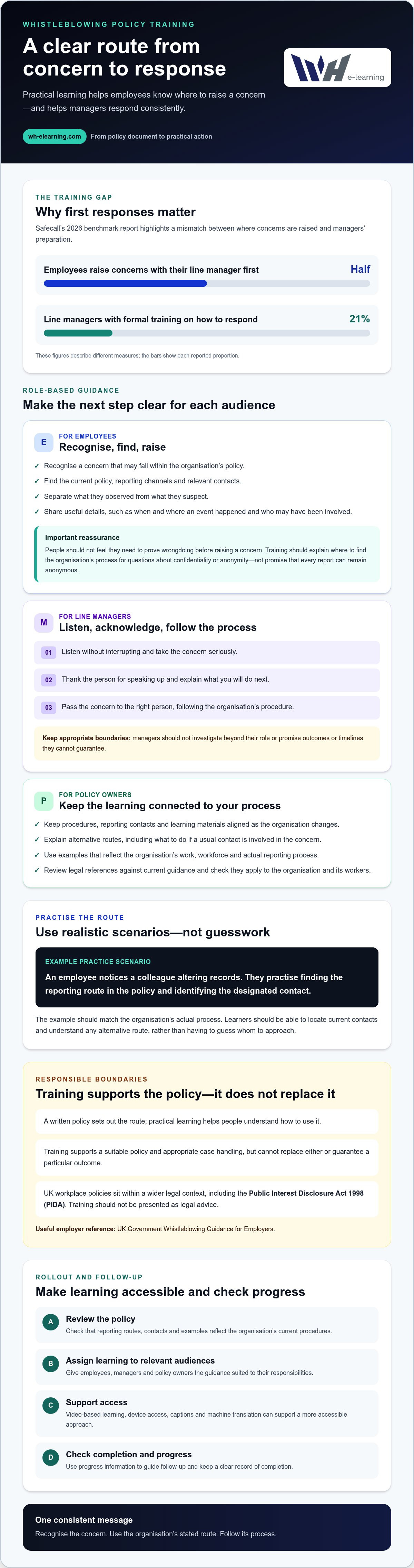
Half of employees raise concerns with their line manager first, yet only 21% of line managers have received formal training on how to respond, according to Safecall’s 2026 benchmark report. That gap is why whistleblowing policy training online should do more than summarise a document: it should help people understand what to say, where to go and what happens next.
A written policy sets out a route, but it can’t build confidence on its own. Employees may be unsure whether an issue qualifies as a concern, while managers may respond differently to similar disclosures. Practical training helps people use the policy and supports a more consistent response across the organisation.
This article explains what effective online whistleblowing training should teach employees and managers, how to deliver it accessibly and responsibly, and how to keep a clear record of completion. It also covers how to align learning with your organisation’s policy, make reporting routes easy to find and use progress information to guide follow-up.
Key Takeaways
- Training can help staff recognise concerns and understand the reporting routes set out in their organisation’s policy.
- Effective whistleblowing policy training online focuses on practical actions for employees and managers, not just legal terminology.
- Online learning can explain key principles consistently, while workplace procedures and reporting contacts should reflect the organisation’s own policy.
- Start a useful rollout by reviewing the policy, assigning learning to relevant audiences and checking completion and progress.
- Video-based learning, device access, captions and machine translation can support a more accessible approach to workplace compliance training.
What is online whistleblowing policy training, and why does it matter?
Online whistleblowing policy training teaches people how to recognise a concern, find the reporting options in their workplace and take an appropriate next step. It turns a written procedure into practical learning, helping staff connect the policy to decisions they may face at work. Sending employees a document makes information available, but doesn’t show them how to use it.
Online whistleblowing policy training is learning that helps employees and managers understand how to recognise, raise and respond to concerns using their organisation’s reporting procedures.
That distinction matters because someone raising a concern may be unsure whether it is appropriate to report or whom to tell. Training can explain the organisation’s routes and what information may help when making a report. It should also set realistic expectations: training supports a suitable policy and appropriate case handling, but can’t replace either.
UK workplace policies sit within a wider legal context, including the Public Interest Disclosure Act 1998 (PIDA). Training can introduce relevant principles, but it shouldn’t be treated as legal advice or as a substitute for the organisation’s own procedures. The policy and the people responsible for handling cases remain central.
How is whistleblowing training different from reading a policy?
A policy may name a reporting channel, but training helps learners decide how to use it in a real situation. For example, an employee who notices a colleague altering records can practise finding the route specified in the policy and reporting the concern to the designated contact. They shouldn’t have to guess whether a particular manager is the right person to approach. The example should reflect the organisation’s actual process.
That connection to local procedures is essential. Training should point learners to current reporting contacts, explain any alternative route described in the policy and make clear what to do if their usual contact is involved in the concern. This makes whistleblowing policy training online useful in practice, rather than a general overview detached from workplace reality.
Who needs whistleblowing policy training?
Different roles need different guidance. Employees need to recognise concerns and know how to raise them. Line managers need a clear starting point for listening, responding calmly and following the organisation’s process, rather than trying to investigate beyond their role. Policy owners need to keep procedures, contacts and learning materials aligned as the organisation changes.
Responsibilities may also vary with seniority and the reporting route. A concern about a direct supervisor, for instance, may need to follow an alternative pathway set out in the policy. Training examples should reflect the organisation’s work and workforce, so learners can recognise relevant situations without having to infer procedures that haven’t been explained.
A well-designed programme gives each audience the guidance it needs while reinforcing one consistent message: use the organisation’s stated routes and follow its process. That makes the policy easier to act on, without suggesting that training alone guarantees a particular outcome.
What should effective whistleblowing policy training teach employees and managers?
Effective training should leave people with clear actions, not just a list of legal terms. Employees need to recognise a concern that may fall within their organisation’s policy and know where to find the procedure. Managers need to respond calmly, maintain appropriate boundaries and pass the concern to the right person. The learning should reflect the organisation’s own reporting routes and make clear that these can differ between workplaces.
Legal references need particular care. If training discusses protections or UK legislation, review the content against current guidance and check that it applies to the organisation and its workers. The UK Government Whistleblowing Guidance for Employers is a useful reference for employers developing or reviewing their approach. Training should support the policy, not present itself as legal advice.
What should employees learn about raising a concern?
Employees should practise finding the current policy, relevant contacts and available reporting channels. A useful activity asks them to choose a route for a realistic scenario, then locate that route in the policy. This helps reveal whether the instructions are easy to find and follow.
Staff can also learn to communicate clearly by separating what they observed from what they suspect. Relevant details may include when and where an event occurred and who may have been involved. They shouldn’t feel they need to prove wrongdoing before raising a concern; the organisation’s process should explain what information is helpful.
Explain confidentiality and anonymity carefully. A policy may describe how information is handled, but training shouldn’t promise that every report can remain anonymous or that a person’s identity will never be disclosed. Learners should know where to find the organisation’s process if they’re unsure.
What should managers learn when someone speaks up?
Managers are often an initial point of contact, so training should give them a steady first-response approach: listen without interrupting, take the concern seriously, thank the person for speaking up and explain what they’ll do next. They should avoid making promises about outcomes or timelines they can’t control. Reassurance should be honest and consistent with the policy.
Managers also need to understand the limits of their role. They shouldn’t dismiss a concern because it seems minor, confront someone named in a report or start an investigation unless the organisation’s process authorises them to do so. Instead, they should record the information in line with internal procedures and promptly escalate it to the designated person or team.
- Know who receives and handles reports.
- Use the stated escalation route, including an alternative if the usual contact is implicated.
- Keep information within the appropriate process and avoid informal discussion.
Well-planned whistleblowing policy training online can help deliver consistent learning, while examples and contact details remain specific to each organisation. It can sit alongside wider workplace compliance learning, helping organisations build practical knowledge across related topics.
Can online whistleblowing training handle a sensitive workplace topic effectively?
Yes, if it’s designed with clear boundaries. Online learning can explain core principles, prompt learners to consider appropriate responses and present consistent information across a team. It can’t determine how a particular disclosure should be handled or replace an organisation’s procedures. Those must remain specific to the workplace, including its reporting contacts, escalation routes and support options.
Choose the format according to the learning goal, rather than assuming one method suits everyone. Self-paced modules work well for shared foundations, especially across teams in different locations or with varied schedules. Facilitated discussions give people a chance to explore nuanced questions and role-specific situations. Each format has strengths and limits.
Which learning format suits different whistleblowing training needs?
Online modules can establish a consistent baseline: what a concern might look like, where the policy is kept and how to find the stated reporting channel. Scenario-based questions can then help learners practise choosing a sensible next step. Keep scenarios realistic but respectful. For example, ask what an employee should do after noticing a possible breach of procedure, without presenting the situation as entertainment or suggesting that the learner investigate it themselves.
Facilitated discussion is useful when teams need to unpack complex roles or talk through how a policy applies in their setting. It can make room for questions, but conversations need clear boundaries so no one is pressed to share personal experiences or disclose a real case. Organisations can combine online foundations with in-house face-to-face sessions where useful.
| Learning format | Useful for | Consider |
|---|---|---|
| Self-paced online learning | Consistent core information for distributed teams | Provide a clear route to policy details and support after the module |
| Facilitated discussion | Exploring complex or role-specific scenarios | Set boundaries and direct questions about real cases to the proper channel |
| Combined approach | Shared foundations followed by local discussion | Keep examples and guidance aligned with current procedures |
How can online training feel accessible and responsible?
Use plain language, a steady pace and examples that reflect different roles and working environments. Video-based learning can support engagement, while captions can help learners follow the content in different settings. WH eLearning’s workplace compliance courses are accessible on different devices and include closed captions and machine translation into more than 25 languages. These features can widen access, though translated wording should be reviewed where exact policy terms matter.
Protect people’s dignity. Avoid graphic, sensational or identifying details, and don’t use real cases in a way that could expose someone involved. Close with practical signposting: show learners where to find the current policy, reporting contacts and relevant support channels. This lets the module teach principles without pretending to replace local guidance.
How can you roll out whistleblowing policy training and check that it works?
A clear rollout starts with the organisation’s own process, not with assigning a generic module and assuming the job is done. Review the policy, identify who needs which learning, then make completion straightforward and review the results. This keeps examples and reporting details accurate while helping you spot where people may need further explanation.
How do you prepare and assign the training?
Use a simple sequence to prepare the programme:
- Review the policy. Check that it is current and clearly explains reporting options, escalation routes and relevant contacts.
- Identify audiences. Include employees, relevant managers and the people responsible for maintaining the policy. Consider whether different roles need different guidance.
- Align the learning. Make sure scenarios, contact details and instructions match current procedures. If a reporting contact or route has changed, update the learning materials before assigning them.
- Assign and explain. Set out who should complete the learning, how completion will be recorded and why it matters. Make the policy easy to locate alongside the training, so learners can refer to the organisation’s full process.
These checks help prevent a mismatch, such as a module directing someone to a contact who has since changed roles. They also give policy owners a practical prompt to revisit learning whenever internal arrangements are updated. Whistleblowing policy training online can support a consistent rollout across teams, but the organisation still needs to keep its local information accurate.
How can an organisation review completion and learning?
Completion records show who has finished the assigned training and where follow-up may be needed. Review them by relevant team or role, then remind people who haven’t completed the learning. Administrative features can help organisations oversee staff progress and compliance status, making it easier to maintain a clear record.
Completion is only one measure. Assessment results can indicate whether learners understood the material, while feedback may reveal unclear wording, hard-to-find policy details or scenarios that don’t feel relevant. Neither assessment scores nor course completion prove that someone will apply the process correctly in a real situation. Treat them as signals for review, not guarantees of behaviour.
Use feedback and policy changes to decide whether learning materials need updating or a refresher would be useful. There’s no universal schedule that suits every organisation; review the content when procedures change and consider what completion and learner responses show. For practical ideas on tracking staff training progress online, keep progress records alongside a clear process for acting on what they reveal.
Accessible compliance learning can also sit within wider staff development through WH eLearning’s online compliance courses.
How can WH eLearning support accessible online compliance learning?
Whistleblowing learning works best when it fits into a wider programme that helps people understand workplace expectations and act responsibly. WH eLearning provides video-based workplace compliance courses for individuals and organisations, covering compliance, HR and health and safety topics. This wider learning offer can support consistent staff development while whistleblowing procedures and reporting contacts remain specific to each organisation’s policy.
Online learning can make it easier to provide shared foundations across a workforce. Learners can access courses on different devices, while organisations can use bulk access and administrative features to monitor progress and compliance status. This gives administrators a practical view of completion without treating a course record as proof that someone will respond correctly in every real situation.
What can accessible video-based learning offer a workforce?
Video-based courses present workplace topics in a clear, structured format that learners can access across devices. This can help employees fit learning around their working routines and revisit material where appropriate. Accessibility matters too: closed captions support people who prefer or need text alongside spoken content, and machine translation into more than 25 languages can help make learning more accessible to a linguistically diverse workforce.
Translation can support understanding, but organisation-specific policy language still needs to be clear. For whistleblowing, make sure learners can find the current reporting process and contacts alongside any general learning. A course can explain broad principles; the organisation’s own procedures must guide local action.
Some WH eLearning courses provide digital certification after successful assessment. This records a course outcome where applicable; it shouldn’t be presented as a guarantee of competence or as certification for a particular whistleblowing course.
How can organisations connect this topic to wider compliance learning?
Organisations can plan whistleblowing learning as one part of a broader compliance programme, alongside relevant HR and health and safety topics. A programme can give staff a consistent base of knowledge while policy owners keep local reporting instructions accurate and easy to find. WH eLearning offers more than 100 online workplace courses across compliance, HR and health and safety, giving organisations options for building learning around different workplace needs.
For wider programme planning, a business compliance e-learning guide can help frame how individual topics fit together. Keep the purpose practical: assign relevant learning, make it accessible and use progress information to identify where follow-up may be useful.
If you’re developing workplace learning beyond whistleblowing, explore WH eLearning’s online compliance courses for a flexible way to support staff development across related topics.
Make confident speaking up part of everyday practice
Make speaking up a normal part of a healthy workplace, not a one-off training topic. Leaders and managers influence that culture through what they do after learning: respond respectfully, follow the stated process and show that concerns are taken seriously. Those everyday signals help staff see that the organisation’s approach is more than words on a page.
Use whistleblowing policy training online as part of a wider commitment to clear communication and responsible workplace behaviour. Keep the focus on practical learning and give people a straightforward way to revisit relevant guidance when questions arise. Small, consistent actions can help build confidence over time.
To develop your wider staff learning programme, explore workplace compliance training with WH eLearning. Video-based courses, accessible across devices and supported by captions and machine translation, can help you build learning around your workforce’s needs.
Frequently Asked Questions
Is whistleblowing training mandatory for UK employees?
There’s no general UK legal requirement for every employee to complete whistleblowing training. Employers should still have appropriate arrangements for workers to raise concerns, and training is a practical way to help staff understand those arrangements. Requirements can depend on an organisation’s sector and circumstances, so treat this as general information rather than legal advice. Review relevant guidance when developing your policy and decide what learning best supports your workplace.
Can an employee raise a whistleblowing concern anonymously?
Possibly, depending on the organisation’s reporting channels. A policy may explain whether anonymous reports are accepted and how they’re handled. An employee considering this route should share as much factual detail as they can, as limited information may make follow-up difficult. They should also understand that anonymity can’t always be guaranteed throughout handling. The organisation’s policy should explain how personal information and reports are managed.
How often should employees receive whistleblowing policy training?
There isn’t one refresher schedule that suits every workplace. Provide learning when someone joins or moves into a role with different responsibilities, and revisit it when reporting routes or policy wording change. Staff feedback, assessment results or a gap identified during a policy review can also help determine whether a refresher would be useful. Keep a record of the reason for each update, so future reviews have useful context.
What should a manager do after receiving a whistleblowing concern?
A manager should respond respectfully, clarify any immediate practical information without pressuring the employee, and follow the organisation’s procedure. They should make a factual record using the approved process, avoid sharing details informally and pass the concern to the person or team responsible for handling it. If the report involves the manager’s usual contact, they should use the alternative route in the policy rather than attempting to resolve it alone.
Does whistleblowing training apply to small businesses?
Small businesses can benefit from training too, even if they have fewer reporting layers than larger employers. Staff still need to know how to raise a concern, particularly if the person they’d normally approach is involved. A small organisation can make its process clear by naming an appropriate alternative contact and explaining how reports are passed on. Keep the approach proportionate, understandable and suited to the way the business operates.
How can an organisation check whether staff understand its whistleblowing policy?
Use a short scenario or knowledge check that asks learners to choose the right reporting route for a realistic situation. Then ask them to locate the relevant policy contact without prompting. Compare responses across roles to spot instructions that may be unclear, and invite feedback on confidence or accessibility. These checks show where understanding may need support; they don’t prove how someone will act in a real case. Whistleblowing policy training online can include checks like these alongside completion records.


