

Accident investigation training online can teach you a repeatable method, but it can’t make judgement calls for you at the scene. To get value from a course, treat the steps as a starting point, then apply them to your workplace so the findings are useful.
It’s reasonable to ask whether online learning can prepare someone for real incidents. A useful course should explain how to gather evidence, speak with witnesses and identify contributing factors, rather than just cover theory. The right level of training depends on each learner’s role, experience and workplace risks.
This guide explains what a clear investigation process involves, what online training can teach and how to assess whether a course fits your needs. It also shows how to match training to different responsibilities and turn findings into proportionate corrective actions. Use these points to choose training with a practical purpose and build a consistent approach to learning from incidents.
Key Takeaways
- A structured investigation helps you gather evidence and identify contributing factors without jumping to conclusions.
- Accident investigation training online can build knowledge of the investigation process, but workplace practice is still needed.
- Compare courses by audience, learning outcomes, format, assessment and practical application before choosing one for your team.
- Check the provider’s credentials, course scope and any stated accreditation directly before enrolling.
- After training, review investigation roles, escalation routes and how findings can inform proportionate improvements.
Accident investigation training online: what it teaches and why it matters
After an accident or near miss, the first priority is to make the situation safe. The next step is to understand what happened, what contributed to it and how to reduce the chance of a similar event. An investigation is a structured process for gathering and assessing evidence, not simply recording what was visible at the time.
In practical terms: an accident is an event that results in harm or damage; an incident is an unplanned event, which may or may not cause harm; and a near miss is an event that could have caused harm but did not. Organisations and reporting frameworks may use these terms differently, so check the definitions in your workplace procedures and relevant guidance.
A learning-focused investigation looks beyond the first apparent cause. It considers how work was planned and carried out, what conditions were present, and whether procedures, equipment, training or supervision played a part. The aim isn’t to assign blame by default. If individual actions or responsibilities are relevant, consider them fairly and base conclusions on evidence rather than assumptions.
What workplace accident investigation training should cover
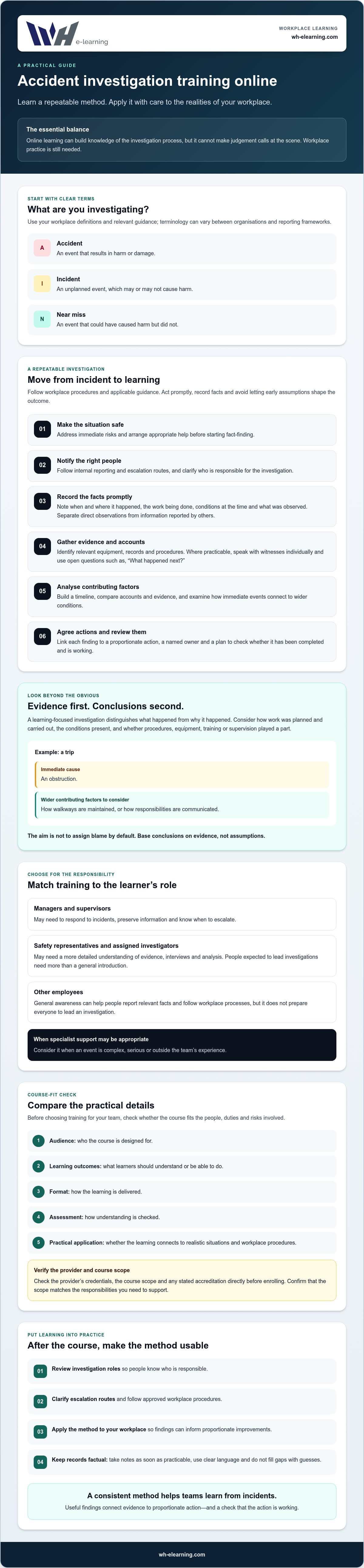
Useful training introduces a repeatable approach to gathering evidence, speaking with witnesses, building an event timeline and reaching proportionate findings. A clear accident analysis process connects fact-finding with analysis and recommendations. It helps investigators distinguish what happened from why it happened. For example, a trip may have an immediate cause, such as an obstruction, as well as wider contributing factors, such as how walkways are maintained or responsibilities are communicated.
The right depth depends on the learner’s responsibilities and workplace risks. Someone expected to lead investigations needs more than a general introduction. They may need to practise applying the method to realistic situations and workplace procedures.
Who benefits from online investigation training?
Managers and supervisors may need to respond to incidents, preserve information and know when to escalate. Safety representatives and staff assigned investigation duties may need a more detailed understanding of evidence, interviews and analysis. General awareness can help other employees report relevant facts and follow workplace processes, but it doesn’t prepare everyone to lead an investigation.
When an event is complex, serious or outside the team’s experience, specialist support may be appropriate. Online learning can provide flexible access to core concepts, but learners still need to follow approved procedures and use sound judgement. For a broader view of workplace learning options, see this occupational safety and health training guide. Before enrolling in accident investigation training online, check the current course catalogue and confirm that the course scope matches the responsibilities you need to support.
How an effective accident investigation moves from incident to learning
A consistent sequence helps investigators act promptly without letting early assumptions shape the outcome. Follow your organisation’s procedures and applicable guidance. OSHA’s overview of investigating a worksite incident also explains how examining incidents can help identify hazards and prevent future events.
- Make the situation safe. Address immediate risks and arrange appropriate help before beginning fact-finding.
- Notify the right people. Follow internal reporting and escalation routes, and clarify who is responsible for the investigation.
- Record the facts promptly. Note when and where the event occurred, the work being done, conditions at the time and what was observed. Separate direct observations from information reported by others.
- Gather evidence and accounts. Identify relevant equipment, records and procedures. Where practicable, speak with witnesses individually and use open questions such as, “What happened next?”
- Analyse contributing factors. Build a timeline, compare accounts and evidence, and examine how immediate events connect to wider conditions.
- Agree actions and review them. Link each finding to a proportionate action, a named owner and a plan to check whether it has been completed and is working.
Take notes as soon as practicable and use clear, factual language. Don’t fill gaps with guesses or decide on a cause before reviewing the available information. Preserve relevant evidence only when it’s safe and consistent with workplace procedures. Interviews and evidence handling should follow those procedures and applicable guidance, particularly if an incident needs to be escalated.
Gather evidence and build a reliable timeline
Record relevant conditions, equipment, work activities and available documentation, such as maintenance or training records where they’re pertinent. Ask witnesses neutral, open questions and note their words accurately. Keep what someone saw, heard or did separate from their interpretation. A timeline can reveal gaps or differences that need checking, rather than treating the first account as conclusive.
Identify causes and select proportionate actions
Root cause analysis helps examine contributing factors; it isn’t a way to automatically assign blame. Depending on the circumstances, consider human factors, training, supervision, equipment and how work was organised. Identifying contributing causes supports prevention because it helps address conditions that could lead to another event, not only the final action or failure observed.
Make each action specific and traceable to a finding. For example, if the evidence shows that a work area’s layout contributed to an obstruction, an action might address how that area is organised, with an owner and review date. Good accident investigation training online should help learners practise this reasoning. Workplace decisions must still follow approved procedures and take account of the actual risks.
To explore available health and safety learning, review WH eLearning’s course options and check the current catalogue for a course that matches your team’s needs.
Is accident investigation training online enough for real workplace incidents?
Online learning can teach investigation principles and a structured method, but it can’t automatically demonstrate that someone can investigate competently in your workplace. Learners need to understand local hazards, procedures and escalation routes, then apply their knowledge with suitable supervision and practice. Course completion alone isn’t proof of practical competence.
That doesn’t make online study less useful. It can establish a shared foundation, while managers reinforce learning through clear responsibilities, workplace procedures and opportunities to practise. The right approach depends on the learner’s role, the risks they may face and the complexity of the investigations they’re expected to support.
What online learning can do well
Self-paced learning gives people flexibility to work through core concepts and revisit explanations when needed. It can also help geographically dispersed teams access shared material, depending on course availability and accessibility. Facilitated discussion offers a different benefit: learners can explore scenarios together, ask questions and compare how they would apply a method. Neither format is automatically better for every team.
WH eLearning’s platform includes video-based learning accessible on different devices, closed captions and machine translation into more than 25 languages. Features may vary between courses, so check the details of the course you’re considering. These options can support access to learning, but they don’t replace practice with the equipment, work conditions or reporting routes learners will encounter locally.
Where workplace practice and support still matter
Investigation responsibilities depend on the organisation. A general course may explain how to gather information, but it won’t necessarily cover your site’s specific hazards, internal records, reporting process or who must be notified. Managers can bridge that gap by connecting course concepts to approved procedures and discussing how they apply to the team’s work.
Try a short, realistic scenario after training. For example, ask learners what information they would record after a near miss involving equipment, which questions they would ask and when they would escalate concerns. Use anonymised details if drawing on a real event, and make sure the exercise follows your organisation’s policies. Supervised practice can help managers identify where someone needs further guidance before taking on an investigation independently.
Choose support in proportion to the circumstances. A straightforward event may be within the capability of a trained manager or supervisor working within their role. If an incident is complex, involves serious risk, exceeds the investigator’s experience or triggers requirements under organisational policy, seek suitable specialist input. Accident investigation training online can provide a useful foundation, but practical judgement develops through applying that learning in context with appropriate oversight.
How to choose accident investigation training online for your team
Start with the job learners need to do, not the course title. A supervisor who reports incidents may need a different level of knowledge from a manager expected to lead investigations. Match course depth to each learner’s duties, your workplace risks and existing investigation procedures. Use the comparison points below to assess whether accident investigation training online is likely to fit.
| What to compare | Questions to ask |
|---|---|
| Intended audience | Is it designed for general staff, supervisors, managers or people who lead investigations? |
| Learning outcomes | Does it cover evidence gathering, witness conversations, causal analysis and corrective actions at the level learners need? |
| Format | Can learners study in a suitable way, and does the course explain how its content applies to workplace practice? |
| Assessment | How is learning checked, and what does successful completion document, if anything? |
| Workplace application | Can you connect course learning to your procedures, hazards and escalation routes? |
Check learning outcomes, assessment and course scope
Read the course description and outcomes closely. Look for a clear explanation of the topics covered, the intended learner and the limits of the course. Check whether learners practise applying the method or mainly review concepts. Ask the provider how learning is assessed and what evidence of completion is issued. If a course claims accreditation or a certificate, confirm that the claim applies to that specific course and verify it directly with the provider or accrediting body.
Also check the provider’s relevant credentials and whether the course reflects the kind of incidents your team may encounter. Don’t assume a broad health and safety course covers investigation in the depth your designated investigators require.
Match delivery to individual learners or a whole workforce
For one learner, individual enrolment may be appropriate. For organisation-wide learning, consider whether bulk access and administrative progress tracking would help you coordinate training. Check device access, closed captions and language options against staff needs, as features can vary by course and provider. WH eLearning offers video-based learning on different devices, with closed captions and machine translation into more than 25 languages. Review its workplace safety training courses guide for broader planning considerations.
Before choosing, check the current catalogue for a course that specifically matches accident investigation needs. Explore WH eLearning’s course options as part of your comparison, then verify the course scope and any assessment or accreditation details before enrolling.
Turn online accident investigation training into safer workplace practice
Training creates value when learners can connect what they’ve studied to how incidents are handled at work. A short follow-up plan can turn learning into consistent action while keeping investigations within approved procedures and each person’s responsibilities.
Create a practical follow-up plan after training
Ask learners to review the organisation’s reporting routes and investigation templates with the manager responsible for their work. Confirm who leads an investigation, who must be informed and where staff can get support if an event is beyond their experience. Keep this guidance accessible so people can refer to it when needed.
A discussion exercise can help learners practise applying course concepts without using a live incident as a test. Choose a suitable scenario and ask the group what information they would record, what they would check and when they would escalate. If the example is based on a real event, remove details that could identify people or disclose sensitive information. This exercise supports learning; it doesn’t replace a formal investigation or workplace procedures.
Organisations can record course completion and use administrative progress tracking to see who has accessed assigned learning. Treat this as a training record, not proof that someone is competent to lead an investigation. Managers can identify further learning needs through discussion, supervision and, where appropriate, observed practice. After corrective actions are agreed, review them later to confirm they were completed and remain effective.
Explore online health and safety learning with WH eLearning
WH eLearning provides more than 100 video-based courses across health and safety, HR and business compliance. Individuals can enrol, while organisations can use bulk training licences and administrative progress tracking. Courses are accessible on different devices, and the platform includes closed captions and machine translation into more than 25 languages. Check each course’s details to confirm which features apply.
Check the current catalogue to see whether a course matches your accident investigation responsibilities and workplace risks. Online learning can support a stronger foundation, while practical judgement and competence still depend on applying knowledge appropriately within your organisation.
Explore WH eLearning’s health and safety training and check which course best matches your needs.
Build a stronger approach to workplace investigations
The right accident investigation training online can give learners a clear method for gathering evidence, examining contributing factors and recommending proportionate actions. Choose training that fits each person’s responsibilities and your workplace risks, then reinforce it through approved procedures, supervision and practice.
Training completion is a useful record, but it doesn’t demonstrate competence on its own. Review how learners apply the method, clarify who should lead or escalate an investigation, and identify where further support may be needed.
WH eLearning offers more than 100 video-based courses across workplace topics. Its platform includes closed captions and machine translation into more than 25 languages, while organisations can use bulk training licences and progress tracking. Course features vary, so check the details and current catalogue to see whether a course matches your investigation needs.
Explore WH eLearning’s health and safety training and review the current course options. With suitable learning and thoughtful workplace follow-through, your team can build a more consistent approach and make incident findings count.
Frequently Asked Questions
What is accident investigation training?
Accident investigation training teaches people how to examine an event systematically, gather relevant information and identify contributing factors. Depending on the course, it may cover evidence gathering, witness conversations, timelines, causal analysis and corrective actions. The aim is to understand how an event happened and what could help prevent a recurrence, rather than jumping to blame. The right depth depends on the learner’s role and workplace risks.
Can accident investigation training be completed online?
Yes, some providers offer accident investigation training online. It can give learners flexible access to explanations of investigation principles and structured methods, which they can revisit at a suitable pace. Check the course description to confirm its scope, format, assessment and intended audience. Online learning can establish a foundation, but learners may also need workplace-specific instruction and practice before taking on investigation duties.
Is online accident investigation training enough to investigate a workplace accident?
Not by itself. An online course can teach a method, but it can’t automatically show that someone can apply it competently in your workplace. Learners also need to understand local hazards, reporting routes and approved procedures. Managers can reinforce learning through supervision and scenario discussions, then identify where more practice or specialist input is needed. Course completion is a training record, not proof of investigation competence.
Who should take accident investigation training at work?
Managers, supervisors, safety representatives and staff assigned investigation responsibilities may benefit, with training matched to their duties. General awareness can help employees understand how to report an event and share relevant facts. People expected to lead investigations may need more detailed learning and supervised practice. If an incident is complex or exceeds the team’s experience, follow organisational procedures for escalation and consider suitable specialist support.
What should an accident investigation training course cover?
Look for course content that explains how to gather and record evidence, speak with witnesses, build an event timeline and identify contributing factors. Useful coverage also connects findings to proportionate corrective actions. Check whether the course considers immediate causes alongside wider influences, such as equipment, supervision or work organisation. Its scope should suit learners’ responsibilities and the risks they may encounter, rather than simply offering a general overview.
Does accident investigation training provide a certificate?
That depends on the provider and the specific course. Before enrolling, check whether an assessment is included and what successful completion documents, if anything. If a certificate or accreditation is mentioned, confirm directly with the provider that the claim applies to that course. Don’t assume a certificate proves someone is competent to lead workplace investigations; competence also depends on applying learning appropriately within organisational procedures.
How do you choose the right accident investigation course for a team?
Start by mapping learners’ roles and investigation responsibilities to your workplace risks. Compare courses by audience, learning outcomes, format, assessment and how the content could be applied at work. Check the provider’s credentials and verify any accreditation or certificate claims directly. For a whole team, also consider individual or bulk access, progress tracking, device access and language needs. Confirm that the current course catalogue includes training that matches your requirements.


