

A workplace accident doesn’t, by itself, show whether an employer took reasonable care. In Canada, proving due diligence in a workplace accident means demonstrating that reasonable precautions were in place before the incident; due diligence can be a defence to an occupational health and safety charge, established on the balance of probabilities. The focus is on what the employer did to prevent harm in the circumstances, not simply what happened afterwards.
After an incident, it is natural to focus on the immediate cause. A sound review also examines the safety arrangements in place beforehand, whether they were followed and monitored, and what could be improved. This article explains how reasonable care is assessed and why it depends on the work, the risks and the people involved.
You’ll also learn which records can help build a clear picture, from training and inspections to incident investigations and corrective actions. Worker input can reveal issues that paperwork alone may miss. The practical checklist brings these points together so you can assess your approach and identify where safety measures or documentation need attention.
Key Takeaways
- Assess due diligence by looking at the reasonable precautions in place before an incident, not only the response afterwards.
- Review whether training was understood and verified, and whether workers and contractors received site-specific safety orientations.
- Bring incident and near-miss records together with inspections, audits and worker feedback to identify patterns and underlying hazards.
- Use the work, level of risk and available controls to judge whether safety measures were appropriate to the circumstances.
- Keep clear evidence of hazard assessments, corrective actions and how safety procedures are monitored and enforced.
Strict liability for occupational health and safety offences
Due diligence focuses on reasonable precautions taken before harm occurs, not simply the response afterwards. The legal test varies by country, so international strict-liability rules should not be treated as a single uniform framework.
Strict liability and due diligence
In occupational health and safety, proving due diligence in a workplace accident means taking all reasonable precautions in the circumstances to prevent workplace injuries and accidents. In many jurisdictions, it can be a defence to an occupational health and safety charge if the defendant establishes reasonable care on the balance of probabilities.
Strict liability matters because the prosecution must prove the prohibited act beyond a reasonable doubt, but does not need to prove negligence. The employer’s evidence therefore needs to show a functioning health and safety programme, not just a policy written after an accident. For example, a machinery procedure should be in place and followed before an injury occurs.
In various regions, regulatory bodies impose substantial financial penalties for wilful or repeated violations. That makes clear records of hazard controls, training and supervision important when an employer needs to explain its safety practices.
Safety information and supervision
Safety information, instruction, training and supervision help workers understand hazards and follow safe procedures. Regulatory authorities advise employers to provide these measures. Employers should document both formal and informal training.
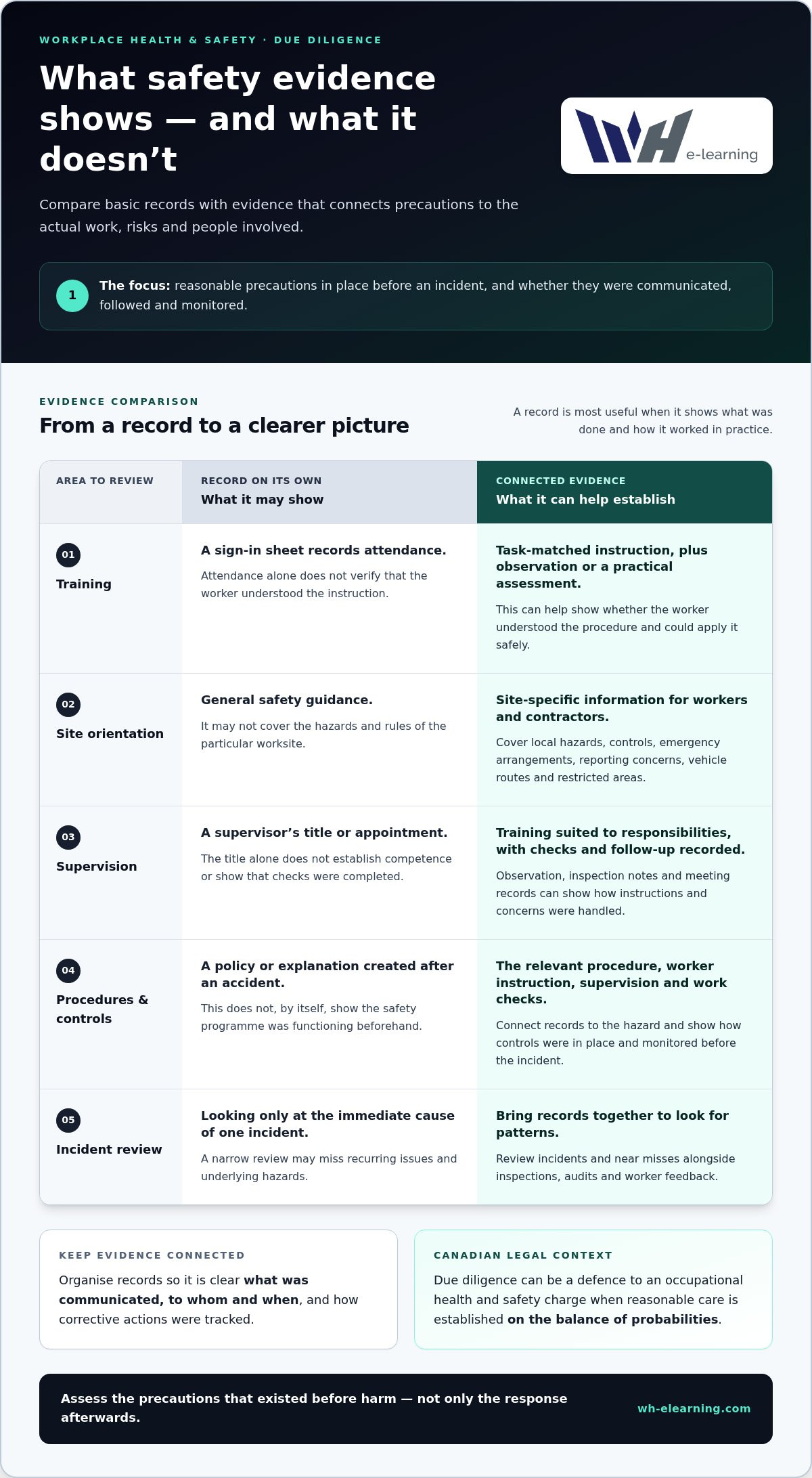
For example, a worker assigned to use hazardous equipment needs instruction on the relevant procedure and supervision to check that it is followed. A training record can show what instruction was delivered; observation or a practical assessment can help establish whether the worker understood it.
Employers also need to understand their legal obligations and make responsibilities clear to supervisors and workers. Authorities advise employers to know their statutory obligations under applicable health and safety legislation and regulations. A supervisor’s title alone does not establish competence. Employers should train supervisors and verify that required safety checks are completed.
Proving due diligence after an accident
When proving due diligence in a workplace accident, an employer seeking to show that it took reasonable precautions needs evidence of its safety practices. Connect that evidence to the hazard, the work and the controls in place before the accident, rather than relying on explanations created afterwards.
Start with records showing the relevant procedure, worker instruction, supervision and checks of the work. If an incident involved a machine guard, for example, records should establish the safety requirements and how the employer monitored compliance. Multi-employer citation policies may also allow regulators to cite more than one employer for the same hazardous condition at a worksite, so responsibilities between employers may matter.
To exercise due diligence, employers should identify risks, take reasonable and prudent precautions, and keep evidence that those precautions work in practice. Reviewing legal duties alongside incident records can reveal whether procedures were suitable, communicated and enforced. These steps help establish what the employer did before the event, which is central to assessing reasonable care.
What are areas to consider when reviewing due diligence?
Review how safety expectations were communicated, how understanding was checked and how supervisors responded to gaps. Training records matter, but they should relate to the actual tasks and conditions at the site.
Verifying training and site orientations
Training verification means checking that instruction matches the task and that each worker can apply it safely. A sign-in sheet records attendance, but practical observation can show whether someone follows the required procedure.
For a site-specific orientation, cover hazards, controls, emergency arrangements and who workers should tell about concerns. A contractor arriving at a worksite, for example, needs information about local vehicle routes and restricted areas, not just general safety guidance.
A documented contractor management programme can include prequalification, training and certification checks, site orientations and corrective-action tracking. Keep the records together so an investigation can establish what was communicated, to whom and when.
Worker communication and supervision
Worker communication means sharing relevant policies and procedures in a form workers can understand, then providing a way to raise concerns. WorkSafeBC advises employers to communicate health and safety policies and procedures and ensure workers are trained on them.
Supervision should connect those instructions to on-the-job behaviour. For example, a supervisor overseeing a lifting task can check that workers use the agreed method and pause work if site conditions change.
Supervisors need health and safety training suited to their responsibilities. Employers should also verify that a competent person has completed required work, rather than assuming the appointment alone proves it. Meeting records, inspection notes and follow-up actions can show how concerns were handled.
Mistakes that weaken a due diligence defence
Common mistakes include relying on attendance records without checking understanding, giving generic orientations that miss site hazards and failing to follow up on known problems. Each can create a gap between written procedures and how work was actually managed.
Another weakness is treating a competent worker or supervisor as a substitute for oversight. A system should show how the employer checked performance, addressed unsafe behaviour and tracked corrective actions. If an investigation identifies a training gap, respond with suitable instruction and record the change.
Workers’ feedback can expose unclear instructions or hazards that formal documents overlook. Use a clear reporting route, record concerns and show what action followed. For teams needing structured instruction, Health and Safety Training Courses can support workplace learning alongside task-specific orientation and supervision.
Meaning of reasonable care
Reasonable care is judged against the work, risks and available precautions in the circumstances. A safety measure that is adequate for one task may be insufficient for another.
Applying reasonable care
Reasonable care means taking the precautions a reasonable person would take in the circumstances. It does not require perfection, but employers should show how they identified risks and acted to reduce them.
For example, work at height calls for controls suited to the fall risk, equipment and workers’ experience. A routine inspection may be inadequate if the task involves a more serious hazard or conditions have changed.
Assess the specific situation. Consider workers’ knowledge and experience, the task, the likelihood and potential severity of harm, and who controlled the work. Also ask whether a safer alternative was available.
Practicability matters too. The Labour Program (Canada) describes reasonably practicable precautions as those that are possible and suitable or rational in the particular situation. Available resources, feasibility and urgency can affect which precautions are reasonable.
- Identify the hazard, such as moving machinery or an unstable work surface.
- Consider who could be harmed, including workers affected by another employer’s work.
- Choose controls suited to the risk and the people performing the task.
- Document why the selected precautions were appropriate and how they were applied.
Reasonable care also extends to hazards not specifically addressed by legislation. The absence of a specific rule does not remove the need to consider a foreseeable risk, such as a vehicle and pedestrian route crossing at a busy loading area.
Distinguishing diligence from negligence
Courts distinguish due diligence from negligence by examining the precautions taken and the circumstances, rather than treating an accident alone as proof of fault. The question is whether the employer exercised reasonable care, not whether its safety system was perfect.
Negligence centres on a failure to take reasonable care. Due diligence examines the broader preventive effort: whether risks were identified, suitable controls chosen, and those controls communicated and monitored before the incident.
For example, if a worker is injured despite a documented procedure, a review can examine whether the procedure addressed the actual hazard and whether supervisors checked that it was followed. A procedure that existed only on paper offers less evidence of effective workplace safety.
Keep the assessment grounded in evidence. Compare the hazard assessment, selected precautions and site conditions with what workers and supervisors knew at the time. If a safer, feasible option was available, explain why it was or was not adopted.
This approach gives employers a practical way to assess reasonable care: examine the risk, available controls and actions taken before harm occurred.
Reviewing incident records and consulting workers
Employers should preserve incident evidence, review related records and speak with workers who understand the task. WorkSafeBC advises reviewing incidents and trends, inspections, audit findings, programme evaluations and worker input to identify workplace issues.
Reviewing incident records
Incident records help show what happened, which hazards were present and whether existing controls worked. Compare the report with risk assessments, inspection notes, audit findings and maintenance records for the equipment involved.
Look beyond the immediate injury. Near-miss reports may reveal that the same hazard appeared before anyone was hurt. For example, repeated reports of a slippery walkway can point to a cleaning or maintenance issue that needs attention.
WorkSafeBC advises employers to investigate incidents and near misses to identify root causes and required corrective actions. Record the issue, contributing conditions, assigned actions and how completion was checked. This links findings to changes in workplace policies.
Review patterns across the safety programme, not only the file for the specific accident. Compare incident trends with inspection and audit findings. If reports identify a recurring equipment fault, check maintenance records and whether the controls addressed the hazard.
Investigating accidents and consulting workers
A useful investigation establishes the sequence of events, contributing hazards and measures needed to prevent a recurrence. Record when and where the incident happened, the work underway, the equipment involved and the conditions workers observed.
Where practical, speak separately with the injured worker, witnesses and supervisors. Ask what task they were doing, what changed and whether procedures matched the conditions. A worker may report that a route became obstructed before the accident, adding context that an inspection form does not capture.
Gather relevant evidence, such as photographs of the area, equipment details, inspection records and applicable procedures. Keep observations distinct from conclusions, and note who provided each account. These steps make the investigation traceable and clarify how its findings were reached.
Then identify root causes rather than stopping at the immediate event. If a worker slips near a machine, examine the floor condition, work process and maintenance history. Assign corrective actions to a responsible person, record completion and communicate the change to affected workers.
Consult workers and supervisors when reviewing the findings. Their input can establish whether revised policies address the actual task and hazards. WorkSafeBC also advises employers to consider worker input when identifying workplace issues. A follow-up inspection can show whether the corrective action works in practice.
Workplace due diligence checklist
A useful checklist tests whether safety practices work in the circumstances, not simply whether documents exist. For each hazard, connect the risk, control, responsible person and evidence that the control was implemented.
Start with the task and the people who could be affected. WorkSafeBC advises employers to identify workplace issues through risk assessments involving appropriately knowledgeable people. Consider contractors and subcontractors too, as their work can create or expose others to hazards at the same site.
- Identify hazards: Record the work activity, who may be exposed and the potential severity of harm. For a lone worker, assess hazards such as heights, confined spaces, electricity, hazardous materials and public violence.
- Choose practical controls: Develop policies, procedures and practices that address the specific hazard. WorkSafeBC advises employers to develop controls for particular hazards and check that procedures are followed.
- Assign responsibility: Name who will implement each control and who will check it. Include contractor work, site access and corrective-action follow-up in the responsibility plan.
- Confirm worker understanding: Document training and assess whether employees can perform the task competently before assignment. Provide suitable personal protective equipment and enforce its use.
- Check conditions: Arrange workplace inspections and regular audits to identify hazardous conditions. Record findings, decisions and any action taken, including why a control was selected.
- Invite feedback: Give employees a clear way to report unsafe conditions or activities. Record the concern, response and follow-up so worker input leads to visible action.
- Review performance: Keep records of inspections, training, incident investigations, committee meetings, equipment maintenance, emergency drills and enforcement of safety rules.
Make the evidence usable. A dated inspection record should identify the area checked, the hazard found, the corrective action and how completion was verified. If a worker reports a damaged guard, for example, document how the hazard was controlled and who checked the repair.
Hold workplace safety talks monthly and document attendance with signatures. Review the occupational health and safety programme at least once a year, then record improvements. WorkSafeBC also advises employers to review systems frequently through self-evaluations and apply relevant changes to operations.
A completed checklist is not a substitute for action. Compare records with workplace conditions, investigate gaps and update controls when risks or work practices change. To strengthen staff knowledge of safety procedures, explore Health and Safety Training Courses.
WH eLearning: Health and Safety Training Courses
WH eLearning offers Health and Safety Training Courses to help employers build workers’ knowledge of workplace risks and safe practices. Its video-based courses are accredited and accessible on any device, with closed captions and machine translation into more than 25 languages.
Choose training that supports the needs of your team, then connect it with site-specific instruction, supervision and practical checks. WH eLearning also offers In-House Face-to-Face Training, HR and Business Compliance Courses, and Multi-language Course Translation. These options can support organisations working to make learning accessible and relevant across different roles and languages.
For help exploring training options for your organisation, contact WH eLearning or visit its website.
Build stronger safety practice from here
Use the next review to turn learning into a lasting workplace routine. Identify where workers or supervisors need clearer guidance, then build that learning into how tasks are planned, monitored and improved. This forward-looking approach keeps safety practices active instead of treating them as paperwork assembled after an incident.
For teams developing their knowledge, WH eLearning offers IOSH Managing Safely Online, IOSH Working Safely Online and health and safety training courses. Choose learning that fits roles and responsibilities in your organisation, then connect it with practical workplace instruction and oversight.
Building a stronger understanding of proving due diligence in a workplace accident starts with preparing people before risks become incidents. Contact WH eLearning to discuss training options that support your team’s learning needs. Each step towards clearer knowledge and safer practice can help your organisation keep improving.
Frequently Asked Questions
What is meant by due diligence?
Due diligence means taking reasonable precautions to prevent harm, based on the work and its risks. It does not guarantee that accidents will never happen. For example, an employer planning a delivery task should consider vehicle movements, pedestrian access and suitable controls. The standard also applies when a specific hazard is not expressly covered by a rule, because foreseeable risks still need attention.
How does an employer establish a due diligence programme?
An employer establishes a due diligence programme by assigning responsibility for identifying hazards, setting controls and checking that they work. Start with the activities and people at each worksite, then set procedures for managing the risks. For example, a warehouse programme could define who separates pedestrian and vehicle routes, who inspects barriers and how reported damage is addressed. Review the programme as operations or hazards change.
What documentation is needed to show due diligence?
Keep records that connect a safety decision to the work it addresses. Useful documents include risk assessments, written procedures, training records, inspection findings, maintenance logs and action records. If an inspection identifies a damaged guard, for example, retain the finding and the record showing how the issue was addressed. Clear dates, task details and named responsibilities make each record meaningful rather than an isolated form.
What is an example of a due diligence checklist?
For a loading area, a checklist could ask whether vehicle and pedestrian routes are separated, signs are visible, lighting is suitable and barriers are intact. It could name the person responsible for each check and provide space to record a hazard, corrective action and follow-up. This connects workplace conditions with decisions and evidence, rather than treating a completed checklist as proof that controls are effective.
Why does due diligence have special significance?
Due diligence matters because it examines an employer’s preventive efforts, not only the fact that an injury occurred. In Canada, it can provide a defence to an occupational health and safety charge if the defendant establishes that reasonable precautions were taken. The significance is practical as well as legal: reviewing the steps taken before an incident can expose gaps and guide improvements to workplace safety.
What does due diligence mean in a workplace accident investigation?
In an investigation, proving due diligence in a workplace accident means examining whether the employer’s precautions addressed the hazard before the incident. Investigators can compare the task as performed with the relevant assessment and procedure. If conditions changed during a job, for instance, establish who noticed, what action followed and whether workers received updated instructions. This helps assess how safety arrangements operated in practice.
What evidence helps prove an employer exercised due diligence after a workplace accident?
Evidence for proving due diligence in a workplace accident includes records created before the incident, such as risk assessments, inspection notes, maintenance entries and worker training records. Statements from workers and supervisors can explain how a task was carried out and whether the written procedure matched site conditions. Photographs or equipment details may clarify the physical circumstances. Together, these sources can show how decisions were made and precautions put into practice.
What records should employers preserve after a workplace accident?
Preserve the incident report, investigation notes, witness accounts, relevant risk assessments, procedures, training records, inspection findings and maintenance information. Keep material related to the task and equipment involved, including corrective-action records. If a machine was involved, for example, retain its relevant maintenance history and the inspection record for the area. Organised, complete records help an employer understand the event and track follow-up measures.


