

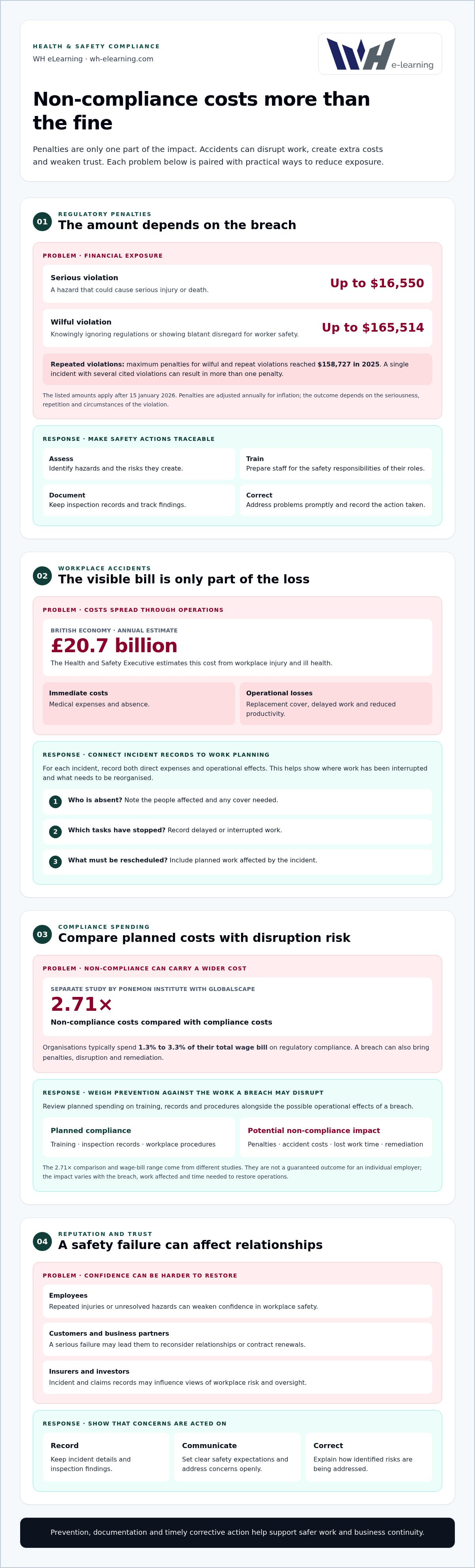
The cost of health and safety non-compliance can extend well beyond a fine, reaching lost work time, accident-related costs and damage to trust. In the United States, according to the Occupational Safety and Health Administration, serious violations can carry penalties of up to $16,550 per violation after Jan. 15, 2026. The total impact depends on the breach and its consequences.
It’s easy to focus on the penalty, but an incident can also disrupt operations, affect employees and undermine confidence among customers and business partners. This article explains how fines, workplace accidents and reputational harm contribute to the cost of health and safety non-compliance, and why prevention matters. It also outlines how practical training can help staff understand their responsibilities and support safer working practices.
Key Takeaways
- Assess the type and severity of a breach to understand how enforcement penalties may apply.
- Factor in disruption, lost productivity and staff cover when weighing the wider impact of workplace accidents.
- Consider how incidents can affect employee confidence and relationships with customers and business partners.
- Use relevant health and safety training to help employees recognise risks and follow workplace procedures.
Financial penalties for non-compliance
Financial penalties depend on the seriousness of the violation, whether it is repeated, and whether the employer knowingly disregarded safety requirements. Employers can reduce the risk and financial impact of regulatory violations by assessing hazards, training staff for their roles, documenting inspections, and correcting problems promptly.
Inflation-adjusted penalty amounts
Maximum regulatory penalties are adjusted annually for inflation, and the listed amounts apply after Jan. 15, 2026. This means employers need to consider current limits rather than relying on older penalty figures when assessing exposure. Official regulatory authorities state that serious violations can carry penalties of up to $16,550 per violation. A single incident involving several cited violations can therefore create more than one financial penalty.
Penalties for repeated and serious violations
A serious violation involves a hazard that could cause serious injury or death, while repeated violations reflect a recurring failure to meet safety requirements. The distinction matters: an unresolved hazard can endanger workers, and a repeated breach can signal that earlier corrective measures did not work. In 2025, maximum penalties for willful and repeat violations reached $158,727. Employers should track inspection findings and corrective actions so the same hazard does not recur.
Penalties for willful violations
A willful violation involves knowingly ignoring regulations or showing blatant disregard for worker safety. Regulatory authorities state that willful violations can carry fines of up to $165,514 per violation after Jan. 15, 2026. That makes documented decisions and timely action important when a hazard is identified. For example, retaining inspection records and recording how a reported risk was addressed can help demonstrate that safety concerns were taken seriously, rather than ignored, supporting compliance standards promoted by WH eLearning.
Direct and indirect financial costs of workplace accidents
The cost of health and safety non-compliance includes immediate accident expenses and less visible operational losses. Medical costs, absence, replacement cover, delayed work and reduced productivity can all add to the impact.
Compliance and non-compliance costs
Compliance costs fund measures that help meet regulations, whilst non-compliance can bring penalties, disruption and remediation. Comparing both helps employers assess why prevention matters financially, not only during enforcement. A separate Ponemon Institute study with Globalscape found non-compliance costs were 2.71 times compliance costs.
These averages come from different studies, not a guaranteed outcome for an individual employer. The scale of a breach depends on its consequences, the work affected and the time needed to restore operations. Organisations typically spend 1.3% to 3.3% of their total wage bill on regulatory compliance. To assess the cost of health and safety non-compliance, employers can weigh planned spending on training, records and procedures against the disruption a breach may cause.
Workplace injury costs to the economy
The Health and Safety Executive estimates that workplace injury and ill health cost the British economy approximately £20.7 billion annually. That figure captures a wider burden than an employer’s immediate accident expenses, including lost working time and impacts on people and businesses. Work-related illness and injuries can lead to substantial lost working time in the UK.
Absence can mean reorganising shifts, covering essential duties and delaying planned work. Track each incident’s direct expenses alongside its operational effects: who is absent, which tasks have stopped and what work must be rescheduled? This connects workplace safety with business continuity, rather than treating injury costs as a standalone item in the accounts.
Reputational damage and loss of stakeholder trust
How can non-compliance affect insurance premiums, workers’ compensation rates and business reputation? Claims and incident records may shape insurers’ assessment of workplace risk, while repeated injuries can affect workers’ compensation costs. Publicly known failures can also weaken confidence among employees, customers and business partners.
Reputational harm can extend well beyond the incident. A serious workplace failure may prompt customers to reconsider a relationship, investors to question oversight, or contract partners to review renewal decisions. High-profile incidents can affect contract renewals, investor confidence and expansion into regulated markets. The result may be lost opportunities, even if operations continue. Clear communication and timely corrective action help show stakeholders that safety concerns are being addressed.
Public trust can be especially sensitive where people depend on an organisation’s duty of care. In healthcare, a data breach is a different type of compliance failure from a workplace accident, but it illustrates how quickly trust can shift: healthcare organisations experience a 6.7% patient churn rate following data breaches. The figure is specific to breaches, not occupational safety incidents. Still, it highlights why organisations should treat transparency, accountability and protection of people as central to maintaining confidence.
The 2018 Anthem breach exposed the protected health information of nearly 79 million people. That example concerns privacy, rather than workplace safety, but shows how a compliance failure can become a widely discussed reputational event. For employers, an injury or safety breach may similarly attract scrutiny from staff, customers and the wider public. The impact depends on what happened, how people were affected, and whether the organisation responds openly and corrects the underlying problem.
Reputation depends on consistent behaviour, not a single policy statement. Employers can strengthen stakeholder confidence by recording incidents, setting clear safety expectations and showing how identified risks are addressed. A workplace culture that encourages staff to report hazards gives leaders a clearer view of emerging issues. They can then respond before a concern becomes a serious incident, a disputed contract renewal or lasting damage to public trust.
Fines for health and safety non-compliance
OSHA penalties vary by violation type, while separate rules may apply to privacy breaches. Serious violations can carry up to $16,550 per violation; willful violations can carry up to $165,514 per violation, according to the Occupational Safety and Health Administration.
Fines and prosecutions
Fines are financial penalties; prosecution can bring criminal consequences in cases referred for enforcement. This distinction matters because an organisation may face both financial and operational disruption after a serious failure. OSHA may refer employers for criminal enforcement, with penalties including up to six months in federal prison. Criminal penalties can also include a personal fine of $250,000.
Enforcement examples show how multiple hazards can add up. These cases underline the importance of addressing hazards before an incident exposes workers and the organisation to further consequences.
Fines by violation type
OSHA penalties distinguish serious, willful, repeated and failure-to-abate violations. A serious violation can carry up to $16,550 per violation, while a willful violation can carry up to $165,514 per violation. In 2025, maximum penalties for willful and repeat violations reached $158,727. After Jan. 15, 2026, OSHA serious violations can carry penalties of up to $16,550 per violation. The category and timing of a breach affect the potential penalty.
HIPAA fines concern healthcare privacy compliance, not workplace safety citations. They can range from $100 to $50,000 per violation, and the stated maximum can reach $1.5 million per incident per year. Keeping these regimes distinct helps organisations understand which programmes and corrective actions address each risk. Build staff awareness to support safer work practices and strengthen workplace safety knowledge.
WH eLearning: Health and Safety Training Courses
WH eLearning offers health and safety training courses to help employers build staff knowledge of workplace risks and safe practices. The courses can support organisations introducing training, refreshing existing learning or helping employees understand procedures relevant to their roles.
Its library includes over 100 online courses across health and safety, HR, business compliance and other workplace topics. Courses are video-based, accredited and accessible on any device, with closed captions and machine translation into more than 25 languages. Organisations can also choose In-House Face-to-Face Training or Multi-language Course Translation to suit their learning needs.
Training works best alongside clear procedures, suitable supervision and action on reported hazards. Choose learning that reflects the risks employees encounter, then reinforce it through day-to-day workplace communication. Contact WH eLearning to discuss its health and safety training options.
Build safer habits into everyday work
Make prevention part of how work is organised. The cost of health and safety non-compliance is not only financial; it can also affect how confidently people carry out their roles and raise concerns. Treat training as an ongoing part of workplace practice, not a one-off task.
WH eLearning offers IOSH Managing Safely Online and IOSH Working Safely Online, alongside its Health and Safety Training Courses. These options can support learning suited to management responsibilities and general worker awareness. Pair learning with clear procedures, visible leadership and follow-up on reported hazards. This helps employees connect what they learn with the work they do each day.
Choose a training route that fits your team’s roles and current priorities, then make space to apply and reinforce that learning. Contact WH eLearning to discuss training and take a practical step towards a more confident, safety-aware workplace.
Frequently Asked Questions
What is the average cost of a workplace injury to employers in the U.S.?
The cost to an individual employer depends on the injury, absence and disruption to work. Across the United States, work injuries cost $167 billion in 2022, including wage and productivity losses, medical expenses and administrative costs. That total gives employers a sense of the wider economic burden, but their own exposure depends on the incident, the employee’s recovery and how much work must be covered or delayed.
How much can workers' compensation claims cost after a workplace injury?
Claim costs vary depending on the injury and the work involved. These Ontario figures illustrate how lost time and operational effects can add to direct claim costs.
What indirect costs do employers face after a safety violation or workplace accident?
Indirect costs can include covering absent workers, recruiting and training replacements, overtime, project delays and lost productivity. Replacing trained staff can cost three to five times the original compliance penalty, whilst replacing a skilled worker can cost up to twice their annual salary. Assess exposure by tracking immediate expenses, postponed work and the time needed to restore normal operations.
What additional legal costs can result from workplace health and safety non-compliance?
Employers may need to pay for legal advice, respond to investigations, prepare records and defend a personal injury claim. In the UK, claims against businesses can cost thousands of pounds, especially where negligence is proven. The overall legal burden depends on the circumstances, evidence and consequences of the incident. Keep relevant inspection, training and incident records organised to support a clear response.
Can safety violations lead to criminal charges or personal liability for employers?
Yes. OSHA may refer employers for criminal enforcement, and penalties can include imprisonment and personal fines. This distinguishes financial penalties imposed on an organisation from potential consequences for an individual. Employers should preserve relevant safety records, document decisions about reported hazards and make corrective actions traceable. These records help establish what was known and how the organisation responded.
What are the costs of workplace safety compliance compared with the costs of non-compliance?
Compliance requires resources, but the Ponemon Institute estimated in a study of 46 organizations that non-compliant organizations incurred about 3.5 times the cost per employee: $820 compared with $222. These findings show why employers should weigh planned prevention against the broader costs that can follow a breach, rather than comparing only training expenses with fines.


