

A health and safety budget is more likely to win support when it is framed as an investment in reliable operations, not simply a list of costs. To get management buy-in for an H&S budget, connect every proposed expense, including training, to a workplace risk, a business priority and a practical benefit. This gives decision-makers a clear basis for weighing the request.
Managers naturally want to understand what a budget will achieve, particularly when safety measures do not directly generate revenue. Incidents can disrupt work, strain staffing and take managers away from their responsibilities through investigations and administration. A realistic plan shows how prevention supports continuity, compliance and workforce wellbeing.
This article explains what a health and safety budget covers, why management support matters and how to align spending with business goals. It also shows how to present training as a business asset, with a clear rationale for the people, resources and actions needed to put safety plans into practice.
Key Takeaways
- Use the operational and financial impact of workplace injury and ill health to explain why prevention deserves investment.
- Show how a safety budget covers different needs, from day-to-day controls to planned projects, and how incidents can bring wider costs.
- Connect each budget priority to a business goal, with clear actions, resources and responsibilities.
- Position relevant training as a practical way to support safer work and strengthen the case for investment.
Why Is Management Buy-in Essential for Workplace Health and Safety?
Management support turns safety priorities into funded actions instead of plans left on paper. Build your case around workplace impacts, operational risks and specific spending decisions.
The costs of workplace injury and ill health
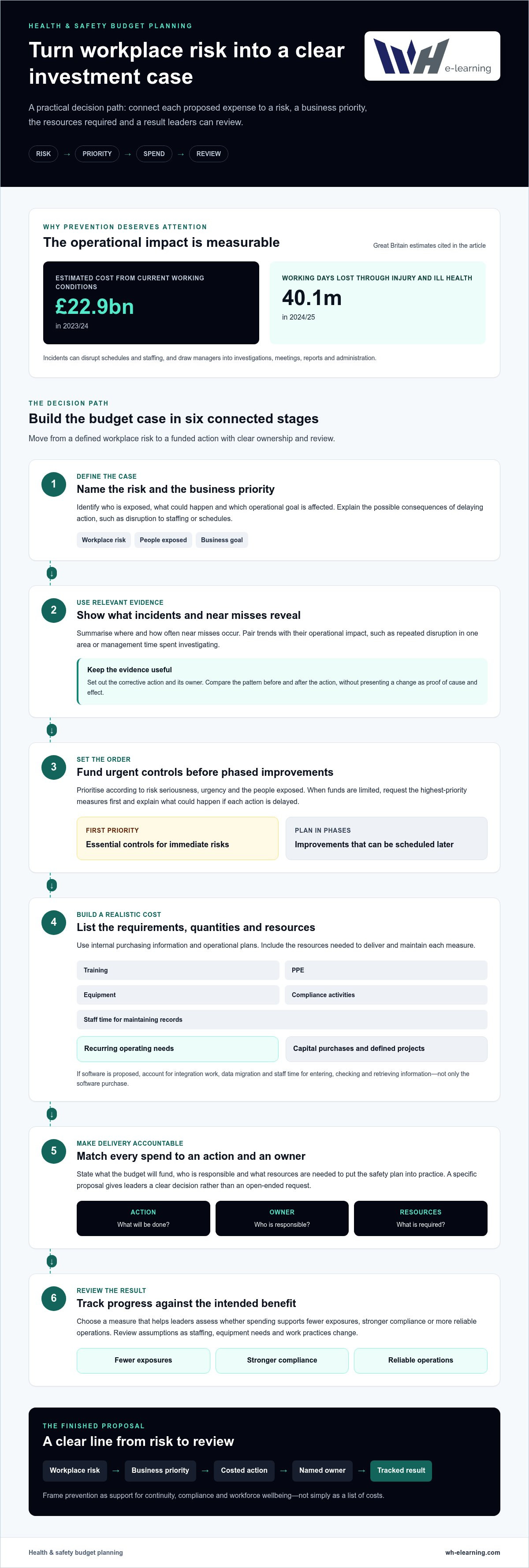
Workplace injury and ill health create direct costs and disrupt the work an organisation needs to deliver. In Great Britain, the estimated cost from current working conditions was £22.9 billion in 2023/24, while injury and ill health led to 40.1 million working days lost in 2024/25. Use figures relevant to your workforce to show why prevention deserves investment.
Incidents also require investigation meetings, reports and administrative work, taking managers away from operational goals. Explain how a serious incident could affect staffing, schedules and management time in your organisation. This makes compliance and prevention part of business continuity, rather than just another budget line.
Executive-facing safety data and investment returns
Present safety data in a way that connects incidents and near misses to workplace risks, actions and potential benefits. Show trends alongside their operational impact, such as repeated disruption in one area or time spent investigating incidents. To get management buy-in for H&S budget decisions, pair each proposed expense with the risk it addresses and the result you will track.
For near-miss reports, summarise where and how often they occur, then identify the corrective action and its owner. Compare the pattern before and after the action, without presenting a change as proof of cause and effect. This helps executives assess whether spending supports fewer exposures, stronger compliance or more reliable operations.
Approval for safety spending when funds are limited
When funds are limited, prioritisation is essential: separate urgent risk controls from improvements that can be phased. Tell leaders what could happen if each action is delayed, what resources it requires and who is responsible. Request approval for the highest-priority measures first, linking each to a defined workplace risk or business goal.
For investment in data security and compliance, describe the information or process at risk and the safeguard the budget would fund. Make the proposal specific, such as protecting incident records and maintaining access for authorised staff. This gives executives a clear decision to make instead of an open-ended request for more resources.
The US Department of Health and Human Services (HHS) offers an example of a formal investment review: its Chief Information Officer reviews and advises on approval of IT investments included in the department’s budget request. The HHS Chief Financial Officer and Chief Information Officer also review planned IT support for major programmes and significant changes in IT resources. Defined review roles can make spending decisions more accountable.
What Is a Health and Safety Budget, and Why Does It Matter?
A health and safety budget sets out planned spending on prevention, day-to-day controls and defined projects. Comparing these costs with the impacts of accidents helps leadership prioritise resources and protect the organisation’s mission.
Prevention costs and the cost of serious injury
Prevention spending funds measures intended to reduce exposure, while serious injuries can lead to wider operational and financial costs. Comparing the two helps decision-makers assess planned spending without assuming every incident can be prevented.
In a US example, adults in medical and surgical units experience 3.56 falls per 1,000 patient days, and 26.1% of falls cause injury. These figures give healthcare leadership a concrete basis for examining prevention priorities alongside incident costs.
Estimating safety provision costs
Estimate safety costs by listing each requirement, the quantity needed and the resources required to deliver it. Include training, PPE, equipment, compliance activities and staff time for maintaining records. Use internal purchasing information and operational plans to develop the figures, then distinguish recurring operating needs from capital purchases and defined projects.
Software may also require integration work, data migration and staff time, particularly when systems do not share records. Budget for entering, checking and retrieving information, not just the software purchase. Review assumptions regularly as staffing, equipment needs and work practices change, so the forecast stays connected to actual activity.
Building a budget case from accident costs
A business case links proposed prevention spending to accident costs, operational disruption and organisational priorities. Workplace accidents can lead to medical bills, workers’ compensation costs, legal fees, regulatory fines, insurance effects and staffing gaps.
For US organisations, an underfunded safety budget can leave risks insufficiently controlled and increase exposure to accident-related costs, fines and legal claims. Set out the risk, proposed control, required resources and measure for reviewing progress. This makes the decision clearer without promising that prevention spending will eliminate every cost.
Aligning budget allocations with operational and financial goals
A strategic safety budget connects risk controls to corporate priorities and operational needs. This helps leaders see how each allocation supports the work the organisation needs to deliver.
Prioritise requests according to the seriousness and urgency of each risk and the people exposed. Fund essential controls for immediate risks before improvements that can be scheduled later, and explain the operational impact of any delay.
Start with the company’s mission and vision, then connect safety actions to daily tasks, monthly projects and yearly goals. For example, if a production objective depends on reliable staffing, explain how reducing workplace risks supports continuity. State the current position, the action needed, the resources required, who is responsible and when it should happen.
Make the financial case easier to assess by involving the finance department early. If budgeting is not your strength, ask a finance colleague to review assumptions, distinguish recurring operating costs from project spending and explain how allocations fit existing plans. This turns a safety proposal into a clear resource decision, rather than a list of items to fund.
Build financial literacy across the safety team so members can explain cost categories and trade-offs. Use a practical example, such as showing how a training allocation relates to a specific workplace risk, planned delivery and the outcome to monitor. Teams that understand the budget can spot changing needs and describe them in terms leadership recognises.
Separate ongoing workforce needs from temporary staffing requirements, and identify which costs recur and which support a defined project. Review allocations against operational changes during the annual planning cycle instead of carrying every request forward unchanged. If priorities shift, record the reason, revised action and responsible owner. This helps leadership compare proposals consistently and keep spending aligned with business goals.
Presenting training as a business asset
Treat safety training as an investment in employees’ ability to carry out work consistently. Link each learning initiative to a specific task, risk and operational objective. For example, warehouse staff who handle loads need instruction relevant to their work, while supervisors need to recognise and respond to reported hazards. This positions training as part of delivering the organisation’s plan, not as an isolated course expense.
Show executives how you will assess the return on investment without promising that training alone will prevent injuries. Set a baseline, define what employees should learn, then measure completion, knowledge and application at work. For example, compare assessment results with supervisors’ observations of the relevant task, and review incident or near-miss patterns over time. Explain what each measure can show and which other workplace factors may affect it.
Match the learning format and content to the people and risks involved. A medical team may need learning related to patient-handling risks, while maintenance employees may need task-specific hazard awareness. Identify who needs training, which skill or knowledge gap it addresses, and how managers will reinforce learning in day-to-day work. This helps leadership judge whether the initiative fits operational priorities.
Present the request as a concise investment case: name the risk, the employee group, the learning objective, delivery approach and evaluation method. Explain how managers can use the results when reviewing future spending, rather than treating attendance as the only measure of value. Where teams need structured health and safety learning, explore relevant training options as part of the budget plan.
WH eLearning: Health and Safety Training Courses
WH eLearning can help organisations turn an approved training budget into practical learning for employees. Its library includes over 100 online courses across health and safety, HR, business compliance and other workplace topics. Courses are video-based, accredited and accessible on any device, with closed captions and machine translation into more than 25 languages.
Choose relevant health and safety learning to support workforce development, or consider in-house, face-to-face training for teams that benefit from group delivery. HR and business compliance courses can also support broader workplace learning priorities.
To discuss training that fits your organisation’s needs, contact WH eLearning.
Make your next budget conversation count
Turn your proposed investment into a decision leadership can act on. Set out the priority, assign responsibility and explain how progress will be reviewed. Leave room to adjust allocations as operational needs change, keeping safety planning connected to business decisions after the initial approval.
A practical way to get management buy-in for an H&S budget is to treat the conversation as ongoing: share clear updates, explain changes and show progress on agreed actions. Training can be part of that plan. WH eLearning offers comprehensive online health and safety training courses to support workplace learning and staff development.
If you’re planning training as part of your H&S investment, contact WH eLearning to discuss your training needs. A clear, considered proposal can help build lasting support for safer work.
Frequently Asked Questions
How do you calculate ROI and cost savings from workplace safety investments?
Compare measurable costs avoided with the full cost of the safety investment over the same period. Include direct incident expenses and trackable operational impacts, such as replacement staffing or interrupted work. Record a baseline before introducing the measure, then compare it with later results. Treat the difference as an estimate and note other changes that may have influenced the outcome.
How do you connect health and safety spending to business goals and productivity?
Link every proposed expense to a business objective, work process and outcome that leaders already monitor. For example, if a team needs to meet delivery schedules, explain how addressing a task-specific hazard supports consistent work. Assign an owner to check whether the control is being used, then review relevant productivity measures alongside safety indicators. This makes the connection clear without treating productivity as the only measure of success.


