

Work-related deaths and injuries cost the United States, employers and individuals more than $1.3 trillion in 2023. That scale makes building a business case for safety training investment a financial decision as well as a people-first one: the case should connect training spend with incident costs, operational disruption and workforce performance. It should also set out the problem, expected benefits, desired outcomes and a practical implementation plan.
It’s understandable to want clear evidence before committing budget, particularly when training competes with other priorities. A well-structured case helps decision-makers weigh the investment against the cost of inaction and understand how stronger skills and safer practices can support productivity and reliable operations. This guide shows how to gather relevant cost and performance evidence, estimate and present potential returns, and shape a proposal leaders can assess.
Key Takeaways
- Map direct and indirect injury costs across departments to build a fuller picture of the financial impact.
- Compare proposed safety measures with the costs of inaction, and present the assumptions behind your expected return.
- Connect safer working practices to productivity by identifying how incidents disrupt staffing, workflows and output.
- Build a decision-ready proposal that defines the problem, desired outcomes, implementation plan and ongoing budget.
How can investing in workplace safety and health improve your organization's financial performance?
Build the case by showing how prevention could reduce incident costs, limit disruption and protect employees’ capacity to work. Use your organisation’s own records to connect safety priorities with financial outcomes.
-
Identify direct and indirect event costs
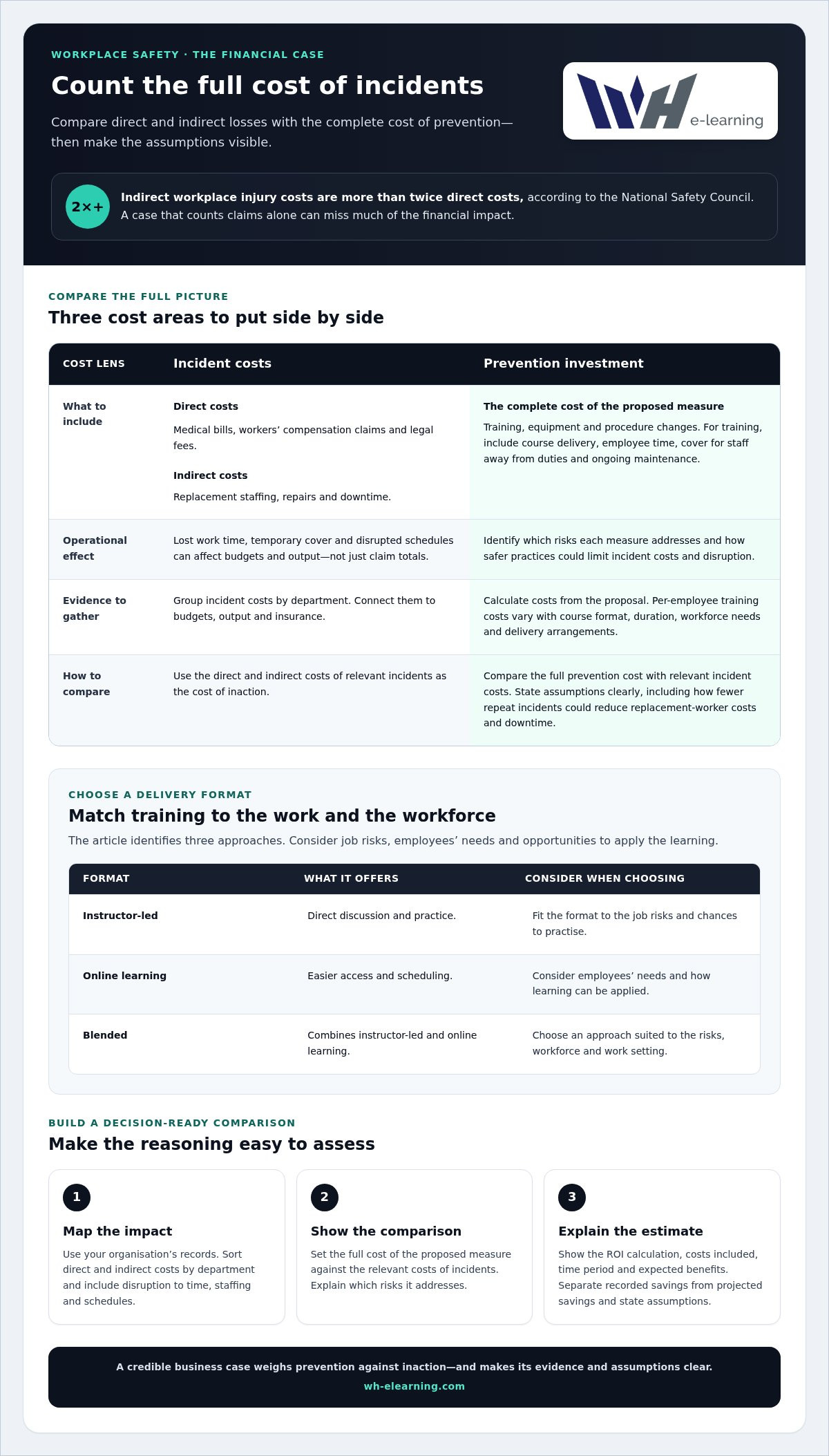
List direct expenses, such as medical bills, workers’ compensation claims and legal fees, then add indirect costs such as replacement staffing, repairs and downtime. The National Safety Council states that indirect workplace injury costs are more than twice direct costs.
-
Assess and communicate injury costs
Group incident costs by department and explain their effects on budgets, output and insurance. Include lost work time, temporary cover and disrupted schedules, not just claim totals. Instructor-led training allows direct discussion and practice; online learning can make access and scheduling easier, while blended approaches combine both. Choose a format that suits the job risks, employees’ needs and opportunities to apply the learning.
-
Compare mitigation and event costs
Compare the full cost of a proposed measure with the direct and indirect costs of relevant incidents. Include training, equipment and procedure changes, then identify which risks each measure addresses. State your assumptions clearly: for example, explain how fewer repeat incidents could reduce replacement-worker costs and downtime. This helps decision-makers compare prevention with the operational and financial consequences of inaction.
-
Include training costs and calculate ROI
Include course delivery, employee time, cover for staff away from duties and ongoing maintenance. Per-employee training costs in the United States vary with course format, duration, workforce needs and delivery arrangements, so calculate them from your proposal rather than using a generic figure. Estimating ROI can help organizations compare potential benefits with costs.
Making the financial and competitive case for safety
Evaluate safety investment against financial returns, insurance impacts and evidence that prevention can strengthen operational performance. Use the steps below to make the comparison clear to decision-makers.
- Set a financial benchmark. Compare the proposed investment with potential savings, using evidence carefully. Industry research estimates that every pound invested in safety yields substantial savings. Treat this as a benchmark, not a promised result. Your case should explain which workplace risks the proposed training addresses and how you will track relevant costs and outcomes.
- Include insurance in the evaluation. Document current premiums and any safety-related changes over time. Workers' compensation insurance discounts for documented safety management systems and strong safety records are often significant. Show how training supports safer practices and contributes to the wider system, rather than presenting a discount as an automatic outcome. This gives finance teams a clearer view of possible savings and the evidence behind your assumptions.
- Show the competitive value of prevention. Explain how a stronger safety record can support reliable operations and demonstrate sound risk management to customers and business partners. Use this as context, then identify the comparable costs your organisation will monitor.
- Present a measured return. Well-implemented safety programmes typically deliver a strong return on investment within the first three years. Make your proposal credible by showing the calculation, time period, costs included and expected benefits. Separate recorded savings from projected savings, and identify the assumptions behind each estimate. This makes the case easier to evaluate, compare with other investments and revisit as results accumulate.
Safety investment and organizational productivity
Measure training through workplace behaviour and operational output, not course completion alone. Track incident trends, employee participation and workflow disruption to assess whether learning supports safer, more productive work.
-
Measure safety training effectiveness
Compare incident records from before and after training, including recordable injuries, near misses, absence and days away from work. Add learning checks, such as assessment results and supervisor observations, to see whether employees apply safe procedures on the job. Review the same measures consistently, noting changes in staffing, workload or processes that could affect results.
Liberty Mutual research reports that companies with effective safety programmes have productivity improvements of 4-8%. Treat this as context, then set a baseline using your organisation’s own data. For example, compare incident frequency and output across equivalent periods, and record whether teams follow the practices covered in training.
-
Assess the productivity impact
Connect safety measures to the work employees need to complete. Track incident-related interruptions, replacement staffing, delayed tasks and time spent investigating events. These costs help explain productivity effects in operational terms. Compare similar teams or sites, and account for workload differences before drawing conclusions.
In a Liberty Mutual survey, more than 40 percent of chief financial officers cited productivity as the top benefit of an effective workplace safety programme. Use that finding to frame the discussion, then show what productivity means in your setting: reliable staffing, fewer disrupted shifts or steadier output. Include employee feedback alongside operational records to identify practical barriers to applying training. Review those indicators with managers at regular intervals and use the findings to refine future training priorities.
Cost analysis can strengthen this review. Organisations can estimate potential benefits from safety improvements by quantifying accident and injury costs, including workers’ compensation claims, legal fees and replacement-worker costs.
For a fuller estimate, bring together relevant expenses tracked across departments, including training, staffing, repairs, operational disruption, insurance impacts and downtime. Include equipment purchases, employee training and new procedures among the costs of safety improvements. Then calculate return on investment by dividing potential benefits by costs. Explain the case to management, employees and financial decision-makers to build support.
Making the business case for safety training investment
Turn evidence into a practical proposal linking workplace risks, training and accountable decisions. Building a business case for safety training investment starts with a clear problem and shows how the proposed action will be put into practice.
-
Forecast injury and absence reductions
Set a baseline for injuries, workers’ compensation claims and lost workdays, then identify the hazards training addresses. Explain how stronger hazard recognition and safer task practices could help prevent incidents, reduce claims and limit absence. OSHA’s Voluntary Protection Programs report an average Days Away, Restricted or Transferred case rate 52% below the industry average. Use this as context, not as a forecast for your organisation.
-
Account for ROI risks and limitations
Separate projected savings from recorded results, and document the assumptions behind each estimate. Training may need to accompany improvements to equipment, procedures or production practices. Turnover, changing tasks and uneven participation can also affect outcomes. Compare equivalent periods and note workplace changes that could influence injury rates or absence, so decision-makers can see what the forecast includes.
- Define the business problem, intended outcome and implementation plan. Include employee time, delivery arrangements and ongoing maintenance in the budget. Explain the consequences of inaction, then compare alternative approaches and their drawbacks. Building a business case for safety training investment also means assigning responsibilities clearly, so leaders know who will deliver the plan and monitor progress.
- Allow 60-90 days for research and collaboration when preparing the proposal. Involve a senior leader, such as a chief operating officer, chief financial officer or director of operations, to identify barriers and anticipate decision-makers’ questions. Present the case to managers, employees and financial stakeholders, then assign owners to review outcomes. Plan your safety training investment around the risks and objectives in your proposal.
WH eLearning: Health and Safety Training Courses
WH eLearning offers Health and Safety Training Courses to help organisations put their safety investment into practice. Its library includes over 100 online courses across workplace topics, including health and safety, HR and business compliance. Courses are video-based, accredited and accessible on any device, with closed captions and machine translation into more than 25 languages. These options can help organisations plan training around different roles, learning needs and language requirements.
Choose online learning for flexible access, or consider WH eLearning’s In-House Face-to-Face Training when direct, in-person delivery suits your learning objectives. Multi-language Course Translation can support teams who need course content in different languages. Discuss your organisation’s safety priorities with WH eLearning and choose an approach that fits.
Turn your proposal into a practical next step
Make the next step focused: choose the workplace risk your proposal will address first, then identify who will lead implementation and review progress. Building a business case for safety training investment is most useful when it leads to a clear decision, defined responsibilities and a plan to learn from the results.
WH eLearning offers IOSH Managing Safely Online, IOSH Working Safely Online and other health and safety training courses. Match the course to the roles, risks and learning objectives in your proposal, then include it in the wider plan.
Share your organisation’s safety training priorities with WH eLearning and take the next step towards a proposal your team can put into action.
Frequently Asked Questions
What are the business benefits of investing in workplace safety training?
Workplace safety training helps employees recognise hazards, follow safer procedures and respond consistently as tasks change. For example, a team introducing new equipment can receive role-specific instruction on safe operating practices before routine work begins. Training can also give managers a shared basis for coaching and onboarding, making safety expectations clearer across shifts and departments.
How can employers estimate the financial impact of workplace injuries and incidents?
Use incident, payroll, insurance and operational records to build a consistent picture of each event. For example, link an absence record with overtime payments, temporary cover and delayed work associated with the same incident. Ask finance and operations teams to reconcile categories and avoid double-counting. Review comparable periods, then document assumptions used to estimate costs that aren’t recorded directly.
What steps should employers follow to build and present a safety training business case?
Start with a defined workplace problem, then connect the proposed training to the employees and tasks involved. Set out the intended behaviour changes, how managers will reinforce them and which indicators will show progress. Present the proposal in a concise decision paper with an accountable owner and review points. Tailor the discussion to each audience: operational leaders need implementation details, while finance teams need transparent assumptions.


