

Site safety depends on what people notice and do before a hazard becomes an incident. Construction health and safety courses online can help site teams recognise risks such as falls, moving equipment and hazardous substances, then reinforce safer working habits. Training supports site procedures, alongside practical supervision and clear communication.
It’s understandable that teams need training that fits around busy site work. The right format can make learning more accessible, while giving workers useful knowledge to apply on site. This article explains common construction risks, how online training works, and what certificates and completion records can show.
You’ll also see how course content and delivery can vary, what to consider when choosing team training, and where online learning fits alongside face-to-face instruction. The aim is to help you make an informed decision about training that supports safer work.
Key Takeaways
- Recognise how falls, moving equipment and hazardous substances can put site teams at risk, and the safe behaviours that help reduce exposure.
- Choose an online learning format that fits the team’s work patterns and supports practical understanding, not just course completion.
- Understand what a course certificate or completion record can document, and how that differs from a professional credential.
- Use the article’s guidance to decide when online training suits your team and when face-to-face learning may be a better fit.
Construction site risks, including falls and hazardous substances
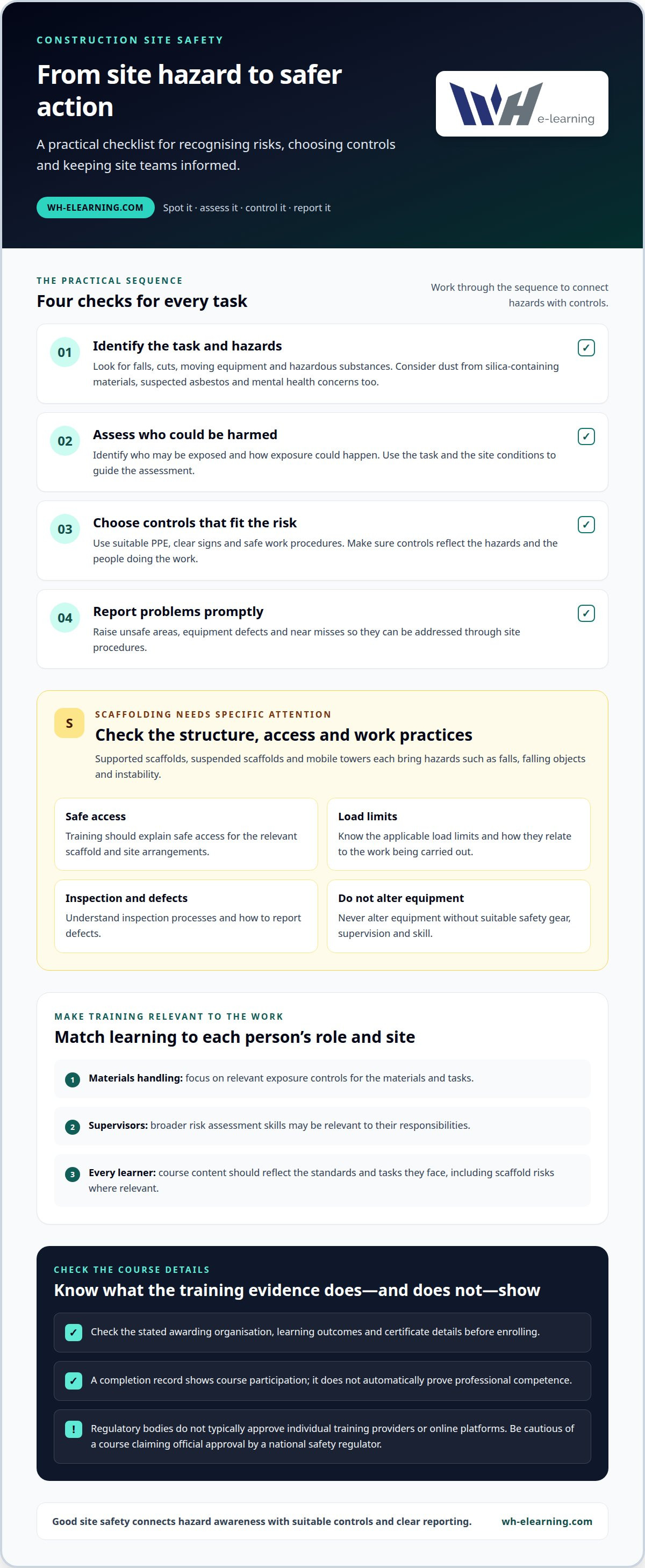
Falls, cuts and moving equipment can turn routine site work into an injury risk. Hazardous substances, including asbestos and silica, may also affect workers’ health. Mental health concerns belong in the risk picture too. A workplace assessment should identify hazards, who could be exposed, and which controls can reduce risk.
Regulatory bodies do not typically approve individual training providers or online platforms, so no course should be described as officially approved by a national safety regulator. For structured learning, comprehensive construction safety modules and accredited online pathways provide robust training options for site teams.
An unauthorised or fraudulent course may falsely claim official approval, leaving learners with misleading credentials or training that doesn’t meet their needs. Check the course’s stated awarding organisation, learning outcomes and certificate details before enrolling. A completion record shows course participation, but doesn’t automatically prove professional competence.
Scaffolding brings distinct hazards, including falls, falling objects and instability. Common examples include supported scaffolds, suspended scaffolds and mobile towers. Responsibilities vary by role and site arrangements, so training should explain safe access, load limits, inspection processes and how to report defects. Never alter equipment without suitable safety gear, supervision and skill.
Use a practical sequence to connect hazards with controls:
- Identify the task and hazards, such as dust from silica-containing materials or suspected asbestos.
- Assess who may be harmed and how exposure could occur.
- Choose controls, such as suitable PPE, clear signs and safe work procedures.
- Report unsafe areas, equipment defects and near misses promptly.
Choose safety training around each person’s role, site hazards and professional goals. A worker handling materials needs relevant exposure controls; a supervisor may need broader risk assessment skills. Course content should reflect the standards and tasks learners face, including scaffold risks where relevant.
Online construction safety training
New York City job sites requiring a Construction Superintendent, Site Safety Coordinator or Site Safety Manager require workers to complete 40 hours of safety training. These requirements are associated with Local Law 196 of 2017. The location and site roles therefore matter when planning employee learning: a general online course may not cover every site-specific requirement.
To enrol, select a course that matches the learner’s role and required subject, then register with the course provider. Complete the learning activities and any assessments, then retain the completion record or certificate. Before choosing, check that the course content and evidence of completion fit the purpose, such as induction or ongoing knowledge development.
For employers with teams across several locations, shared online courses can support consistent learning without bringing everyone into one room. Group assignments by role and site, then organise completion records by employee and location. This makes it easier to identify outstanding training and plan refreshers around workforce changes.
Live virtual instructor-led training is another format. Learners join a scheduled session remotely and can ask questions as the instructor presents the material. It suits teams that benefit from discussion, such as supervisors working through a site scenario together. Unlike self-paced learning, attendance depends on the session timetable, so employers need to coordinate staff availability.
Some online programmes use voice authentication to check identity during remote learning. A system may ask learners to speak at a prompt to help associate activity with the enrolled person. This is a training-platform feature, not a general New York City requirement. Employers can weigh identity controls against ease of access and employees’ needs.
Match the format to the work: choose self-paced learning for flexible study, or live virtual sessions for guided discussion. Explore construction safety courses as one way to review online options for site teams.
Course certificates and completion documentation
A course certificate and a professional certification serve different purposes. A course certificate records completion of specific training, such as learning about site hazards or safe working practices. A professional credential recognises a broader qualification against defined requirements. For compliance records, keep course evidence distinct from credentials used for career progression.
The OSHA construction certificate programme requires at least 68 contact hours. Participants complete 3 required courses totalling at least 39 contact hours, plus electives totalling at least 29 contact hours. These figures describe that certificate programme, not every online course. A shorter course certificate should not be presented as equivalent to the full programme.
Construction safety manager certification has its own eligibility criteria. Applicants for the CHST credential must have three years of construction safety experience. At least 35% of a CHST applicant’s construction-safety job duties must require technical skills and knowledge in safety, health and environment. Course completion alone does not replace these experience requirements.
Renewal depends on the credential or requirement. Construction professionals in Connecticut, New York and Pennsylvania must recertify for the listed publicly funded project requirements every five years. BCSP credential holders must earn recertification points every five years. Keep records of completed learning and relevant professional activity to support each applicable renewal process.
Organise documentation by learner, course and completion date. A simple record system helps employers distinguish training evidence from credentials and identify the topics covered. Retain each employee’s certificate or completion record alongside the course title. This supports internal tracking, but a course certificate should not be treated as proof of every required skill or qualification.
- Match each certificate to the specific training completed.
- Record professional credentials separately from course completions.
- Track renewal dates and points against the relevant requirement.
The experience threshold for CHST applicants is Three (3) years in construction safety, while BCSP credential holders earn recertification points every five (5) years.
Online construction safety course formats
Online education isn’t one format. Self-paced modules let workers study independently, pausing between topics such as fall protection and equipment handling. This suits professionals with changing shifts, because learning can take place anywhere with suitable access. Choosing construction health and safety courses online starts with matching the format to workers’ tasks and study needs.
Interactive courses can use short lessons, knowledge checks and workplace examples. A module might ask learners to spot unsafe access arrangements in a scaffold scenario. These activities connect information with decisions, but they don’t replace practical instruction for tasks that require physical demonstration or supervised practice.
Live virtual sessions offer scheduled teaching with an instructor. Workers can ask questions about a scenario, such as how a site team should respond to a reported hazard. This format supports discussion, though teams need to attend at the set time and have a stable connection. A blended approach can pair online theory with face-to-face practice.
Course prices vary with factors such as subject scope, delivery format and the support or documentation provided. A focused fall protection module, for example, differs from a broader programme covering several construction safety topics. For workforce purchases, learner numbers and access arrangements can also shape the overall cost. Compare what the fee covers, not just the headline amount.
Choose training by learning need. A new worker may benefit from an introductory course, while a supervisor could need broader risk-management education. For fall protection, check whether the material covers hazard recognition, prevention and the limits of online learning. Construction health and safety courses online work best when their format and depth suit the topic and provide relevant knowledge.
- Choose self-paced learning for flexible study around shifts.
- Use live sessions when discussion with an instructor matters.
- Match course depth to workers’ roles and learning goals.
Explore online construction safety course options to find a format suited to your team.
WH eLearning: Health and Safety Training Courses
WH eLearning offers Health and Safety Training Courses for organisations and individual learners building workplace knowledge. Its library includes over 100 online courses across health and safety, HR, business compliance and other workplace topics. The courses are video-based, accredited and accessible on any device, helping learners fit training around their working day.
For teams with different language needs, Multi-language Course Translation can make course content more accessible. Closed captions and machine translation into more than 25 languages support varied learning preferences. Where a team benefits from instructor-led learning, In-House Face-to-Face Training offers another format alongside online study.
Explore WH eLearning’s training options when you’re ready to plan learning for yourself or your team. Contact WH eLearning to discuss your training needs.
Make training part of your next site decision
Use your team’s next training decision to set a clear learning priority. Identify the roles that need support, then choose a course whose subject and format fit their work. This turns construction health and safety courses online from a general requirement into a focused step in professional development.
For structured learning, WH eLearning offers IOSH Managing Safely Online, IOSH Working Safely Online and Health and Safety Training Courses. Consider which option aligns with learners’ responsibilities and experience. A well-matched starting point helps teams build knowledge they can apply in daily work.
Explore the available construction safety courses and choose a suitable next step for your team. Clear, relevant training gives workers a stronger foundation for safer decisions on site.
Frequently Asked Questions
Why is construction safety important to uphold?
Construction safety helps prevent harm by making hazards visible before work begins and encouraging consistent action when conditions change. For example, a delivery route crossing a lifting area needs clear coordination between workers and equipment operators. Reporting a near miss promptly can also alert the team to a problem before someone is injured. Training supports these habits, alongside site procedures and day-to-day decisions.
How long does it take to complete an online construction safety course?
Completion time depends on the course content, required activities and assessment, as well as how learners schedule their study. A self-paced course can be completed in separate sessions, while a scheduled instructor-led course follows its timetable. Check the stated course duration and whether assessment time is included when planning staff availability. For teams, staggered study periods can help maintain site cover while employees train.
How can employers choose online construction safety training for their workers?
Start by mapping each worker’s tasks to the knowledge they need. A new starter, plant operator and site supervisor may need different subject coverage. Then consider whether self-paced study or instructor-led teaching better suits the team’s access and learning needs. Set a consistent process for recording completions and identifying outstanding training. This gives managers a practical view of workforce progress without treating every role as identical.
How much do online construction health and safety courses cost?
Prices vary by subject, format, support, documentation and access arrangements.


