

What good is a completed safety course if a worker couldn’t understand the instructions? For employers with Spanish-speaking teams, online health and safety training in Spanish can make essential information more accessible. But translated content is only one part of choosing training that fits the work.
It’s understandable to want training that’s clear, relevant to each role and straightforward to manage. It’s also important to distinguish language accessibility from regulatory recognition. US OSHA guidance may not answer what’s needed in a UK or international workplace, and completing a course alone doesn’t guarantee compliance.
This guide explains how to choose Spanish-language training that reflects workers’ tasks and workplace risks, deliver it in a way that supports understanding, and organise progress across your team. It also covers how to assess a course’s scope against your location and training needs.
WH eLearning offers more than 100 video-based workplace courses, with closed captions and machine translation into more than 25 languages. Organisations can use bulk licences and administrative features to monitor learner progress and compliance status, helping coordinate training across their teams.
Key Takeaways
- Identify who needs Spanish-language training and what each group needs to learn before choosing a course.
- Compare course topics, learner level, language presentation and assessment to find a better workplace fit.
- Understand why online health and safety training in Spanish and regulatory recognition are separate considerations.
- Use a clear rollout process to enrol learners, coordinate training and review completion information.
- Explore how WH eLearning’s video-based courses, captions and machine translation can support workplace learning in more than 25 languages.
Why online health and safety training in Spanish matters at work
Online health and safety training in Spanish is workplace safety learning delivered digitally in Spanish, either through content created in Spanish or translated from another language. The right course depends on workplace hazards, tasks and learners, so one course won’t suit every team. The Safety training overview introduces the purpose of safety training. Employers can build on that by considering whether workers can readily follow the language used in learning materials.
Language access can help learners engage with safety concepts and assessments. It doesn’t, on its own, prove understanding or remove the need for workplace-specific guidance. Consider what workers actually do and which safety information applies to those tasks.
Which learners may benefit from Spanish-language safety training?
Start by asking which employees would prefer to learn safety concepts in Spanish. This may include new starters unfamiliar with workplace procedures, frontline staff who need to understand task-specific hazards, or teams where colleagues use different languages. A preference for Spanish is about access to learning, not a measure of someone’s competence, experience or ability to carry out their responsibilities.
Consider both the role and the learner’s background. A new employee may need a clear introduction to general procedures, whilst an experienced worker may benefit from training that addresses a particular hazard or reinforces a process change. For example, staff who handle materials and supervisors who oversee work may need different emphasis, even if both groups learn in Spanish. Avoid assuming that colleagues who share a preferred language have identical knowledge or training needs.
Where teams work across languages, accessible materials can give everyone a clearer starting point for discussing safety. Employers can reinforce key points through normal workplace communication, such as explaining how a procedure applies to a specific task.
What can online delivery make easier?
Online courses can be accessed on a phone, tablet or computer, giving workers flexibility over where they complete training. Video presents information visually as well as through spoken explanations, whilst closed captions offer another way to follow the content. These features can support different learning preferences, but they don’t replace clear course language or relevant examples.
- For learners: digital access can make it easier to complete learning using a suitable device.
- For employers: online delivery can help organise training for teams who may not be in the same place at the same time.
- For everyone: Spanish-language materials can support participation, while questions and discussion help clarify how general information relates to the work.
Online learning is one part of a wider training approach, not an automatic substitute for practical instruction. A task involving equipment, a specific site or a hands-on procedure may also require relevant demonstration and practice. Pairing digital learning with appropriate workplace guidance helps connect course concepts to real tasks, without treating language preference as a replacement for experience or safety responsibilities.
Choosing Online Health and Safety Training in Spanish
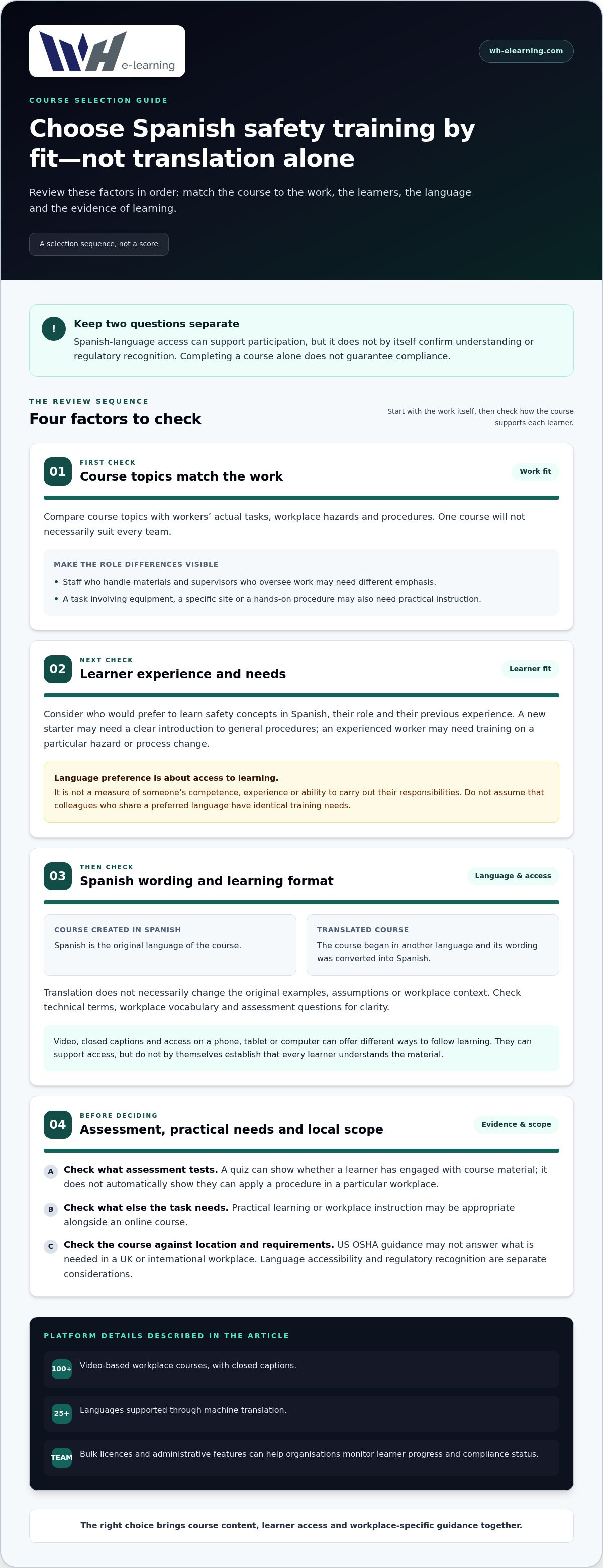
A course is useful only if its subject, language and format fit the people who need to learn. Before selecting online health and safety training in Spanish, compare the work learners do with the course topics. Then consider their previous experience, how Spanish is presented and how learning is assessed. A course for a new starter may not cover the needs of an experienced worker taking on different responsibilities.
Assessment matters, too. A quiz can show whether a learner has engaged with course material, but it won’t automatically demonstrate that they can apply a procedure in a particular workplace. Consider what the course checks and whether practical learning or workplace instruction is also needed.
Does translated training differ from a course created in Spanish?
Yes. A course created in Spanish uses Spanish as its original language. A translated course starts in another language, and its wording is converted into Spanish. Translation changes the language, but it doesn’t necessarily change the original examples, assumptions or workplace context. A translated example may explain a general safety concept without reflecting the equipment or procedures learners use on site.
Pay attention to clarity, especially for technical safety terms and vocabulary used in your workplace. Consider whether learners can follow the material and understand the assessment questions. WH eLearning provides machine translation into more than 25 languages. This can help reduce language barriers, while employers should still consider how course topics relate to their work.
How do captions and video support online learning?
Captions provide a text aid alongside spoken material, which can help learners follow explanations or revisit key terms. Video presents information in a structured, visual format, giving learners another way to engage with a topic. These features support access, but don’t by themselves establish that every learner understands the material.
WH eLearning’s workplace courses are video-based and include closed captions. Courses are accessible on any device, so learners can use a phone, tablet or computer. Consider where employees will take the course and whether the format suits their access to devices and the time available for learning.
Use this checklist to compare options:
- Topic: Does the course address hazards and tasks relevant to the learners’ roles?
- Level: Does it suit learners’ existing knowledge and experience?
- Language: Is the material created in Spanish or machine-translated, and are key safety terms clear?
- Assessment: Does it check understanding of the material in a useful way?
- Format: Are video, captions and device access suitable for the people taking the course?
Matching these features to your team’s needs makes course selection more deliberate. Explore WH eLearning’s video-based workplace courses to compare course subjects and learning formats.
How to assess Spanish safety training against workplace and local requirements
Choosing a Spanish-language course involves two separate decisions: can learners access the content in Spanish, and is the course appropriate for the workplace and jurisdiction? Language availability doesn’t establish regulatory recognition. Equally, a course associated with a recognised training scheme may not cover every hazard, role or site-specific procedure your team needs.
Start with the workplace, not the course label. Map the tasks employees perform, the hazards identified in relevant risk assessments and the location where the work takes place. Then compare those needs with the course scope. This helps avoid treating a broadly relevant course as a substitute for instruction about local procedures or specific risks.
Is Spanish OSHA training suitable for every country?
No. OSHA is a United States agency, and OSHA Outreach training has a US context. Its relevance or recognition in the United States doesn’t automatically mean a course satisfies requirements in the UK or another country. Employers operating internationally should consider the rules and expectations that apply where each employee works, separately from the language used to deliver training.
Keep those questions distinct: first assess whether the material is accessible to learners, then assess whether its scope and recognition fit the relevant jurisdiction. Course completion alone doesn’t guarantee that an employer has met every legal or workplace training need.
How can employers match a course to each role?
Separate general awareness from learning tied to a particular task or hazard. A broad safety course may introduce shared principles, whilst workers using specific equipment or handling particular materials may need more focused instruction. Use actual work activities and relevant risk assessments to identify what each role needs, rather than assigning identical content to everyone by default.
Use this comparison to structure the review:
| Factor | What to consider | Practical check |
|---|---|---|
| Language | Whether Spanish is used throughout the relevant learning material. | Can learners follow key safety terms and assessment questions? |
| Course scope | Whether topics reflect the hazards and tasks in the workplace. | Does it cover general awareness, a specific risk or both? |
| Jurisdiction | Where the training will be used and what local requirements apply. | Is the course’s regulatory context relevant to that location? |
| Learner group | Roles, experience and responsibilities of the people taking it. | Will the same content suit each group, or are different courses needed? |
For example, a course that introduces general workplace hazards may be useful across a team, but it may not explain a site’s procedures for a particular task. Plan how to cover that gap through suitable workplace instruction, including practical learning where the task calls for it.
Use an occupational safety and health training course guide alongside workplace risk assessments to structure your review. Together, they can help shape a training plan that balances accessible language with relevant subject matter and local context. The aim is not simply to select online health and safety training in Spanish, but to understand what it covers, who it serves and what additional learning the workplace requires.
How to roll out online health and safety training in Spanish
A good rollout turns course selection into a clear plan: who needs training, what they need to learn, how they’ll access it and how progress will be reviewed. Individual enrolment can suit a learner completing a course for their own development. For a workforce, bulk licensing and administrative tracking can help coordinate access across teams and keep completion information in one place.
A practical training rollout for multilingual teams
Use this process to organise training around learners and workplace needs, rather than distributing the same course to everyone by default.
- Identify learner groups. Record roles, work locations, preferred learning languages and differences in experience. This helps distinguish groups that need shared introductory learning from those with more specific training needs.
- Match topics to work. Use role requirements and workplace risk assessments to select relevant course subjects. Note where online learning needs to sit alongside site-specific explanation or practical instruction.
- Choose an accessible format. Consider whether learners can use a phone, tablet or computer, and whether Spanish-language content and captions suit the way they’ll take the course.
- Set access and expectations. Communicate which course each learner should complete, how to access it and the expected completion date. Plan access around work patterns so learners know when and how to fit training in.
- Review and follow up. Check completion information, invite feedback on clarity and relevance, and address gaps with suitable follow-up learning or workplace guidance.
How can organisations track training progress?
For a single learner, individual enrolment provides a straightforward route to a course. For an organisation coordinating training across a workforce, bulk licences support wider access, whilst administrative features let administrators track learner progress and compliance status. These records help show who has completed assigned learning and where follow-up may be needed.
Use progress information as a management aid, not as proof that every workplace requirement has been met. For example, an administrator may see that a learner completed an online course, then arrange additional practical instruction where the role or hazard calls for it. Keep assignments and follow-up activities connected to the training plan, so a completion record has useful context.
A guide to customised corporate training programmes can provide a framework for thinking about workforce-wide learning needs and coordination.
WH eLearning offers individual enrolment and bulk licensing, with administrative features for monitoring progress and compliance status. Explore WH eLearning’s workplace training options to plan access for an individual or coordinate learning across your organisation.
How WH eLearning supports online health and safety training in Spanish
Putting language access into practice means finding learning that fits both the people taking it and their workplace. WH eLearning provides more than 100 video-based workplace courses across health and safety, business compliance and HR. Closed captions and machine translation into more than 25 languages offer additional ways to access course material, including for learners who prefer Spanish. Translation supports access, whilst employers remain responsible for matching course content to workplace roles and risks.
That flexibility can support different training needs. An individual may be looking for a specific course for their own learning, while an employer may need to coordinate training across teams, departments or locations. The delivery route can differ, even when the aim is shared: make relevant workplace learning easier to access and organise.
Online courses for individuals and organisations
Individuals can enrol in courses suited to their learning needs. For organisations, bulk licensing provides a way to arrange course access across a workforce. Administrative features help track learner progress and compliance status, making it easier to see where training is complete and where follow-up may be needed.
Successful course completion includes digital certification. A certificate records completion, but it doesn’t by itself establish that all workplace or legal training requirements have been met. Employers should consider it alongside role-specific instruction and any practical learning required for the work.
A flexible way to access workplace learning
Video-based courses are accessible on any device, so learners can use a phone, tablet or computer. Closed captions provide text alongside spoken course material, while machine translation can make learning available in additional languages. WH eLearning uses machine translation, so translated delivery should not be confused with every course being originally authored in Spanish. Employers can consider how the course language and terminology fit their learners and work.
These features can support a more accessible learning experience without making every course right for every role. A course about general workplace safety, for instance, may provide a useful foundation, whilst a particular task may also call for site-specific guidance or practical instruction. Pairing digital learning with relevant workplace support keeps training connected to what employees actually do.
A guide to multi-language e-learning courses can help employers frame questions about language access across a wider workforce, from learner needs to course format.
Whether you’re choosing a course for yourself or organising training across a team, explore WH eLearning’s workplace training courses to find learning options that can support your training plan.
Make your next training decision a practical one
Start with one clear question: what should each learner be better equipped to understand or do after training? That focus makes language access a useful part of your wider learning plan, rather than a separate checkbox. It also gives you a basis for reviewing whether course content remains relevant as roles, tasks or workplace risks change.
For your next step, choose a learner group and identify the training need you want to address. Then explore options that fit the topic, language and delivery approach, keeping local requirements and practical workplace instruction in view. Online health and safety training in Spanish can support a more accessible learning experience when selected with those needs in mind.
Explore online health and safety training with WH eLearning and take a considered step towards learning that works for your team. Clear planning makes progress easier to organise, and a well-chosen course can help build a stronger foundation for workplace learning.
Frequently Asked Questions
Is online health and safety training available in Spanish?
Yes. Spanish-language options are available through online safety courses and translated learning. WH eLearning provides workplace courses with machine-translated content and closed captions. Before enrolling, consider how the language is presented and whether the course covers the learner’s actual tasks. For example, a warehouse worker and an office-based employee may need different subject matter, even if both prefer to study in Spanish.
Can Spanish-language online training meet workplace requirements?
It may contribute to workplace learning, but Spanish delivery alone doesn’t establish regulatory recognition or show that every training need has been met. Requirements depend on the jurisdiction, work activities and course scope. For instance, OSHA Outreach training relates to the United States. Employers should record why a course was chosen, which roles it covers and whether additional instruction is needed for a particular task.
What is the difference between translated and Spanish-original training?
Translated training presents material originally written or delivered in another language in Spanish, whilst Spanish-original content is created in Spanish from the outset. Translation can improve access, but examples may still reflect the source course’s setting. Consider whether learners can understand the safety terms and assessment wording. A practical check is to compare course examples with the equipment, procedures and vocabulary employees encounter at work.
How can employers provide health and safety training to Spanish-speaking employees?
Begin by listing the roles and tasks that need training, then assign courses that address those needs and communicate clear access and completion instructions. For example, a supervisor can explain which course applies to each team and how to raise questions about unfamiliar terms. Review completion records and learner feedback afterwards. If a task needs demonstration or practice, arrange suitable follow-up rather than relying on an online course alone.
Does OSHA training in Spanish apply to UK workplaces?
OSHA is the United States Occupational Safety and Health Administration, so its training has a US context. A Spanish-language OSHA course doesn’t automatically show that UK workplace requirements have been met. UK employers should consider the requirements relevant to their workplace, the course subject and the tasks employees perform. Keep language access and jurisdictional relevance as separate parts of the training decision.
Can employees complete online health and safety training on a mobile phone?
Yes, WH eLearning courses can be accessed on mobile devices as well as other devices. Before assigning a course, tell employees how to access it and where to find the completion instructions. A worker using a phone during a break, for example, may benefit from captions when reviewing video material. Employers can also plan a suitable time and setting so learners can focus on the course.
How can a business track employees’ online training progress?
Organisations can use administrative features to monitor learner progress and compliance status. Assigning courses by role makes those records easier to interpret: managers can see which learning applies to each group and identify outstanding completions. Review the information regularly, then follow up with learners who need support or additional instruction. A completion record tracks course status, but it doesn’t by itself demonstrate practical competence or confirm that all local requirements are met.


