

A short survey can uncover concerns that employees may not raise in person. The Minnesota statewide safety perception survey is expected to take 5-15 minutes and contains 35 questions, according to the Minnesota Department of Administration, Risk Management Division. Well-chosen employee safety perception survey questions can cover safety culture, management commitment, anonymity, retaliation and what happens after feedback is shared.
It’s reasonable to want a survey that respects employees’ time and gives leaders useful answers. The questions matter, but so does employees’ confidence that they can respond honestly without facing repercussions. This guide offers practical questions, explains how to approach anonymity and follow-up, and shows how to turn responses into clear next steps. It also covers questions about training, reporting safety concerns and whether employees feel supported when they raise them.
Key Takeaways
- Use clear, focused questions to explore whether safety policies are reflected in everyday decisions and teamwork.
- Set expectations for anonymity and reporting so employees can respond candidly without feeling exposed.
- Ask whether staff feel trained, supported and able to raise concerns without fear of retaliation.
- Plan how leaders will share findings and act on feedback before inviting employees to take part.
2. Respondent anonymity and reporting thresholds
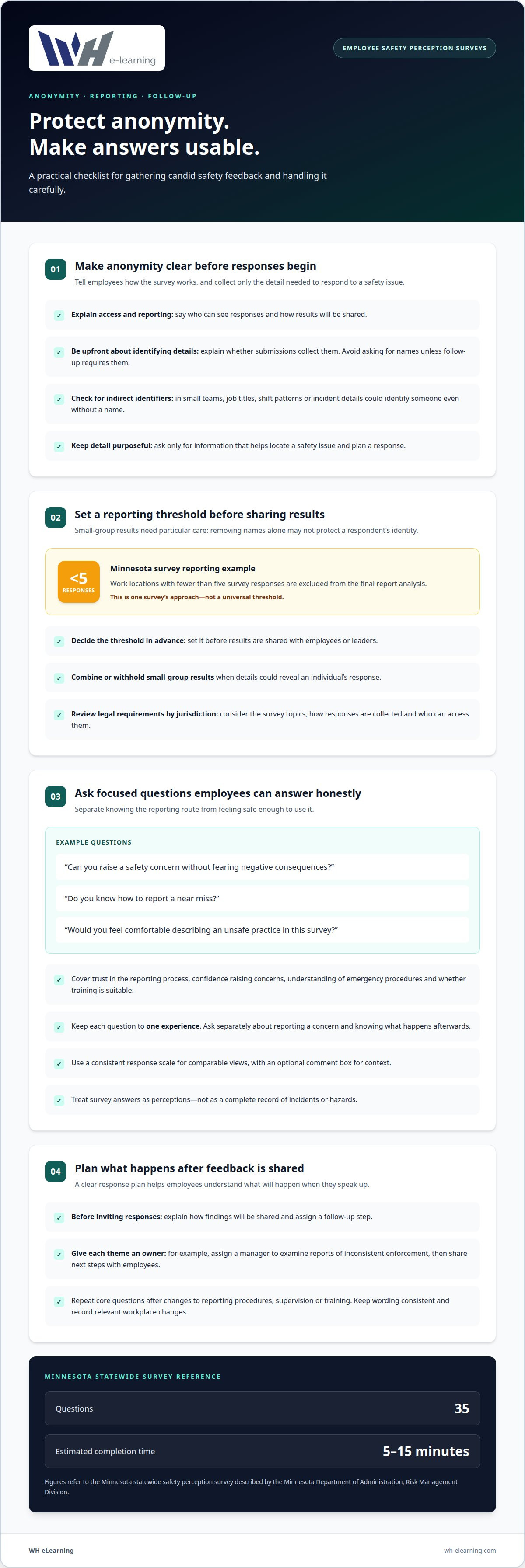
Protect candid answers by explaining who can see responses, how results will be reported and whether submissions collect identifying details. Avoid asking for names unless follow-up requires them. In small teams, job titles, shift patterns or incident details can identify someone even if their name is removed. Ask only for details that help locate a safety issue and plan a response.
For US workplaces, treat legal compliance as a jurisdiction-specific review rather than assuming one survey template will settle it. Consider the survey topics, how responses are collected and who can access them. This keeps questions focused on workplace safety while ensuring sensitive feedback is handled carefully.
Set a reporting threshold before sharing results. In Minnesota, work locations with fewer than five survey responses are excluded from the final report analysis, according to the Minnesota Department of Administration, Risk Management Division. This is one survey’s reporting approach, not a universal threshold. Combine or withhold small-group results when details could reveal an individual’s response.
Cover whether employees trust the reporting process, feel safe raising concerns, understand emergency procedures and receive suitable training. Keep each question focused on one experience. For example, ask whether employees can report a near miss without fear of retaliation, rather than combining reporting, management response and discipline in one question.
- “Can you raise a safety concern without fearing negative consequences?”
- “Do you know how to report a near miss?”
- “Would you feel comfortable describing an unsafe practice in this survey?”
A Minnesota statewide survey contains 35 questions, according to the Minnesota Department of Administration, Risk Management Division; it takes 5-15 minutes to complete. Short, clear questions help respondents finish thoughtfully. Use a consistent response scale for comparable views, plus an optional comment box for context.
Surveys capture perceptions, not a complete record of incidents or hazards. Fear of being identified can suppress honest answers, while unclear wording can produce misleading ones. Explain how findings will be shared and assign a follow-up step before inviting responses, so employees know what happens after they speak up.
Safety culture and management commitment
Measure safety culture through decisions employees see, not policy statements alone. Ask whether management treats employee and fleet safety as a priority business goal. Then test whether the written policy reaches staff and shapes daily work. A positive response about policy awareness means little if employees describe inconsistent practice.
Use focused questions to assess leadership, communication and shared responsibility. Ask whether employees are invited to help resolve safety concerns and whether supervisors and staff work together to improve the programme. Separately, ask whether management has communicated the safety policy to all employees. These distinctions help pinpoint where communication or participation breaks down.
- “Does management treat safety as a priority business goal?”
- “Can employees contribute to resolving safety concerns?”
- “Are safety rules enforced consistently across teams?”
- “Are accidents and near misses investigated, with corrective action afterwards?”
Look for differences between stated expectations and reported experience. If employees know the policy but doubt that rules are enforced consistently, examine how supervisors apply it. If staff don’t feel involved, invite them to describe one change that would help resolve a current concern. Open-text answers can reveal barriers that a rating alone won’t explain.
Before launching the survey, agree who will review each theme and what action will follow. For example, assign a manager to examine reports of inconsistent enforcement, then share next steps with employees. Don’t collect feedback without being ready to respond: unanswered concerns can weaken trust in the process.
Use the findings to strengthen practical knowledge as well as management communication. If responses point to gaps in employees’ understanding of workplace hazards, health and safety training courses can support a focused learning response. Compare later feedback against the same questions to see whether employees notice changes in policy communication, teamwork and follow-up.
Employee perceptions of safety and retaliation
Employees may notice a hazard but stay silent if speaking up feels risky. Ask about concrete workplace situations, such as reporting a damaged tool or questioning an unsafe instruction. Distinguish between knowing the reporting route and feeling able to use it without negative consequences. This can reveal whether employees face a process barrier, fear of retaliation or both.
Conduct surveys regularly to track changes over time. Repeat core employee safety perception survey questions after changes to reporting procedures, supervision or training. This lets you compare employees’ accounts of their experience rather than relying on impressions alone. Keep the wording consistent and record relevant workplace changes that may shape responses.
- “Can you report an unsafe condition without fearing negative consequences?”
- “Would you feel comfortable challenging an unsafe instruction?”
- “Do you know what happens after you raise a safety concern?”
- “Would you report a near miss involving a colleague?”
Use employee safety perception survey questions that focus on one issue at a time. Avoid wording that implies a preferred answer or asks employees to assess several experiences together. For instance, ask whether staff feel comfortable reporting a concern, then ask separately whether they know what happens next. An optional comment field can provide context without requesting names or identifying details.
Interpret ratings alongside comments and reported experiences. Low confidence in speaking up may reflect fear of blame, uncertainty about the reporting route or a previous concern that received no visible response. Treat these as different issues. Assign a manager to review recurring themes, communicate actions and explain how staff can raise urgent hazards outside the survey.
Before inviting responses, explain how feedback will be handled and who can access it. If employees think critical comments could be traced to them, they may hold back. Keep reporting channels clear, respond consistently and revisit the same core questions after follow-up. Comparing results can show whether employees perceive progress and where further action is needed.
4. What is an employee safety perception survey?
A safety perception survey captures how employees experience everyday risks, controls and communication. It complements incident records by showing where procedures feel workable or difficult. For example, a written reporting route may exist, yet staff may find it impractical to use. The survey records that gap in employees’ own words.
Build questions around observable work experiences rather than broad judgements. Ask whether staff understand the safety procedures for their tasks, receive training before starting unfamiliar work and know how to raise a concern. Keep each topic separate. A single question about training, equipment and supervision makes answers difficult to interpret.
Use a consistent response scale for statements such as, “I can find the safety guidance I need.” A strongly disagree to strongly agree scale helps compare answers across teams. A 1-to-5 scale can also show perceived safety levels, with 1 representing none or low and 5 representing high. Keep the meaning of each endpoint clear.
- “Do you know where to find the safety procedure for your task?”
- “Have you received the safety training needed for your current work?”
- “Can you explain how to report a hazard?”
- “What change would make this task safer?”
Combine rating questions with yes-or-no items and open-text prompts. Ratings reveal patterns, while a comment about a blocked walkway or unclear instruction can suggest a specific improvement. Keep prompts simple, focused and neutral. Avoid wording that assumes a problem exists or signals which response is preferred.
Use results as one input to decisions, not as a substitute for inspecting work or reviewing incidents. Compare responses across relevant work areas while protecting privacy in small teams. Assign each recurring concern an owner and follow-up action. A later survey using the same core questions can show whether employees notice a change in communication, training or working conditions.
WH eLearning: Health and Safety Training Courses
WH eLearning offers Health and Safety Training Courses to help organisations respond when survey feedback highlights a knowledge gap. For example, comments about uncertainty around a task or safety procedure can inform a focused learning plan. Its video-based courses are accredited and accessible on any device.
Choose a learning format that suits the feedback and workforce. Online courses support individual learning, while In-House Face-to-Face Training provides a practical option for teams. Multi-language Course Translation can help make course content accessible to employees who use different languages. HR and Business Compliance Courses can also support wider workplace learning needs.
Use survey findings to identify relevant learning topics, then connect training with clear follow-up actions. Contact WH eLearning to discuss Health and Safety Training Courses for your organisation.
Turn employee feedback into a stronger safety culture
Make feedback part of how your organisation learns. Choose a priority raised by employees, assign responsibility for acting on it and communicate what changes. Then keep listening. A visible response shows that speaking up can influence decisions, not simply fill in a form.
Use employee safety perception survey questions to identify where practical learning could support safer work. WH eLearning offers comprehensive Health and Safety Training Courses and specialised online modules. These options can help address training needs identified through employee feedback.
For support with choosing a relevant training route, contact WH eLearning to discuss safety training. A thoughtful follow-up can turn employee insight into steady progress, one practical action at a time.
Frequently Asked Questions
How long is the survey?
The Minnesota statewide safety perception survey is expected to take 5-15 minutes to complete and contains 35 questions, according to the Minnesota Department of Administration, Risk Management Division. Your survey’s completion time depends on its length, question format and whether employees add written comments. Test it with a small group first, then remove repetitive questions that don’t support a clear decision.
How many questions should a safety perception survey include?
For a workplace safety pulse check, use 5 to 15 core questions. Choose items that address a defined purpose, such as understanding whether staff can access equipment instructions or know the right process for a specific task. A focused set is easier to complete and analyse. Add questions only when their answers could guide a practical decision or reveal a relevant issue.
How can employers make safety surveys anonymous and confidential?
Make the distinction clear: anonymous responses aren’t linked to a person, while confidential responses may be identifiable but access is restricted. Avoid collecting names, email addresses or unnecessary demographic details in an anonymous survey. Before sharing results, check whether comments mention a unique incident, role or shift that could identify someone. Explain who can view raw responses and how findings will be reported.
What steps should employers take after reviewing safety survey results?
Start by sorting responses into practical themes, such as equipment access, task instructions or reporting routes. Compare each concern with current procedures and workplace observations, then decide which issue needs attention first. Record the action, responsible role and how completion will be checked. Once changes are made, tell employees what was addressed and what remains under review, without exposing individual responses.


