

A corporate manslaughter conviction can bring serious penalties for an organisation, but directors and senior managers are not automatically guilty simply because they hold office. In England and Wales, the prosecution must prove that the way the organisation’s activities were managed or organised caused a death and amounted to a gross breach of a relevant duty of care. The consequences of a corporate manslaughter conviction can include a fine, a remedial order and publication of the conviction.
It is understandable to want clear answers about who can be prosecuted and what a conviction means for the organisation and those responsible for its operations. The distinction matters: the corporate offence applies to qualifying organisations, while individuals may face separate charges if their own conduct meets the requirements of another offence.
This article explains how the Corporate Manslaughter and Corporate Homicide Act 2007 applies, how sentencing guidelines shape fines, and what other orders or practical consequences may follow. It also clarifies when individual liability may arise, so you can understand the legal framework without confusing corporate responsibility with personal guilt.
Key Takeaways
- Understand why the corporate offence applies to qualifying organisations, and why seniority alone doesn’t make an individual criminally liable.
- See how organisation size, offence seriousness and financial circumstances shape sentencing, including the potential for an unlimited fine.
- Learn about other consequences a court may impose, such as remedial orders, prosecution costs and publication of the conviction.
- Find out how separate charges may apply to individuals and how a court considers compensation for victims’ families.
- Explore how safety training can support stronger workplace practices and help organisations build staff awareness.
Corporate Manslaughter and Corporate Homicide Act 2007
The Corporate Manslaughter and Corporate Homicide Act 2007 created an offence for qualifying organisations in the UK. It came into force on 6th April 2008. In England and Wales, the offence applies to organisations covered by the Act, not every group or association. The title uses “corporate homicide” in Scotland, while “corporate manslaughter” is used in England and Wales. The law focuses on how an organisation’s activities were managed or organised, rather than treating a fatal accident alone as proof of the offence.
For a prosecution in England and Wales, the organisation’s management or organisation of its activities must have caused a death and amounted to a gross breach of a relevant duty of care. Senior management’s role must be a substantial element of that gross breach. The prosecution must establish both the organisation’s duty and how its management contributed to the fatal outcome. The 2007 Act does not create new duties of care; relevant duties arise under the civil law of negligence. Section 2(5) makes whether a duty is owed a question of law for the judge.
Parliament introduced the Act after concerns about how the law dealt with fatal incidents involving organisations. Earlier corporate manslaughter law changed after a series of incidents in the 1990s. A 1996 legal commission report called for standalone laws allowing companies to face criminal offences normally reserved for individuals. A 2000 study endorsed UK reforms to increase penalties where corporate negligence or failures to meet safety and duty-of-care standards caused death. The UK government drafted a corporate manslaughter bill in 2005, before the 2007 Act became law.
The Act identifies duties arising from particular relationships and activities. Under Section 2(7), relevant duties include duties under the Occupiers’ Liability Act 1957, the Defective Premises Act 1972 and the Occupiers’ Liability Act 1984. These examples show how established legal duties can inform a corporate manslaughter case. They do not mean every breach leads to prosecution: the prosecution must still prove the required gross breach, causation and substantial senior-management contribution.
Public bodies are not universally exempt. Sections 3 to 7 provide exceptions from liability for certain actions of public bodies, while Section 11(1) and Schedule 1 allow specified government bodies to be prosecuted. The Act also treats police officers as employees of their police force for its purposes. Those provisions make the organisation’s legal status and the nature of its conduct important when assessing potential liability.
A conviction can also require corrective action. According to UK legislation.gov.uk, Section 9 of the Corporate Manslaughter and Corporate Homicide Act 2007 provides for remedial orders in corporate manslaughter cases. Such an order addresses the relevant management failure by requiring steps to remedy the breach. The Act therefore connects prosecution not only with punishment, but with action to address the conduct behind the offence.
Corporate manslaughter sentencing guideline applicability
Sentencing guidelines give courts a structured framework for setting penalties after a corporate manslaughter conviction. Their application depends on the sentencing date, the organisation’s turnover and the seriousness of the offence.
Applying the sentencing guidelines
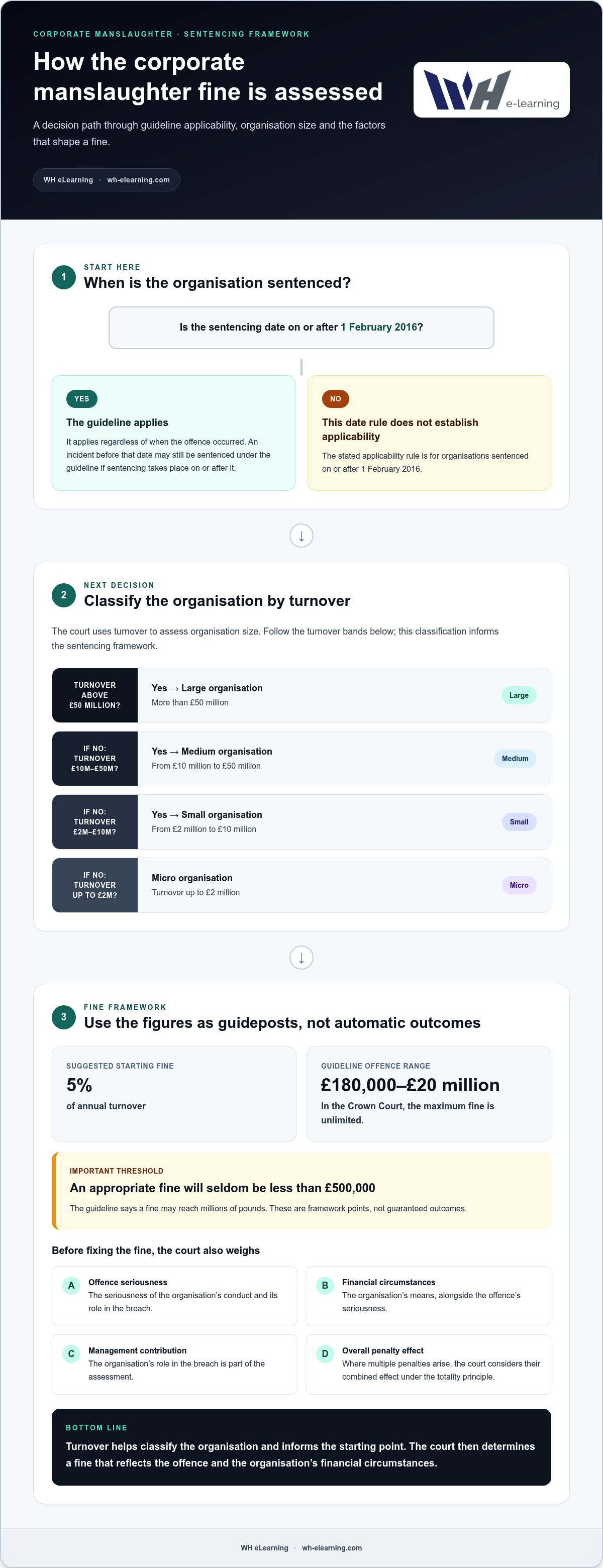
The corporate manslaughter guideline applies to organisations sentenced on or after 1 February 2016, regardless of when the offence occurred. This matters because a fatal incident before that date can still be sentenced under the guideline if sentencing takes place later. In the Crown Court, the maximum fine is unlimited, and the offence range runs from £180,000 to £20 million.
The court assesses the organisation’s size using turnover. A micro organisation has turnover up to £2 million; a small organisation has turnover from £2 million to £10 million; a medium organisation has turnover from £10 million to £50 million. A large organisation has turnover more than £50 million. The suggested starting fine is 5% of an organisation’s annual turnover, but the court also weighs the offence’s seriousness and the organisation’s financial circumstances. The guideline says an appropriate fine will seldom be less than £500,000 and may reach millions of pounds.
Those figures are framework points, not automatic outcomes. The court considers the organisation’s role in the breach and the seriousness of its conduct. It then determines a fine that reflects the offence and the organisation’s means, rather than applying a turnover percentage without further assessment.
Sentencing reasons and totality
The totality principle means a court considers the overall effect of multiple penalties together, rather than viewing each sentence in isolation. This matters if corporate manslaughter is accompanied by health-and-safety charges arising from the same incident. Section 19 of the Corporate Manslaughter and Corporate Homicide Act 2007 allows a jury to return verdicts on both corporate manslaughter and Health and Safety at Work Act offences when an organisation faces both charges.
Sentencing reasons explain how the court reached its result. Under section 125 of the Sentencing Code, a corporate manslaughter fine must reflect the offence’s seriousness and take the offender’s financial circumstances into account. A court therefore considers the breach and the organisation’s ability to pay when setting the penalty. It must also consider reductions for a guilty plea under section 73 and assistance to the prosecution under section 74.
Custodial sentences for individuals
A custodial sentence is imprisonment imposed on an individual, not a penalty available against an organisation under the corporate manslaughter Act. An organisation cannot be imprisoned for this offence. This distinction matters for directors and senior managers: holding office alone does not make someone personally guilty of corporate manslaughter.
Individuals may face separate charges where their own conduct meets the requirements of another offence. For example, the Health and Safety at Work etc Act 1974 provides for duties of employees under section 7, and section 37 can apply to an officer where a corporate offence involved that officer’s consent or connivance, or was attributable to their neglect. A separate investigation must establish the individual’s conduct and liability; the organisation’s conviction does not, by itself, prove personal guilt.
A guilty plea can affect the sentence imposed on the organisation. In England and Wales, courts must consider a reduction under section 73 of the Sentencing Code. They must also consider a reduction for assistance to the prosecution under section 74. These are separate considerations, so the court examines the plea and any assistance when determining the final penalty. Together with the guideline’s turnover categories, seriousness assessment and totality principle, they help explain why two organisations convicted of the same offence may receive different fines.
Corporate manslaughter conviction penalties
Penalties depend on whether the defendant is an organisation or an individual, and on the jurisdiction. The UK corporate offence chiefly brings fines and court orders, while the US state examples below concern individual involuntary manslaughter sentences.
Maximum penalties and offence ranges
The offence range describes the guideline’s fine range, while the maximum is the highest penalty the court may impose. For corporate manslaughter in the Crown Court, the guideline sets an unlimited maximum fine and an offence range from £180,000 to £20 million. The court assesses the seriousness of the offence and the organisation’s financial circumstances. This distinction matters because the range guides sentencing, but does not cap the fine.
The guideline’s starting points also vary by organisation size and offence category. For a large organisation with turnover more than £50 million, a category A starting point is £7,500,000, with a range of £4,800,000 to £20,000,000. For a micro organisation with turnover up to £2 million, a category A starting point is £450,000, with a range of £270,000 to £800,000. These examples show why turnover and the seriousness of the breach matter.
In the United States, the state figures are individual involuntary manslaughter sentences, not a single corporate fine scale. California law provides a sentence of 2, 3, or 4 years for involuntary manslaughter, according to California Legislature. Florida provides a maximum of 15 years, whilst Illinois provides 2 to 5 years. Pennsylvania generally provides a maximum of 5 years. Texas provides 2 to 20 years for manslaughter involving recklessness.
Washington allows up to life imprisonment for involuntary manslaughter when the offence is reckless, and up to 10 years when it is criminally negligent. These are state-level examples; federal and state penalties are distinct, and the figures above should not be treated as one federal tariff. The defendant’s status and the jurisdiction determine which legal framework applies.
Effects on licences, permits and contracts
Losing a licence, permit or government contract is a possible business concern, but it is distinct from the corporate manslaughter fine. A conviction can affect an organisation’s relationships with regulators, public confidence and future fundraising. These consequences of a corporate manslaughter conviction can disrupt operations even where no separate court order removes an authorisation.
A conviction does not, by itself, mean that every licence, permit or government contract is automatically lost. The rules for the relevant authorisation and the terms of a particular contract determine whether further consequences follow. Assessing the consequences of a corporate manslaughter conviction therefore means distinguishing the court’s sentence from any separate regulatory or contractual decision.
Corporate manslaughter convictions
A fatal workplace incident does not, by itself, establish corporate manslaughter. In England and Wales, the prosecution must prove that the organisation’s activities caused a death and involved a gross breach of a relevant duty of care. Senior management’s management or organisation of those activities must be a substantial element of that breach. The investigation therefore focuses on decisions, systems and conduct, not the fatal outcome alone.
Corporate manslaughter is tried only on indictment in England and Wales, and proceedings require the Director of Public Prosecutions’ consent. The prosecution must establish the relevant duty, the gross breach and the connection between the organisation’s management and the death. “Gross negligence” is sometimes used informally to describe grave failings, but the statutory test is a gross breach of a duty of care. An organisation’s conviction does not automatically establish an individual’s guilt.
Conviction examples show how different failures can lead to charges under the 2007 Act. Cotswold Geotechnical Holdings became the first company convicted under the law, in February 2010, after a geologic trench collapse; it was fined £385,000 on 15 February 2011. Sterecycle (Rotherham) was fined £500,000 on 7 November 2014 after a worker was struck by debris from an autoclave explosion. CAV Aerospace received a £600,000 fine on 31 July 2015 after overstocked metal sheets collapsed.
Other cases illustrate the range of workplace circumstances examined. Baldwins Crane Hire was fined £700,000 on 22 December 2015 after a crash involving a crane with faulty brakes. These outcomes reflect the court’s sentencing assessment; a case’s fine should not be treated as a fixed tariff for similar incidents.
By the end of 2017, the article’s reported record included 25 successful corporate manslaughter convictions, four of them in 2017. A Leicestershire food waste recycling company was fined £2 million after a conviction involving two staff deaths. Deco-Pak was convicted in 2022 in connection with an employee’s death in a 2017 workplace incident. These examples show that prosecution can follow very different fatal events, with the organisation’s management failures assessed in each case.
A conviction may also carry consequences beyond the fine. The court can order publication of the conviction, and Section 9 provides for remedial orders addressing relevant failings. Health and safety offences may also be considered alongside corporate manslaughter, depending on the charges involved. Section 18 also means an individual cannot be guilty of aiding, abetting, counselling or procuring corporate manslaughter. Separate offences may still apply to individual conduct.
Can corporate manslaughter convictions lead to restitution or compensation for victims' families?
Yes. In England and Wales, after an organisation is convicted of corporate manslaughter, the court must consider whether to make a compensation order. Compensation is not automatic. Following a death, compensation is often left to the civil courts, so the criminal conviction and a family’s financial remedy are related but distinct issues.
A corporate fine punishes the organisation for the offence; compensation addresses losses suffered by those affected. The distinction matters because a fine does not, by itself, establish that a family has received compensation. The sentencing court considers whether an order is appropriate, while a separate civil claim may be used to pursue compensation after a death.
For families, the practical question is which losses need to be recognised and how they relate to the death. Keeping a clear record of relevant financial effects can help explain the impact, such as costs incurred by the family or income lost after a worker’s death. These examples indicate what information may matter; they do not determine whether a court will make an order or what the civil outcome will be.
The corporate manslaughter case focuses on the organisation’s management of its activities, the duty of care and the gross breach that caused the death. A compensation assessment has a different focus: the family’s loss and whether an order should address it. Separating those questions can help families understand why a conviction may be secured without compensation being resolved in the same proceedings.
The court’s decision to consider an order is an important step, not a promise of payment. Families should distinguish three matters in the outcome: the organisation’s conviction, the penalty for the offence and any compensation decision. If the sentencing court leaves compensation to the civil courts, the conviction does not become a compensation award.
For organisations, the potential compensation question is another reason to take a fatal incident seriously, alongside prosecution, fines and remedial requirements. For families, a conviction can establish the organisation’s criminal responsibility, but compensation remains a separate matter. Keeping records, identifying losses connected with the death and understanding whether the criminal court made an order can clarify what has been decided and what remains unresolved.
WH eLearning: Health and Safety Training Courses
WH eLearning offers Health and Safety Training Courses to help organisations build staff understanding of workplace safety responsibilities. This training can be a practical next step when reviewing learning needs after an incident or identifying ways to strengthen everyday safety knowledge. HR and Business Compliance Courses can support broader workplace learning, while In-House Face-to-Face Training provides an in-person format for staff development.
Courses are video-based and accredited, with closed captions and machine translation into more than 25 languages. These features can make learning more accessible across different teams. Training supports awareness and learning; it does not replace an organisation’s legal responsibilities or advice on a specific prosecution.
To explore training options for your organisation, visit WH eLearning.
Build safer practice into the next steps
Understanding the consequences of a corporate manslaughter conviction can prompt organisations to look beyond legal outcomes and strengthen everyday safety awareness. Training is one practical way to help managers and employees recognise their responsibilities, discuss risks and support safer workplace routines. It cannot replace sound systems or careful management, but it can contribute to informed, consistent practice.
WH eLearning offers comprehensive online health and safety training courses tailored to different organisational needs. Choose learning that reflects your team’s roles and current development priorities, then give staff opportunities to apply that knowledge at work.
If you’re ready to explore training for your organisation, contact WH eLearning. A considered next step can help build stronger safety awareness across your team.
Frequently Asked Questions
What needs to be proved to secure a conviction?
In England and Wales, the prosecution must prove that the way a qualifying organisation’s activities were managed or organised caused a person’s death and amounted to a gross breach of a relevant duty of care. Senior management’s conduct must form a substantial element of that breach. The case also requires proof of the organisation’s duty and the causal link to the death. Proceedings require the Director of Public Prosecutions’ consent.
What punishment options does the judge have under the Act?
The court can fine the organisation and make orders addressing the consequences of its conduct. Section 9 provides for a remedial order, which requires action to remedy the breach. A court may also order publication of the conviction and require payment of prosecution costs. The organisation cannot be imprisoned under the Act. The judge assesses the seriousness of the offence and the organisation’s financial circumstances when determining the fine.
Can trustees or directors go to prison?
Not for the corporate manslaughter offence simply because they are trustees or directors. The Act prosecutes the organisation, and holding office does not automatically establish personal criminal liability. However, an officer may face a separate charge under section 37 of the Health and Safety at Work etc Act 1974 if a corporate offence involved their consent or connivance, or resulted from their neglect. Personal liability depends on evidence of their own conduct.
Can a corporation be placed on probation after a manslaughter conviction?
The corporate manslaughter penalties under the UK Act focus on fines and court orders, rather than placing an organisation on probation. A remedial order under Section 9 can require the organisation to address the breach that contributed to the offence. For example, an organisation may need to remedy a failing in how its activities were managed. This is a court-imposed corrective measure, not probation or supervision of the organisation.
What consequences can directors, officers, or employees face alongside a corporate manslaughter conviction?
Individuals may face separate health and safety charges if evidence supports an offence based on their own actions or omissions. For example, section 37 of the Health and Safety at Work etc Act 1974 can apply to an officer where the corporate offence involved consent or connivance, or was attributable to neglect. Employees also have duties under section 7. The organisation’s conviction alone does not establish an individual’s guilt.


