

UK health and safety fines have no upper limit for breaches of duty. Since laws changed in 2016, courts can impose unlimited fines for health and safety offences, so understanding how to avoid HSE fines for safety breaches starts with meeting your legal duties in practice. That means assessing workplace risks, training staff and acting promptly when hazards or compliance gaps emerge.
It’s understandable to want a clear picture of the rules and the consequences before deciding what to improve. A consistent approach to safety can help you protect people and reduce the risk of preventable breaches.
This guide explains how UK health and safety regulation works, sets out practical ways to strengthen compliance and describes the consequences that may apply. It also shows how relevant staff training and clear records can support safer, better-organised work.
Key Takeaways
- Review risk assessments when work or workplace conditions change, and record how identified hazards are addressed.
- Keep staff training relevant to their roles and maintain clear records of instruction, incidents and corrective actions.
- Build routine checks into your compliance programme so that hazards and gaps are spotted and dealt with promptly.
- UK health and safety fines can be unlimited for breaches of duty, making prevention and timely corrective action essential.
- For US context, the Occupational Safety and Health Administration sets a maximum of $16,550 per violation for serious, other-than-serious or posting violations after Jan. 15, 2026.
1. Workplace risk assessments
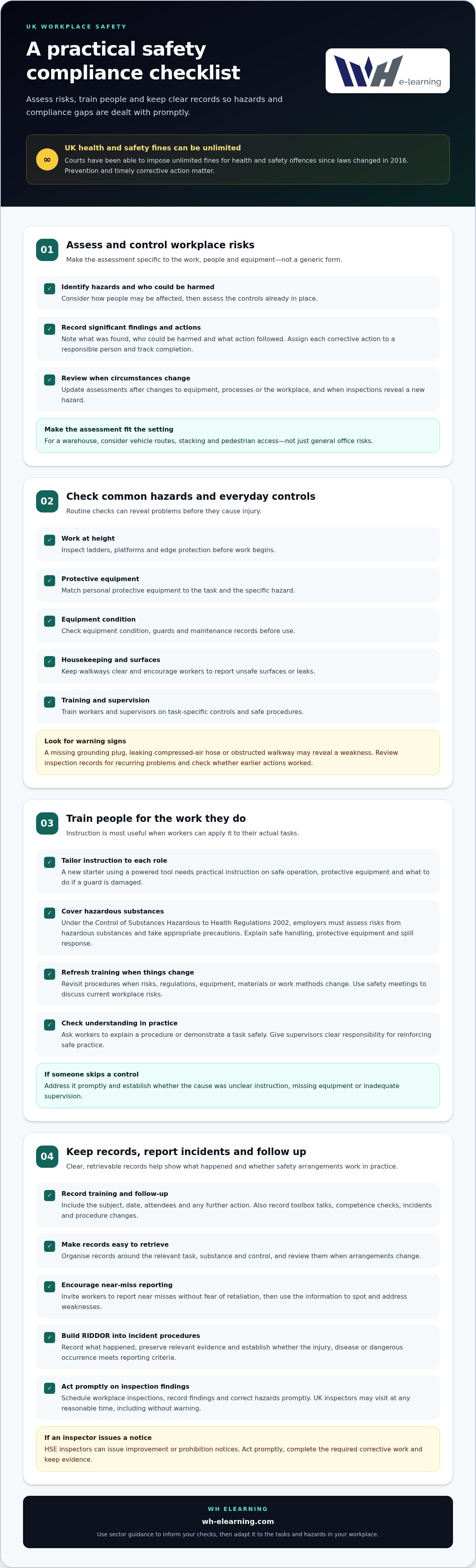
In the UK, a workplace risk assessment helps identify hazards and decide how to control them. Make it specific to the work, people and equipment, then review it when conditions change. A warehouse assessment, for example, should consider vehicle routes, stacking and pedestrian access, not just general office risks. Record what you found, who could be harmed and what action followed.
To follow HSE guidance, identify hazards, consider who could be harmed and how, assess existing controls, record significant findings and review the assessment. Assign each corrective action to a responsible person and track its completion. Update the assessment after changes to equipment, processes or the workplace, and when inspections reveal a new hazard.
Common safety failures include inadequate fall protection, missing personal protective equipment, poorly maintained equipment, poor housekeeping, and insufficient training or supervision. Falls are a leading cause of workplace injuries. In the United States, fall protection has been OSHA’s most frequently cited violation for over a decade, especially in construction. These examples relate to OSHA enforcement, not UK HSE rules.
- Inspect ladders, platforms and edge protection before work at height.
- Match personal protective equipment to the task and the specific hazard.
- Check equipment condition, guards and maintenance records before use.
- Keep walkways clear and ask workers to report unsafe surfaces or leaks.
- Train workers and supervisors on task-specific controls and safe procedures.
Schedule workplace inspections, record findings and correct hazards promptly. Encourage employees to report near misses without fear of retaliation. A missing grounding plug, leaking compressed-air hose or obstructed walkway can reveal a weakness before it causes an injury. Use inspection records to spot recurring problems and check whether earlier corrective actions worked.
UK inspectors may visit a workplace at any reasonable time, including without warning. They can issue improvement or prohibition notices; act promptly on the notice, complete the required corrective work and keep evidence. In the United States, OSHA Standard 1903.15 covers inspections, citations and proposed penalties, so distinguish its processes from HSE enforcement.
RIDDOR requires certain work-related injuries, diseases and dangerous occurrences to be reported. Failing to report a reportable incident can leave an incomplete record and draw an inspector’s attention to the omission. Build reporting into incident procedures: record what happened, preserve relevant evidence and establish whether the event meets reporting criteria. This supports follow-up action and a reliable account of workplace safety.
2. Employee safety training and documentation
Training is most useful when workers can apply it to their actual tasks. Employers should train staff, refresh instruction when risks or regulations change, and prepare supervisors to reinforce safe procedures. A new starter using a powered tool, for example, needs practical instruction on safe operation, protective equipment and what to do if a guard is damaged. Tailor training to each role rather than relying on a general induction alone.
Hazard communication matters wherever workers handle chemicals or other hazardous substances. Under the Control of Substances Hazardous to Health Regulations 2002, employers must assess risks from hazardous substances and take appropriate precautions. Explain how staff can identify substances, follow safe handling instructions, use required protective equipment and respond to spills. Include a way to raise concerns, such as unclear labels or a damaged container.
Treat training as ongoing, not a one-off event. Revisit procedures when equipment, materials or work methods change, and use safety meetings to discuss current workplace risks. Supervisors can check understanding by asking workers to explain a procedure or demonstrate a task safely. If someone skips a control, address it promptly and establish whether the cause was unclear instruction, missing equipment or inadequate supervision.
Documentation helps employers judge whether their safety programme works in practice. Keep training records that identify the subject, date, attendees and any follow-up action. Record toolbox talks, competence checks, incidents and procedure changes. If a worker reports confusion about a chemical label, for instance, document the issue, clarify instructions and brief other relevant workers. Clear records make gaps easier to find and fix.
- Match instruction to the worker’s role, tasks and exposure to hazards.
- Record who received training, what it covered and any further action.
- Ask workers to demonstrate safe steps, such as fitting protective equipment.
- Refresh training after changes to risks, materials or work procedures.
- Give supervisors clear responsibilities for checking and reinforcing safe practice.
For industry-specific guidance and free checklist material, start with the Health and Safety Executive’s official guidance for your sector. Adapt any checklist to your workplace, then use it to prompt questions during training and supervision. A template cannot replace task-specific instruction: a worker handling cleaning products needs different guidance from someone maintaining machinery.
Keep records in a way that makes them easy to retrieve after an incident or inspection. In the United States, employers must retain employee exposure and medical records for 30 years for many substances. That is a US requirement, not a general UK retention period. For UK workplaces, organise records around the relevant task, substance and control, and review them when arrangements change.
3. Maximum penalties for serious, other-than-serious, and posting violations
OSHA penalties apply in the United States, not under UK HSE enforcement. After Jan. 15, 2026, the maximum OSHA penalty in the United States for a serious, other-than-serious, or posting violation is $16,550 per violation, according to the Occupational Safety and Health Administration. After Jan. 15, 2026, the maximum OSHA penalty in the United States for a willful or repeated violation is $165,514 per violation, according to the Occupational Safety and Health Administration.
OSHA classifies violations as other-than-serious, serious, willful, repeat, or failure to abate. Classification and proposed penalties depend on the hazard, its potential consequences, the employer’s conduct and whether a similar violation was cited before. A posting violation concerns a required workplace notice or information that is not displayed as required. Maximum figures are ceilings, not automatic charges for every citation.
A cited employer usually has 15 working days to correct issues, contest a citation, or request an informal conference, according to the Occupational Safety and Health Administration. Read the citation promptly: it identifies the alleged violation, proposed penalty and abatement deadline. Assign someone to investigate each item, preserve relevant records and correct immediate hazards. If contesting, use the stated process and deadline rather than allowing the citation to go unanswered.
OSHA may classify a citation as repeated when it finds the same or a significantly similar danger was cited before, usually within a three-year period. A failure-to-abate penalty can also apply when an employer misses a required correction deadline. Document corrective work, including dates, responsible people and evidence that the hazard was addressed. If danger remains, prioritise control measures instead of relying on paperwork alone.
State enforcement also matters. The United States has 22 state plans covering most private and public sectors, and states operating their own Occupational Safety and Health Plans must adopt maximum penalty levels at least as effective as Federal OSHA’s. A business should identify which authority covers its workplace before interpreting a citation or penalty.
UK examples show why the two systems must not be confused. These are UK HSE cases, not OSHA penalties, and demonstrate that consequences can be severe when breaches cause serious harm.
For employers, the practical response is to understand the alleged hazard, meet the abatement deadline, retain evidence and address the underlying cause. This supports workplace safety and helps prevent repeat injuries, while keeping the US OSHA citation process distinct from UK HSE enforcement.
4. Ongoing compliance programs and mock inspections
A compliance programme turns safety responsibilities into routine actions. Assign someone to coordinate each control, set review points and track unresolved issues. For example, a warehouse can assign equipment checks to a supervisor and log repairs against each machine. Review open actions at management meetings so a missed repair does not disappear from view.
Use mock inspections to test whether written procedures match workplace practice. Walk the routes an inspector might take, observe tasks and sample records. Check whether workers can explain an emergency procedure and whether machine guards work as intended. Record each gap, its risk and who is responsible for fixing it. A mock inspection helps you prepare, but does not replace compliance.
In the United States, OSHA may respond when an inspector identifies an imminent workplace danger that could cause death or serious harm. Set a clear escalation route for immediate hazards, such as unstable materials above a work area. Stop the affected task, make the area safe and record the corrective action. Encourage workers to report hazards and near misses without retaliation.
Make inspections useful by checking physical conditions and management controls. Compare equipment maintenance records with the actual condition of tools. Review whether staff training matches current tasks and whether incident reports have led to corrective action. Repeated faults can point to a weakness in the safety programme, even when each repair seems straightforward.
- Set a schedule for internal checks and assign a named owner.
- Use a consistent checklist, then add prompts for site-specific hazards.
- Record findings, responsible people, target actions and completion evidence.
- Revisit completed fixes to confirm the control works during normal work.
For OSHA inspections, designate a contact to accompany inspectors and locate relevant records. Organise documents by topic, such as training, equipment checks and incident follow-up. Answer questions accurately, note the inspector’s observations and distinguish immediate corrective work from longer-term actions. In the UK, inspectors may arrive without warning, so keep essential records accessible during normal operations.
If OSHA issues a citation, review each alleged violation against the cited condition and supporting records. Decide whether to correct the issue, contest the citation or seek an informal conference, following the applicable process and deadline. Keep evidence of corrective actions, including repair records and revised procedures. Any contest should address the specific finding, not replace efforts to remove the hazard.
OSHA compliance assistance specialists work in most of its 85 Area Offices across the United States. Their presence is a reminder to make compliance an ongoing programme, rather than a rush after an inspection notice. Review internal findings, assign actions and confirm that each change reaches the workers affected.
5. Unlimited fines for health and safety offences
UK health and safety fines can exceed the amounts businesses may expect from a fixed penalty scale. Laws changed in 2016, removing the upper limit on fines for breaches of duty. The amount depends on factors including organisational turnover, so a smaller figure cannot be treated as a universal ceiling. The practical takeaway is to assess each breach on its facts and prevent unsafe conditions before an incident occurs.
How are HSE fines calculated, and what amounts are typical? The stated broad range for UK health and safety offences is £50 to £10 million, but it is not a maximum: fines have no upper limit for breaches of duty. Turnover is one factor used to calculate fines, and large organisations are classified as having turnover above £50 million.
Reported cases show the potential scale. These examples are not a tariff for other cases.
A fatal incident can also lead to a substantial penalty. The case underlines why employers should treat safety and health controls as operational requirements, not paperwork. A failure to maintain an effective control can leave workers exposed to serious harm.
Focus prevention on the hazards created by the work. For tasks involving fall protection, check that equipment suits the job, workers know how to use it and supervisors reinforce the required controls. Review procedures after changes to equipment or working methods. If an incident or near miss exposes a gap, identify the cause, assign corrective actions and record how the fix was completed.
A willful breach is a serious concern. The practical priority is to act on known risks rather than ignore them. Make responsibilities clear, provide role-specific instruction and address hazards promptly. Keep inspection, training and corrective-action evidence together so managers can see whether controls are effective and respond quickly to gaps.
Use Health and Safety Training Courses to support workers’ understanding of safe procedures and workplace responsibilities. Training can help reinforce the controls that reduce breach risks, alongside practical supervision and regular review.
WH eLearning: Health and Safety Training Courses
WH eLearning provides Health and Safety Training Courses to help workers build practical understanding of workplace risks and safe procedures. They can support employers who need to reinforce staff knowledge alongside suitable risk controls, supervision and clear documentation. Courses are video-based, accredited and accessible on any device, with closed captions and machine translation into more than 25 languages.
Organisations can also use In-House Face-to-Face Training where instructor-led sessions suit their team. Multi-language Course Translation can help make learning accessible to staff who use different languages. Choose training that matches employees’ roles and the hazards they encounter, then reinforce it through day-to-day supervision.
Explore WH eLearning’s training options and contact the team to discuss your workplace learning needs.
Make safety learning part of everyday work
Understanding how to avoid HSE fines for safety breaches takes ongoing attention, not a one-off task to file away. Make learning relevant to each role and give workers opportunities to apply it in their day-to-day responsibilities. A considered training plan can help turn safety expectations into consistent workplace practice.
WH eLearning offers comprehensive health and safety courses, including online management training and essential workforce safety programmes. These fully approved and certified courses let learners study in their own time and at their own pace. They can support managers developing their safety responsibilities and workers building their understanding of safe working practices. Choose learning that fits your team and complements existing procedures.
Contact WH eLearning about safety training to discuss a suitable next step for your organisation.
Steady progress starts with informed people and practical learning. Keep building that foundation across your workplace organisation.
Frequently Asked Questions
How is health and safety regulated in the UK?
UK workplace health and safety is governed by the Health and Safety at Work Act 1974 and supporting regulations. The Health and Safety Executive and local authorities enforce requirements, depending on the workplace and activity. A practical starting point for how to avoid HSE fines for safety breaches is to identify which requirements apply to your work and assign clear responsibility for meeting them. A factory and a restaurant, for example, face different risks and rules.
What Triggers an HSE Fine?
An HSE fine can follow a prosecution for breaching health and safety duties, particularly where a serious hazard or incident exposes failures in control. An inspection may reveal unsafe conditions, inadequate training or missing precautions. A notice requires changes or the stopping of specified work, but it is not itself the same as a court-imposed fine. The facts, risk of harm and organisation’s circumstances inform the consequences.
What safety laws and regulations does the HSE enforce in the UK?
Relevant UK legislation includes the Health and Safety at Work Act 1974 and regulations covering particular workplace risks. Examples include regulations addressing workplace risks, hazardous substances, work equipment and work at height. RIDDOR 1995 concerns reporting specified injuries, diseases and dangerous occurrences. Which requirements apply depends on the work, equipment, substances and hazards involved.
What are employers' legal duties under the Health and Safety at Work Act 1974?
Employers must protect employees’ health, safety and welfare at work, so far as reasonably practicable, and consider others affected by their activities. In practice, this means organising safe work, providing suitable information and instruction, and addressing foreseeable risks. A business using machinery, for example, should consider safe operation, maintenance and worker competence. Employees also have responsibilities to take reasonable care and cooperate with safety arrangements.
How should businesses document safety training, inspections, and incident reporting for HSE compliance?
For employers asking how to avoid HSE fines for safety breaches, records should show what happened, what action followed and whether it was completed. A training entry can identify the subject, worker, date and any competence check; an inspection record can note the finding, assigned action and evidence of completion. For an incident, record the circumstances, investigation and resulting changes. Store documents consistently so managers can retrieve them for reviews or enforcement visits.
What should a business do after receiving an HSE inspection notice or enforcement action?
Read the notice carefully, identify the required action and deadline, and assign a responsible person promptly. Make any necessary work safe, then record corrective steps and retain evidence, such as revised procedures or maintenance records. If disputing an HSE fine, businesses typically must appeal to the relevant court within 21 days of issue. A court may uphold, reduce or dismiss an appeal based on the evidence presented.
What are the current HSE enforcement options, including improvement notices and prohibition notices?
UK health and safety inspectors may visit at any reasonable time, including without warning, and can issue improvement or prohibition notices. Act promptly, complete the required corrective work and keep evidence.


